Mineral resources
Estonia is not rich in mineral wealth, but there are several mineral resources, which are successfully used in economic activities.
Oil shale
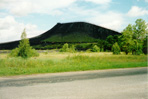
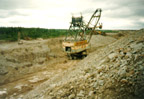
The most important mineral resource is oil shale. Oil shale originates from the algae-rich seaweed deposited in the bottom of the sea during the Ordovician period some 450 million years ago. Oil shale is found as thin intermediate layers in all Ordovician limestones. The thickest layers, which here and there are 4-5 m thick, are found in North-East Estonia, where two oil shale deposits are defined: the Estonia deposit and the Tapa deposit. Oil shale is mined both from open casts and mines.
Oil shale is used in thermal power plants mostly to produce electricity (forms 72 % of the oil shale mined) and to a lesser extent to produce heat energy (8 %). It’s also used in oil shale chemical industry to produce fuel oils, impregnation and other oils as well as various chemical products (16 %).
Limestone
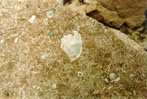
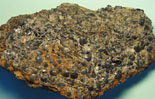
Limestone, or flagstone is widely used as a building material. It can be found in the Ordovician and Silurian outcrop areas in the Northern and Western parts of Estonia, also in Southeast Estonia. Limestone is mostly used in the production of building stones, gravel, cement, etc. In earlier times limestone as building stone was much more extensively used than nowadays.
Cley
Clay is found in many areas of Estonia, but the only clay of industrial importance is the Cambrian blue clay, with outcrops in North Estonia. The blue clay is used in the manufacture of cement, as well as bricks, drainage pipes, brick tiles and flowerpots.
| 
|
Sand and Gravel
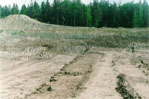
The main deposits of sand and gravel are related to the surface forms (kames, sandurs and radial moraines) shaped by the retreating continental ice sheet. Although the general resources of sand and gravel are huge, the stocks are located unevenly and in many areas the resources are already about to be exhausted. The thin-granular white glass-sand is derived form the Devon sandstones of the Piusa deposit. The glass-sand of Piusa is suitable only for the production of bottles, which are manufactured in the Järvakandi glass-works.
Peat
Peat is one of the more prevalent quaternary deposits. There is about 2.4 billion of peat in Estonia, half of which is fit for heating. The rest can be used as fertilizers, litter etc. Taken the current trend of consumption, the peat reserves will last for at least another 500 years. In fact, it will last even longer, since peat is constantly being reproduced. Peat is found everywhere in Estonia; the biggest fens and bogs are situated in the counties of East-Viru, Pärnu and Tartu. The peat briquettes are produced in Tootsi and Sangla. The Lavasaare mire system is the most important place for the mining of peat.
Phosphorite
An important mineral resource to be mentioned is phosphorite, which currently is not being mined in Estonia. Phosphorite is used to produce agricultural fertilizers.
Mineral Water
In several areas the curative mineral water can be found in deep layers of the Earth. The most popular is the mineral water of the Värska deposit, which is pumped up from the depth of 450 meters.
Links:
Mineral resources