|
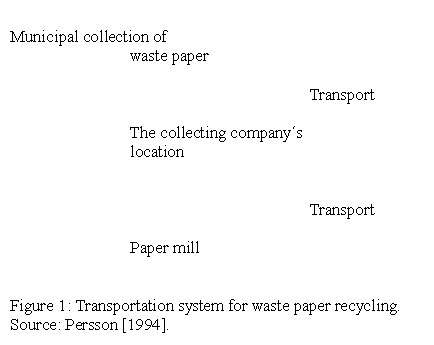
RECYCLING OF PAPER IN ESTONIA AND SWEDEN Mats Nilsson , Olof Stjernström Abstract Several investigations into the functioning of the recycled paper market in mature market economies have been made. But in the case of the transition economies in Eastern Europe there exists a lacuna in this area. Our aim is to study such a market in transition, the Estonian waste-paper situation. The entire institutional set-up from consumer to producer, needs to be investigated and clarified. Essential questions have to be answered, e.g.: Which are the nodes and what are the flows of waste paper? What is the national and regional benefit of paper recycling? Is there a geographic break-even point where further transportation of waste paper involves a loss to society? Is there a "Baltic" market for different kinds of waste-paper fractions? Today, in an age of increased environmental awareness, there is interest in recycled products for every sector of society. Waste paper being no exception. During the past fifty years, recycled fibre paper stock has been of interest to the paper-industry. The primary interest in recycled fibre stock paper has been for economic reasons. Using recycled paper has been (and still is) economically profitable. Paper differs from other materials in the waste stream. Paper has, for example a high-energy value. Secondly, most common paper-products are not fabricated from composite materials, just organic wood fibre paper. Thirdly, paper comes from renewable resources that are amenable with sustainability. A major issue with paper-recycling schemes, centres around justification(s). Is it justified through environmental concern? or by economic benefit(s)? Or…both? Is environmental concern used as a motive for a higher percentage of recycled fibre paper? Despite its seemingly innocuous rational, paper recycling creates extra-transports which often negate the environmental advantage of recycled fibre paper stock. This transportation dilemma then becomes an environmental liability. Key factors are in favour of recycled fibre paper are supply-and demand of waste paper, transportation costs and logistics, population density, industrial infrastructure and prevailing public policies. The purpose of this paper is to discuss if recycling and re-use of waste paper within a nations’ spatial boundaries is defensible based on environmental and economic parameters. In most developed countries governments often enact legislation aimed at reducing consumption of energy and resources. There is a growing interest for recycled materials to minimise pressure on our planet’s natural resource base. We often concentrate on material re-use, meaning that old paper should become feedstock for new paper. Alternatively, waste paper could be used as a fuel for waste-to-energy recovery, like in Sweden’s municipal district heating infrastructure, or as a component for the production of bio-gas. In Sweden, however, policy prohibits waste-to-energy recovery from collected and sorted paper. In Europe, it can be noted, that waste-to-energy recovery is not compatible with environmental regulations within the European Union (EU-commision 1998). Normally, recyclate stock materials are associated with resource-efficiency. Hence, demand for energy is reduced when producing products from recycled industrial feedstock, when compared to the use of virgin natural materials. This scenario does NOT apply to recycled fibre paper. In the transition phase from a central-planned Soviet-economy, to a westernised market economy, Estonia’s national economic planning is of interest to scholars. Economic change in Estonia has been remarkably rapid, promoting the creation of new institutions and regulatory settings. For Estonia to remain at the forefront during this economic transition, the government must abolish the former Soviet Union’s way of handling resources and adopt a long run sustainable resource use policy. To address these resource allocation issues, we should investigate the present "paper-industry system," starting with resource extraction, and ending with value-added product. We will use the Ostrom’s model framework to investigate what effect institutional setting has on the recycling of paper in Estonia. Aiming to identify the social benefits and costs of paper recycling in Estonia using micro-economic cost-benefit analysis. Transition economies are now facing profound changes in policy and institutional settings. However, even with policies and incentives that promote recycling program participation. Estonian’s learned behavior may be difficult to change. While under rule of the former Soviet Union, Estonians were taught "throw it and forget it," this practice is not compatible with recycling of materials. Every sovereign government has its own legal, economic, and social systems, etc. They may, be developed without any consideration for each other. Often systems overlap in some cases and leave a corresponding gap in others. This implies that the system designed for recycling of waste paper may not be compatible with the economic system or social norms of society. Institutions are the framework, where human interaction takes place. Ostrom [1992], defines an institution as a system of accepted social norms and rules which people use to organise activities that persist over time. The participants in this system establish institutional arrangements to lower the transaction costs by co-ordinating operations in one system. The relationship between the institutions and transaction costs are often nebulous. For example, policies that limit waste management operational strategies often increase transaction costs through increased regulatory compliance monitoring. Restrictions can be divided into two spheres, formal and informal. Formal restrictions include political and economic regulations and agreements, like laws interpreted and enforced by political action. Informal restrictions, often only implicit, influence all decisions made by humans. In daily life, for example, they influence our social behaviour. Ostrom defines eight design principles concerning community-oriented irrigation networks. These eight principles are tools that can be used in evaluating "a commons" resource, in particular water. Clearly, analysis of an institutional setting in a transition economy is of great complexity. One has to consider the historical facts as well as current structure(s). The first of the seven design principles considered in this paper concerns the boundaries of the resource. When organising collective action for resource management, the defining of boundaries is a key factor. Without clearly defined boundaries it is often difficult, to discern what is managed and by whom. The second condition is related to distribution between an individual’s contribution to the resource allocation and subsequent benefits received. If participants design their own institutions, they are motivated to insure that each contribution provides maximum benefits. Third, it is important that consumers and producers feel they are an integral part toward management of the resource. Both groups have to feel that the can influence policies that are implemented. If this condition is properly fulfilled it is easier to make the institution fit the local conditions. Collective choice agreements structure processes by which disagreements between participants can be resolved. The fourth design principle deals with the protection of the resource against non-permitted use. Here is the question of encouraging consumer participation. Consumers will resist in supplying waste paper if its use is contrary to what they feel is morally proper. The fifth design principle deals with sanctions designed to prevent exploitation of the resource. To avoid this, implementation of a system with incremental enforcement is suggested. Such a system with gradual sanctions then acts to inform the participants about what is allowed and what is prohibited. The sixth design principle is a matter of organising a forum to resolve resource use conflicts. If participants are going to honour regulation during the long term, there must be a mechanism for dispute resolution. Institutional arrangements that can resolve potential conflicts and ensure more equitable sharing of benefits and burdens among the actors will support co-operative effort. Finally, users will feel little responsibility toward conserving a resource which they have little or no influence in its use; the greater their ‘ownership’ of the resource, the greater their commitment to its survival. Unless the participants have the influence and ability to make their own policies with regard to using the resource, they may contribute to the destruction of the resource simply through lack of commitment. From an environmental point of view, the impact of recycling on greenhouse gas emissions is an important issue to be considered. Scientists have determined that carbon dioxide (CO2) and nitrogen dioxide (NO2) contribute to the greenhouse effect. As mentioned earlier, waste paper’s use as a production feedstock for bio-gas production and municipal district heating is often left out of the political planning process even though waste paper might be an essential future strategic resource alternative. Using waste paper in the heating process would both save non-renewable resources and minimise solid waste needing to be land filled. Virtanen and Nilsson [1992] claim that the energy content of waste paper is 14-17 MJ/kg, which makes 1 ton of waste paper equal to about 0.4 tons of crude oil. If some of the additive material in paper products were replaced with other chemicals, emissions from waste paper combustion would be very clean. In Sweden, as mentioned in this paper’s introduction, environmental regulations prohibit using sorted and recycled fibre for waste-to-energy combustion. Thus, as long as household and/or commercial waste-producers choose not to sort their waste, it can be combusted economically. Sweden’s municipalities are forced to deal with all unsorted waste fractions, while sorted waste, like paper is owned by the "material-company". In some Swedish municipalities this leads to absurd situations. In Kiruna, a town of 21, 000 inhabitants located in northern Sweden, recycled paper is transported by truck to southern Sweden and the industry there. While at the same time, paper is imported from Norway for combustion in Kiruna’s district heating plant. Kiruna’s waste-to-energy facility is prohibited from using collected and sorted paper from its own citizens. Therefore it is important to deal with the whole "paper-resource system" and take into account the geographical conditions before a recycling system is decided. In the case of Sweden, unevenly distributed population centres with extremely low population densities in some parts, combined with long transport distances, and the structure of the paper-industry are important factors. Also, the fact that the government decided that reuse and material recycling should be primary goals in Sweden’s waste policy. Waste-to-energy combustion is not seen as a preferential alternative. It could be argued that combustion of paper in some geographic areas (sparsely populated areas) is an environmentally prudent alternative, when compared to the transport impact of recycling. In the case of Estonia the conditions differ compared to Sweden. Estonia is a small country with rather short distances. The population is concentrated in the metropolitan area of Tallinn. Paper-industry structure is older and the technology transfer for recycled fibre feedstock in the paper making process is less developed than in Sweden. Consumers and producers are not often located in the same geographic area. The recycling of goods creates a need for a transportation system. It therefore becomes necessary to create collection networks between consumers and producers. In addition, greater recycling inevitably leads to increased demand for transportation. In some cases it is better, both for economical and environmental reasons, to combust the waste paper instead of using it as an input into paper production. For instance, when the collection of the waste paper occurs in sparsely and unevenly populated areas. Figure 1 illustrates this in a simplified way. In addition, to make the picture even more complicated, waste reusable fibre can be divided into several groups, usually newsprint, corrugated cardboard, and office-mix paper. The Swedish pulp and paper industries association (skogsindustrierna) has developed a taxonomy were waste-paper is divided into 39 different categories. This often means that a certain paper-mill demands a specific type of waste-paper, not just "waste-paper." The costs of transportation can be divided into fixed and variable costs. All transportation strategies, truck, railroad, waterway, etc., contain certain fixed costs that do not vary with distance. The other components in fixed costs are, for example, the railroad infrastructure or the transportation companies rolling stock, like the train itself. The longer the transportation routes are utilised, fixed costs will decrease while variable costs (e.g. fuel) will increase. Both these costs only include private costs. If we take into account that there are externalities involved in the transportation sector, social costs will be higher. With high fixed costs, transports favour economies of scale. Given this knowledge, to minimise transport costs, the collecting company will choose a strategic location where the supply of waste paper is high, thereby maximising their return-on-investment. Recycling of waste paper in sparsely populated areas is therefore not likely to promote a sustainable society, since externalities in terms of hydrocarbon emissions is likely to be greater than environmental benefits from the collection of recycled paper. This further implies that it should be allowed to use waste paper for local combustion if the collection area is geographically large (Stjernström 1997, Lehto & Danielsson 1998, Jernelöv & Jonsson 1998). When Estonia changed from a planned economy with state ownership to a market economy built on private ownership the institutional structure changed dramatically. The structure of the economy was shaped according to the needs of the Soviet Union rather than those of a sovereign nation. Hence, to reach a fully operational system for the recycling of waste paper it is important that private and public investors are able to base their decisions on transparent regional and urban policies. Plans and implementation programs should be the result of participative plicy development where affected individuals, groups or companies are actively involved in the planning process. Estonia has well-established laws and regulations to collect and recycle waste products. However, the agency that oversees this regulatory compliance is under staffed and under budget. The monitoring system is therefore in need of some substantial changes. At the present, 20,000 tons of waste paper is collected in Estonia, with 13,000 tons of this quantity being collected in Tallinn. Today, all waste paper is exported to Belarus. The companies collecting waste paper, as other firms, maximise their profit. Without this economic incentive it is possible that a smaller amount would be collected since the social benefits from recycling are not interesting for the single firm. In addition, the Estonians do not have any history of recycling that would help Estonia to reach socially optimal levels of recycling. This indicates that public policy to promote recycling seems to be justified.´ At this early stage in study we need to study the recycling of paper in Estonia more deeply. The possible amounts, the infrastructure, the industrial structure. Estonia is a interesting case to study in order to see in what way the "market" itself can deal with the recycling of paper and how much the paper-recycling has to be regulated. Is there for instance an option and a future environmental profit for incineration? There are also some concluding remarks from this early stage to be drawn. In the waste-flow, paper is one of the most environmental harmless fractions. Therefore it seems a little perculier that society put such an effort and strength in order to recycle paper. It would be much better for the society as well as for the environment if the environmental hazardous waste could be treated first. It is possible to burn paper. In some geographical areas this is a very good alternative instead of building up an unefficient collecting system. On the waste-paper market two different system are working parallelly. The market-economy with supply and demand of different qualities of waste-paper on the one hand, and on the other hand the subsidiced collecting system with compulsory regulations. This two systems sometimes come into collisions. The economical benefits of reusing fiber does not all the times means a environmental benefit. This study will continue with the ambition to identify the geographical "break even-points" where collecting and reusing waste-fiber is not profitable from an environmental point of view and other alternatives could be used (incineration, bio-gas. deposit). Further, the external costs of waste-paper transportation have to be more investigated. Anderberg, S. (1996) Flödesanalys i den hållbara utvecklingens tjänst, Lund University Press, Lund. Byström, S. and L. Lönnstedt (1995) "Waste paper usage and fiber flow in Western Europe" Resources, Conservation and Recycling ____(1997) "Paper Recycling: Environmental and Economic impact" Resources, Conservation and Recycling Danielsson, Å., Lehto A. (!998): Återvinning och transproter av paper i Västerbottens inland. Examensarbete. Kulturgeografiska institutionen, Umeå universitet. Umeå. Ezeala-Harrison F. (1995) "Analysis of Optimal Recycling Policy in a Market Economy". Natural Resources Forum. Vol. 19, No. 1, pp. 31-37. Hanley N.D. (1993) "Cost-Benefit Analysis of Paper Recycling: A Case Study and Some General Principles". Stirling Discussion papers in Economics, Finance and Investment. No. 13, 17p. Jernelöv, S, Jonsson, J (1998) Återvinning av returpapper iKiruna kommun och Norrbottens län. Lägesinventering och miljöekonomiska beräkningar. EAL Miljökapital AB. Krugman, P. (1995) Development, Geography and Economic Theory The MIT press, Cambridge MA. Mainwaring, L. (1995) "Primary Resource Use and Voluntary Recycling Schemes:Dynamic Issues in a Global Context". Resource and Energy Economics, Vol. 17, No. ?, pp. 341-356. Virtanen, Y and S. Nilsson, (1992) "Some Environmental Policy Implications of Recycling Paper Products in Western Europe" Executive report 22. IIASA, Laxenburg. Peace, J.L.J (1994) Three Essays on the Economics of Recycling. Colorado School of Mines. Ph.D. dissertation, Colorado School of Mines Sterner T. (1997) "Waste Management and Recycling" Studies in Environmental Economics and Development 1997:5. Göteborgs universitet. 62 p. Stjernström O, Svensson, I (eds.) (1998): Kommunerna och avfallet. Slutrapport. Kulturgeografiska institutionen, Umeå universitet. Umeå (forthcoming). |