|
GLOBALISM AND REGIONALISM IN THE BALTIC SEA REGION - THE ROLE OF INTERNET SERVICES IN THE INTERPLAY David Rylander Dept. of Human and Economic Geography, Göteborg University SE-405 30 Göteborg, Sweden, E-mail: david.rylander@geography.gu.se ABSTRACT It is argued in this paper that the role of internet services in the interplay between globalism and regionalism is limited but in fact not insignificant. On the contrary internet services underpin social networks and function as catalyst in processes of change like the one in focus in this paper: the regionalization of the Baltic Sea area into a region in accordance with the definition. It is likely that the speed of the regionalization process is influenced by the catalytic character of the increasing use of internet services in networking activities among key actors as well as a growing part of the population.
1. INTRODUCTION Cross-border interregional cooperation and processes of regionalization have increasingly occurred since the geopolitical transition began in the late 1980s. Together with the globalization, that is understood as a geoeconomic transition, the geopolitical transition brings an increase of competition but also changed cooperation patterns, an increase of interchange and deepened cooperation between actors. The interchange on economic, political, cultural and social arenas is implemented through communication, journeys and transports. Both positive and negative effects occur in this context. The cooperation pattern in the Baltic Sea area has as a consequence changed substantially since 1989. The regionalization process is in the late 1990s featured by the construction of several transnational micro regions; e.g. Euroregion Baltic and Pomerania. This is a result of the geopolitical transition and the European integration process which encourages cross-border cooperation between subnational regions. The vision of the regional Europe plays a central role in this context. New geoeconomic coalitions composed of actors within local administration and industry have been created in order to improve the microregions’s positions in the global system. Firstly, intraregional networks have been formed, and secondly networks for interregional cooperation. The main driving forces in these processes are the needs of political and economic reforms together with rapid economic growth in transition countries and the creation of new security structures in Europe. The gradually increase of trade, cultural and social interchange between the countries in a previous divided Baltic Sea area, has made it possible to talk about a Baltic Sea region again.
In this context there are central concepts that need to be focused upon. First, we have to make clear what we mean with a region. A region is here defined as an area with distinct and internally consistent patterns of physical features and/or human development which give it a meaningful unity and distinguish it from surrounding areas (Goodall 1987). Veggeland classifies the regions in Europe according to three types: (1) administrative regions belonging to the state hierarchy, (2) historical/ethnic regions based on region movements, and (3) net-worked based regions, including transnational regions (Veggeland 1998). Globalization is defined as the sum of all transborder phenomena which have created a new state of order. The process is not new. But in our time is this process taking a large leap, and the old institutions are targets for hard constrains due to these global influences. A new value structure characterized by globalism, multiculturalism, heterogeneity and postmodernism is gaining in importance (Karlsson 1997). In a world of global products and globally integrated transnational corporation production, the competition between regions is becoming more evident on macro regional and global scale. The transnational corporations use enabling technologies, e.g. ICT, to take advantage of political and social-economic differences between territorial states and between regions within territorial states. They can control their economic activities in several countries and move capital and production relatively easy. Technological development of information processing, transport systems and communication systems have increased the mobility and flexibility of the economic activities, both in space and time. Localization factors and transport costs have decreased in relative significance in comparison to human capital, e.i. knowledge and competence (Rylander 1998). Globalization is triggering a process of systemic convergence in which all governments face pressures to pursue more or less similar policies to enhance their national or regional competitiveness vis-á-vis other countries and regions, as locations for international production (Hamdani 1997). Regionalization is defined as a process where different localities and subregions increasingly are involved in cooperation and integration of economy, culture, politics and social arrangements. The process also aims at a stronger regional identity. Closely related to the concept regionalization is regioness (Hettne 1997a). Different shades of regioness means that a certain region can be more or less integrated as such. (1) The physical geographic/ecological region, (2) The region as a social system, (3) The region as a formal organization for cooperation, (4) A systematic cooperation on several fields gives rise to a regional civic society, e.g. a functional region with a common labor market. (5) The region becomes finally a historic formation with a distinct identity, which can be expressed in the formation of a micro region with self-determination and authority that has been taken over from the included states. The development could go in both directions, i.e. towards increasing or decreasing "regioness" (Hettne 1997a). The advancement of the processes of globalization and regionalization and the importance of ICT (information and communication technology) in this context, implies a gradually shift of the social structure from having being based on national space to being based on social networks supported by ICT-applications in general and internet services in particular. Social networks are understood as open structures, able to expand without limits, integrating new nodes as long as they are able to communicate within the network, namely as long as they share the same communication codes (for example, values or performance goals). A network-based social structure is a highly dynamic, open system, susceptible to innovating without threatening its balance (Castells 1996). The territorial nation-state’s future role and the localities’ possibilities to respond to negative socio-economic consequences, and provide good preconditions for deepened democratization and vitalization of the economy, are related to the intricate interplay between the processes of globalization and regionalization (Rylander 1998). Regionalism is defined as the feeling of distinctiveness, group consciousness or sectional identification and loyalty shared by people who live in a particular area (Goodall 1987) The new regionalism refers to the attempts to define areas for a new, intermediate level of government and administration between local and national levels, triggered by the European integration process (Hettne 1997b). The regionality concept represent a pluralistic approach to regionalization, and has a more extensive meaning related to the concept regionalism. Regionalism depends on regional movements while regionality is linked in turn with the reorganization of the local state as new forms of local partnership (geoeconomic coalitions) which have emerged to guide and promote the development of local resources. "Regionality is based on shared decision-making and policy-making power in public partnership and local economic and cultural networks. Regionality is closely connected to the power of regional governance structures." (Veggeland 1998 p. 81). Internet services and other kinds of network services provide opportunities for mobilizing resources like education, skills and organizational and institutional capacity. These services are becoming more and more important as tools to link people together, twin local settlements, underpin cooperation networks and support businesses. Global networks that link places together are in this way becoming the norm. Transnational corporations are able to scrutinize what each place offers much more closely within the vast amount of location options available, within a context of increasingly free-flowing capital, finance, goods, services, technology and information. It is therefore an important task for regions and localitites and their actors, to make sure that their territories are represented on these global networks. Otherwise they run the risk of being excluded and marginalised in a networked based economy. On the other hand they should also make sure that they are represented in ways that bring the greatest possible developmental benefits and spin-offs, within complex international divisions of labor (Graham and Marvin 1996). The growing role of network services and the opportunities of innovations, e.g. applications based on Internet and web technology, suggest the most prospective tendency to be the development of regional networks based on cooperation between localities to decrease the disadvantages of global market competition; i.e. severe socio-economic consequences in the form of de-industrialization and unemployment. Such regional cooperation networks have been created in the area during the 1990s. For example the Union of Baltic Cities (1991), Ballerina (1996), Baltic Business Network (1998) and many more (see further part 4).
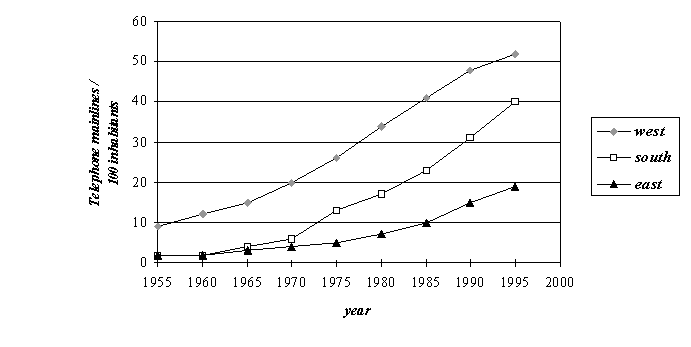
3. BASIC PRECONDITIONS: INFRASTRUCTURE IN PLACE AND WORK Enhanced investments in infrastructure and the creation of city networks and regional networks compose together with a wide range of applications, some of the results of the trend towards more entrepreneurial appearances of urban-regional governance in order to boost economy, to develop social and community applications of ICT and to further develop cooperation networks between cities (Harvey 1989, Graham 1994). At the same time as these cooperation networks facilitate the linkage between localities and the global market, they also form the local respond to the negative consequences of the increase of global competition. In order to deal with the increase of interregional competition, structural changes and high levels of unemployment, a growing local and regional policy intervention in the field of Information and Communication Technology (ICT) have resulted in a large number of telematics projects. The objective with these projects is to serve as demonstration of applications in order to spread the use of the wide range of network services among potential users like small businesses and households. Regional development agencies are also beginning to experiment with information infrastructures as planning tools for directly helping to shape new types of places. A wide range of regional strategies and plans are rapidly emerging, designed to propel places as sites for investment and creativity in the new media and communication landscape (Graham and Marvin 1996). The success of ICT in stimulating development depends on how well individuals, businesses and communities use network services to improve their economic prospects. The link from infrastructure to effective use of network services is the crucial point. Different types of policy initiatives have been applied in order to stimulate effective use. Gillespie et al describe the link from infrastructure to effective use in a series of translations: (1) Infrastructure investment, (2) Provision of appropriate services and applications, (3) Awareness by users of what is on offer and what is possible, (4) Actual adoption, (5) Effective usage. If any of these translations fail to take place satisfactorily, the assumed causal link from infrastructural investment to regional development will break down (Gillespie et al 1995). A sixth phase of competitive advantage can be achieved (at least temporarily) for a region that offers modern infrastructure and deployed use of applications of network services (see figure 1). This is strongly related to the knowledge and skills among the inhabitants. An important assumption in this paper is that the enhanced capacity and quality of the information and communication infrastructure together with a growing use of internet services, result in an increase of the communication activity and that the communication culture therefore also is deepening in areas where universal or at least fairly good access to ICT, only during recent years has begun to be realized. It is important to have in mind that sparsely populated areas with little or hardly no access to ICT-applications rather quickly can adopt when the infrastructure is in place and applications are available (Lorentzon 1996). The linkages between these localities and the regional networks are then able to develop into opportunities to overcome recession and vitalize the local economy if the population can be mobilized and local actors cooperate. Closely related to this is the process of innovation diffusion. Innovations diffuse with different speed in different regions. This is due to regional features as for instance the differences in contemporary and previous political and economic system, traditions, and the economic strength a region has achieved which together, to some extent, reflect the attitudes to change and willingness to adapt new applications among the actors in the region (Rylander 1997). Figure 2. Shows how Greece, Portugal and Spain increased their investment level in telecommunication infrastructure during the 1970s, which resulted in a narrowed gap between themselves and the EU+EFTA countries in this respect. This happened parallel with the democratization processes in these three countries and their applications for membership in the European Union. The investments in former communist countries have increased in latter years (see figure 2 and 3) but is still insufficient to meet the demands of telephone services and Internet services in these countries.
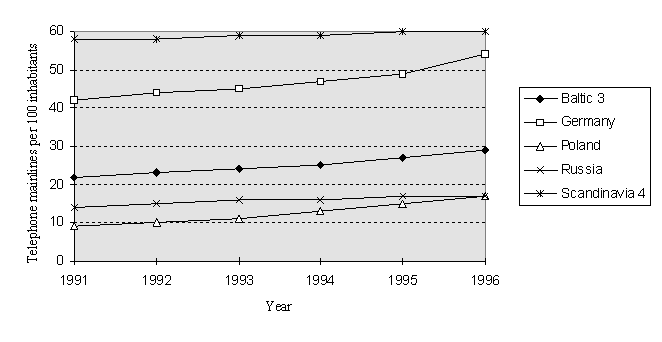
In figure three the infrastructure investments (telephone mainlines per 100 inhabitants) are visualized in order to compare the development in Estonia, Latvia and Lithuania (Baltic 3), Germany, Poland, Russia and the group of Denmark, Finland, Norway and Sweden (Scandinavia 4). The latter group represent a saturated market of ordinary telephone services where the demands instead are focused on mobile services and internet services as shown in table 1. The German telecom company has modernized the telecom infrastructure in former DDR during the 1990s and the density of telephone mainlines is getting closer to the same level as in the Scandinavian countries.
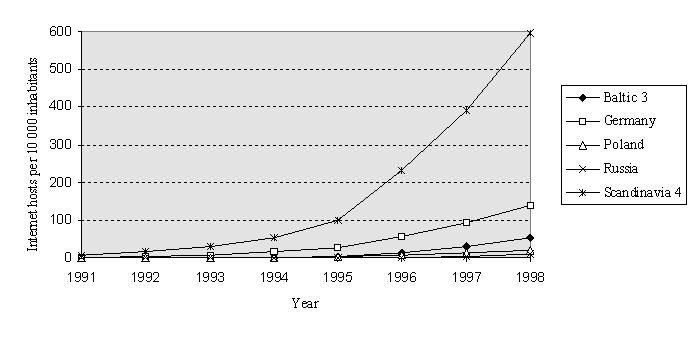
Figure 3. Infrastructure investments in telephone mainlines during 1991-1996 in the Baltic Sea area. The development in the three Baltic countries between 1991-96 has resulted in a 40 per cent increase, while the density of telephone mainlines in Poland almost doubled during the same period. The infrastructure development in Russia has on the other hand stayed on the same level as in 1991. In figure 4 we see how the demands for internet services have exploded in the Scandinavian countries since 1995 (here measured by internet hosts per 1000 inhabitants), while the development in Germany is slower. Among the three Baltic countries Estonia has a leading role as can be read out from table 1. The development of internet infrastructure in Poland has gained speed in recent years but the difference in comparison to a rather stagnant development in Russia is still small. It is important to have in mind the large differences between large cities and the country-side in infrastructure development.
Figure 4. Infrastructure investments in Internet hosts during 1991-1998. Internet hosts per 1000 inhabitants. Internet hosts refer to computers directly connected to Internet with a unique domain on the web. Source: RIPE 1998.
It is important to remember that the degree of deregulation vs. monopoly of the telecom and internet markets in each country vary. The more developed infrastructure and availability of services the more liberated tend the markets to become. In the three Baltic countries, Poland and Russia is competition limited and monopoly is not abolished yet as contrast to the competition on the telecom market in the Scandinavian countries and to an increasing degree also in Germany (Kubasik 1997, Hultén & Mölleryd 1997). Table 1 also shows the telecom traffic in minutes per capita which mirrors on one hand the size of the country (and its home market) and on the other hand the degree a country is integrated in the world economy. The size of the Russian international traffic is contrasting to the one of Estonia for instance. 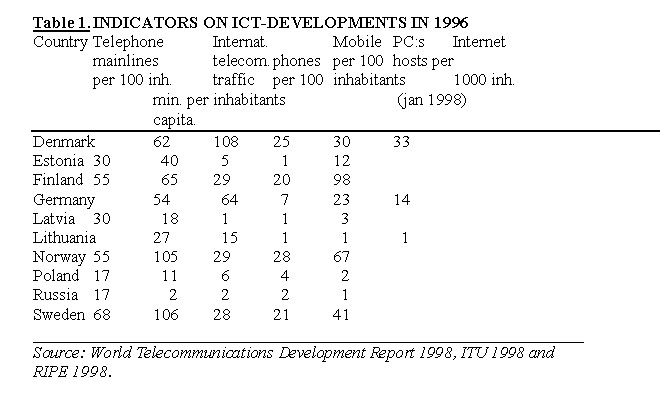
__________________________________________________________________ Source: World Telecommunications Development Report 1998, ITU 1998 and RIPE 1998.
Internet services and other kinds of network services provide opportunities for mobilizing resources like education, skills and organizational and institutional capacity. Discussing the role of internet services in regionalization, we also have to consider the communication culture within a country or a region, in order to understand the impact of interactive means of communication with a cross-border feature like internet services. In societies featured by dialogue and transparency the telephone deployed faster than in societies where the regimes preferred to have a monologue with the people. The same pattern is valid for internet services, but in the contemporary complex processes of globalization and regionalization the diffusion of internet services is going more rapidly.
4.APPLICATIONS THAT MEET THE DEMANDS OF SOCIAL NETWORKING The broadest possibilities to result in applications which will fill the needs of increased social networking in the Baltic Sea area are offered by network services carried by computer networks like Internet, where interactivity is combined with the full variety of scope of communication. In addition to this the communication can be carried through in real time or with time delay as preferred, and the content could be multiformed in text, sound and pictures. These conditions also forms the reasons behind why internet services are growing in use and diffuse rapidly. The explosive development of the Internet and the World Wide Web demonstrates that Internet is the medium where the commercial and end users’ interests converge. Contrary to much of the hype that posits cyberspace as the uncontested domain of rugged individualists, computer networks and traffic exhibit deeply social and political roots. The Internet is neither inherently oppressive nor automatically emancipatory; it is a terrain of contested philosophies and politics (Warf and Grimes 1997). The question of true or false information on websites is a challenge to the critical thinking and implies training of skills in critical scrutinizing and questioning of the contents. There is therefore a need for more face-to-face contact to interpret the exploding flows of information on global networks like e.g. Internet. This new technology means neither the end to the importance of space and place, nor the collapse of face-to-face contacts (Graham and Marvin 1996). There are a fast growing amount of networks between cooperation partners in different places. On one hand there is the type of regional cooperation networks focused upon in this paper, which upholds geoeconomic coalitions composed of actors within local administration and industry with the purpose to improve their territorial region’s positions in the global system. There are also global cooperation networks which together work for a common goal (business, environment, human rights etc.). These networks interact with each other in networking activities. As support to economic, cultural, environmental and social cooperation projects several telematics projects based on Internet and web technology have been created by coalitions of cooperation partners with the scope of the entire Baltic Sea area. Four of them are briefly presented in table 2 and another four projects with local scope are briefly presented in table 4.
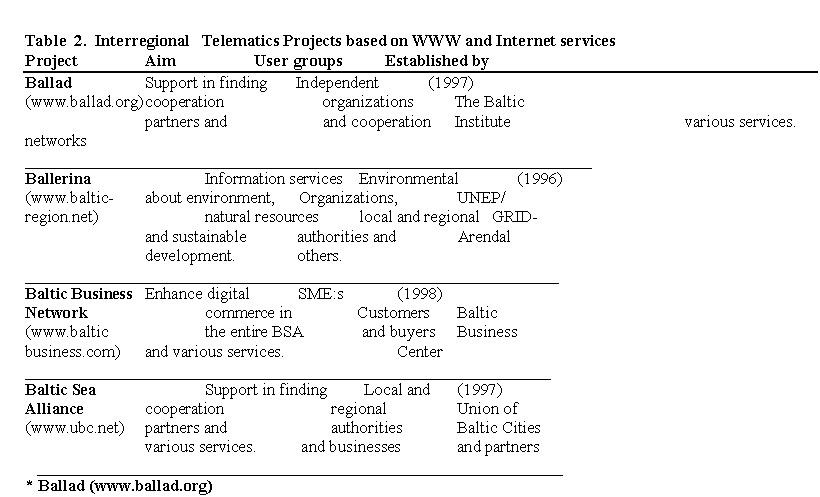
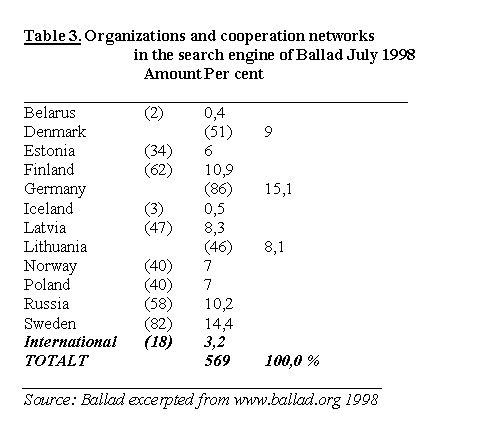
* Ballad (www.ballad.org) Ballad was launched by the Baltic Institute in Karlskrona, with the target groups of independent organizations and cooperation networks. Some 600 actors from all over the Baltic Sea region are registered in the search engine. The internet services include relevant information, daily news services, discuss forum and support in finding cooperation partners. In April 1998 Ballad had 4 000 unique users, 12 000 pages were updated and the home page had had 124 000 visitors (Ballad 1998). Table 3 shows the geographical origin of organizations and networks in the database of Ballad.
* Ballerina (www.baltic-region.net) The overall aim of the Ballerina initiative is to contribute to the sustainable development of the Baltic Sea area environment, by improving the availability and accessibility of relevant information on the Internet for decision-making at all levels. Ballerina was initially proposed by United Nations Environmental Program and regional partners. Main objectives are: To bring more substantive and relevant information on environment, natural resources and sustainable development from and about the Baltic Sea region to the Internet. To make it easier for the increasing number of Internet users to find Baltic Sea region information on environment, natural resources and sustainable development by offering a user-friendly 'top-level' Baltic Sea region web site - the Ballerina web site. To develop a voluntary personal and institutional network of partners working towards the overall aim of Ballerina
* Baltic Sea Alliance (www.ubc.net) Baltic Sea Alliance was created by three cooperation networks: The Union of Baltic Cities, The Baltic Sea Chambers of Commerce Association, The Baltic Sea States Subregional Cooperation. The target groups are the local and regional administrations and businesses. The internet services is focused on information and finding cooperation partners.
* The Baltic Business Network (www.balticbusiness.com) The Baltic Business Network’s aim is to support small and medium sized enterprises and enhance digital commerce in the entire Baltic Sea area. The BBN is being implemented by the Baltic Business Center in Karlskrona during 1998. The internet services being offered include among others: self-building newspaper, digital shops, support in finding cooperation partners and tele learning. A multinational cooperation network of eleven trade centers in ten countries gives support for the assumption that the role of internet services in interlinking actors in those subregions will grow. All four of these telematics projects are based on the concepts of networking and self-building. They were established during recent years (during 1996-98) and it is therefore too early to say in what extent these four telematics projects are contributing to the regionalization of the Baltic Sea area more than underpinning and possibly strengthening already existing cooperation networks. New contacts are also made thanks to interactive applications on the web sites. In table 4. We have a look at four local/regional networks and telematics projects. 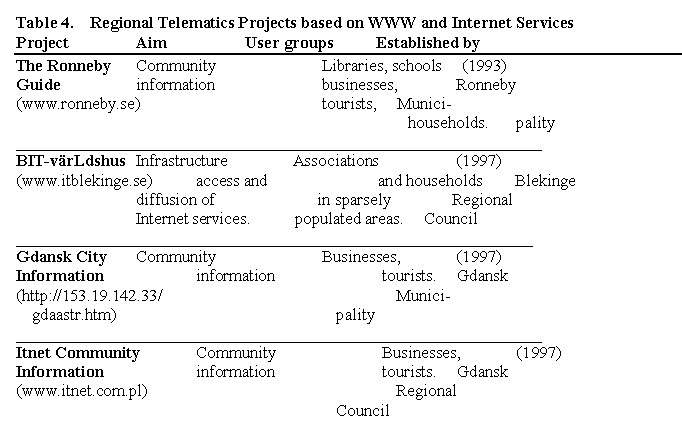
The Ronneby Guide started in 1993 as a cluster of information services that at that time was technically based on First Class. The purpose was to offer a wide range of community information that was made accessable at on-line computers, either private or at access points like the public libraries and schools. Already during the first year it become clear to the initiators that the technical platform should be changed in favour of Internet and web technology. Today, the Ronneby Guide is accessable on the web through a personal computer or through a handfull information kiosks distributed at a few access points. The content is limited to local community information but there is however a link out to the rest of the world were it is possible to find information about e.g. the twin cities in the north of Poland and cooperation partners in the rest of the world. * BIT-värLdshus (www.itblekinge.se) The concept of BIT-värLdshus stands for Blekinge Information Technology Inn and it forms a combination of the concepts of the tele cottages from the 1980s and the Internet cafés of the 1990s. The first pilot Inn was introduced in spring 1997. During the autumn a call was made for local associations and potential project leaders to create and run ten new BIT-värLdshus to be located in sparsely populated areas of the region. Those areas were known as lacking access to the infrastructure that constitutes the high capacity city networks, able to carry multimedia applications at high speed. The BIT-värLdshus are today being linked with new infrastructure and equipped with high quality ICTs. Education, small businesses, art and one call center are some of the activities taking place there. * Gdansk city information on the web (http://153.19.142.33/gdaastr.htm) Information about city facilities, services for citizens and tourists. Much of the contents were published as preparation and during the millenium anniversary in 1997. There is a connected web site with community information from the localities in the Gdansk Wojewodztwo. Information about and links to the twin cities in the south east of Sweden as well as cooperation partners in the rest of the world is also available. * ITnet community information (www.itnet.com.pl) Community information about the localities in the Gdansk Wojewodztwo as well as company information and search engines are available. Information services and cooperation offers directed to potential investors form a large part of the contents. The instigator is the regional administration through its Regional Development Agency and the Internet Service Provider Itnet. Most of the interactive services are still under implementation in pase with the growing demand, which is inhibited by the lack of sufficient capacity and quality of the infrastructure. 5. THE ROLE OF INTERNET SERVICES IN THE INTERPLAY: AN OUTLINE TO A MODEL With the objective to achieve a deeper understanding of the global-local interplay in the Baltic Sea region the following outline to a model visualize aspects of the processes that fuel the regionalization of the Baltic Sea area. The four spheres consist of: Construction of Regional Identity; Competition and Cooperation leading to integration; Global-Local Interplay; Infrastructure understood as organization structures based on technical and social networks. Changes in all four spheres have to take place in an interplay in order to influence integration between localities towards a common functional region and also when subnational regions construct a geoeconomic and geosocial entity, and possibly even a geocultural entity and (though unlikely) a geopolitical entity. The purpose with the establishment of new links and coordinated actions is to increase the economic, cultural and social integration of the Baltic Sea area, i.e. regionalization. There is interregional cooperation between close located cities/regions with the direction towards geoeconomic coalitions where regional worlds integrate and that partly have resulted in a more integrated geosocial entity with enhanced social interchange in many fields like for example knowledge exchange, sport and tourism. From there to a geocultural entity with a growing regional identity, in this case a Baltic Sea regional identity, there are not only physical distances to overcome but also mental distances due to different languages, traditions and experiences of political and economic systems. The role of internet services in this context is related to the concept "imagined communities" (Anderson 1983). In all societies that exceed that small group of people that makes it possible for each member to know everybody else of the members, the community is imagined in each member's mind. The imagined community is made possible through consumption of the contents in newspapers, books, radio and television (Anderson 1983), and today also through the content on web sites and internet services (Rylander 1998). The interlingua in praxis is de facto English, even though there are efforts to translate the contents on websites to more languages than the two that often are available to use. There are no doubts that ICTs, and internet services in particular, play a role in interlinking local and regional actors. If the cooperation networks to some extent lead to a decreasing mental distance between the actors the result might be a process towards cultural integration. Within the framework of multiple identities, it could also result in an imagined transregional identity. It would then most likely be characterized as an imagined global citizenship which contain a Baltic Sea regional identity as well as national and local identitities. The interregional and local telematics projects presented in this paper point out that there are an increase of confidence and use of Internet services by local and regional actors, aiming on deepened cross-border interregional cooperation and regionalization of the Baltic Sea area. The applications offers support in finding cooperation partners and in finding relevant information to use in business and cooperation projects. The active use of cyberspace leads to a deepening and enlargement of the "Imagined Community", bringing forward improved conditions for the construction of regional identity and enhanced regionalization. Regional and local actors hope that innovations within the field of ICT will result in new products and services able to help boost the regional economy. To some extent this is already the case in some places (Storper 1997). The role of internet services in regional development is in their perspective a question of a growing group of innovations and applications that can be part of the solution in order to (re)gain competitiveness. But internet services has also another distinguishing feature as communication channels that help spreading information about themselves and other innovations. In that way they support innovation processes as well as diffusion-of-innovation processes. This makes internet services essential for learning individuals living their lives in learning regions and acting in a learning economy. The role of internet services in this context is of course limited but in fact not insignificant. On the contrary internet services underpin social networks and function as catalyst in processes of change like the one in focus in this paper: the regionalization of the Baltic Sea area into a region in accordance with the definition above. It is likely that the speed of the regionalization process is affected by the catalytic character of the internet services. 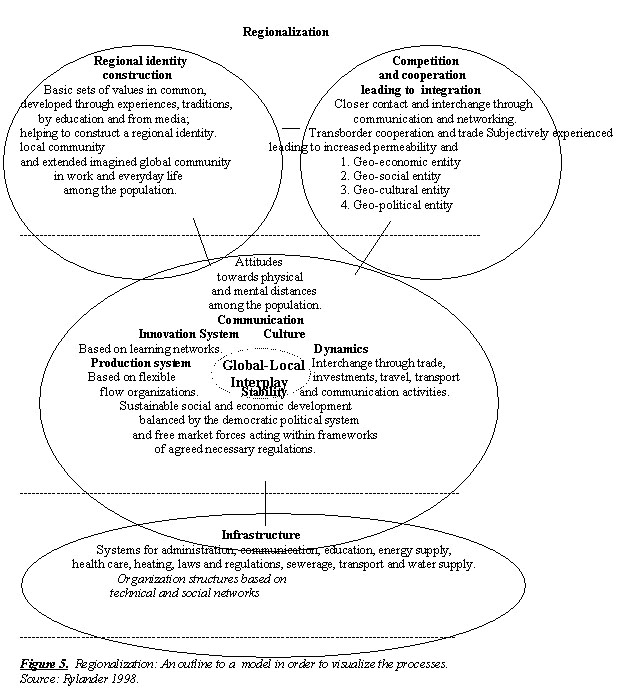
6. CONCLUSIONS The interregional and local telematics projects presented in this paper point out that there are an increase of confidence and use of Internet services by local and regional actors, aiming on deepened cross-border interregional cooperation and regionalization of the Baltic Sea area. The applications offer support in finding cooperation partners and in finding relevant information to use in business and cooperation projects. The active use of cyberspace leads to a deepening and enlargement of the "Imagined Community", bringing forward improved conditions for the construction of regional identity and enhanced regionalization. The role of internet services in the interplay between globalism and regionalism is limited but in fact not insignificant. On the contrary internet services underpin social networks and function as catalyst in processes of change like the one in focus in this paper: the regionalization of the Baltic Sea area into a region in accordance with the definition. It is likely that the speed of the regionalization process is influenced by the catalytic character of the increasing use of internet services in networking activities among key actors as well as a growing part of the population. REFERENCES Anderson, B. (1983) Imagined Communities. Versa: London. Castells, M. (1996) The Rise of the Network Society. Blackwell Publishers, Cambridge and Oxford. Gillespie, A. & Richardson, R. & Cornford, J. (1995) Information Infrastructure and Territorial Development. CURDS, Newcastle Upon Tyne/OECD, Paris. Goodall, B. (1987) Dictionary of Human Geography. Penguin Books. London. Graham, S. (1994) Networking Cities: Telematics in Urban Policy - A critical review. pp 416-432 in International Journal of Urban and Regional Research. Graham S. and Marvin S. (1996) Telecommunications and the city - electronic spaces, urban places. Routledge, London. Hamdani, K.A. (1997) Introduction. pp 1-10 in Dunning, J.H. & Hamdani, K.A. (ed:s) The new globalism and developing countries. United Nations University Press, Tokyo/New York/Paris. Harvey, D. (1989) From managerialism to entrepreneurism: The transformation in urban governance in late capitalism. Geografiska Annaler, Series B. Human Geography. Volume 71B, Number 1, 1989. Hettne, B. (1997a) Den europeiska paradoxen. Om integration och desintegration i Europa. Nerenius & Santérus Förlag, Stockholm. Hettne, B. (1997b) Europe in a world of regions. pp 16-40 in Falk, R. & Szentez, T. (ed:s) A new Europe in the Changing Global System. United Nations University Press, Tokyo/New York/Paris. Hultén, S. & Mölleryd, B.G. (1997) Estonia, Latvia and Lithuania: Balancing the demands for short term profitability and network expansion. pp 167-179 in Schenk, K-E et al (co-ed:s) Telecommunications Take-Off in Transition Countries. Avebury, Aldershot/Brookfield/Hong Kong/Sydney. Karlsson, I. (1997) Territoriets uppkomst. pp 11-18 in Karlsson, I. (editor) Territoriets gränser. SNS Förlag, Stockholm. Kubasik, J. (1997) Poland: Problems of opening and regulating the public network. pp 97-138 in Schenk, K-E et al (co-ed:s) Telecommunications Take-Off in Transition Countries. Avebury, Aldershot/Brookfield/Hong Kong/Sydney. Lorentzon, S. (1996) IT:s roll som lokaliseringsfaktor i perifera regioner - Exempel från de "IT-aktiva kommunerna Arvidsjaur, Åre, Sotenäs och Ronneby. Choros 1996:1, Göteborg University. Rylander, D. (1996) Transnational Networks: Impact in East-Central Europe. Working Paper . Dept. of Human and Economic Geography. Göteborg University. Rylander, D. (1997) Förändrade kontaktmönster i södra Östersjöområdet: Nätverks-tjänsternas roll i den regionala utvecklingen. i Cramér, P. & Lindahl, R. (ed:s) Forskning i Europafrågor. CERGU, Göteborg. Rylander, D. (1998) The Role of Internet Services in Regionalization. Case studies from the Baltic Sea region. Paper presented at the Regional Implications Track at the 8th global summit of Internet Society INET’99 in Geneva 21-24 June 1998. Storper, M. (1997) The Regional World: Territorial Development in a Global Economy. The Guilford Press, New York. Veggeland, N. (1998)"Region", "Regionalism", "Regionality" Key concepts in regional Europe. pp 74-82 in Nordisk Samhällsvetenskaplig Tidskrift, Nummer 26, April 1998. Westermann, R. (1998) VASAB 2010: A Critical Analysis. pp 163-186 in Hedegaard, L. & Lindström, B. (ed:s) The NEBI Yearbook 1998. North European and Baltic Sea Integration. Springer, Berlin. |