|
Maija Rozite Paper reveals the main results of the author's doctor's thesis. The aim of the work is to study tourism as a city function and to describe peculiarities of tourism industry in Riga city in different historic periods, to determine if urban tourism has been developing in Riga and is there is a specific tourist district. To fulfil the tasks of the work records of archives, published and unpublished data of Central Statistical Bureau of Latvia have been used, tourism industry enterprises have been visited and their specialists have been interviewed, surveys of Riga city visitors and Latvia inhabitants have been carried out. The author has also studied plans and strategy of Riga city development. Introduction.
At the end of the twentieth century a tendency to replace secondary
economic sector by tertiary sector was observed in European cities.
There were also changes in service sector as, apart from transport
and trade functions, information, financial, medical and entertainment
services became more important. According to these changes cities
are described not only as places of industrial production but
also as "increasingly as centres of control, interaction,
creativity and enjoyment" (Burtenshaw, 1991:70). The process,
that happened in Western European countries in the eighties of
this century when the majority of economically active inhabitants
were involved in service sector, took place in Eastern Europe
in the nineties of this century. For example, in Riga in 1996
70% of employed persons worked in tertiary sector. As industrial
production in the cities was reduces, it searches new trends of
development and Riga City Council considers the tourism is a new,
promising branch for Riga economic development and it works at
tourism developing strategy. Is tourism a new industry in Riga?
Is it tourism in a historic city or urban tourism?
Analysing tourism development in Latvia and Riga, the author draws a conclusion that it is possible to distinguish four periods in tourism history. Tourism organizing, types of tourism industry enterprise (public, state or private enterprise), types of tourism, the value and flows of travellers are different in each period. 1. Prime origin of trips and origin of tourism. Riga has been connected with intensive trade and political links with other European countries and cities since its foundation. According to historians research, the first records about inns as places of lodging for the night in Latvia territory were found already in the records of the 13-th century, but the first hotel in Riga was mentioned in 1435 (Pavulans,1971:178). At that time the main travellers were merchants and apprentice. As traveller's movement grew the network of inns developed. In Swedish records of 1638 there were mentioned 8 inns in Riga. In 1642 a special hotel for Russian merchants was founded. There were two rooms for lodging in that hotel. Still the majority of city guests stayed overnight at their acquaintances. It was so even up to the 18-th century. Travelling in Latvia territory in the 17-th and 18-th century was connected with development of spas in Europe. In 1795 the first bathing establishment was founded in Baldone and in 1796 the first patients were sent to Kemeri thus laying foundations for development of Baldone and Kemeri spa already in the 18-th century. So the 18-th century can be regarded as a period of tourism prime origin. Trips for health treatment are characteristic for that period. As travellers' movement grew tourism industry started to form and the 19-th century, especially its second half, can be regarded as the first period of tourism development in Latvia. The main factor that promoted tourism development, was sea bathing which was very modern in Europe. In the beginning of the 19-th century rest places for summer residents were established in Kurzeme, Riga's and Vidzeme seaside. Although the flows of holiday-makers flew from Riga to seaside, also Riga attracted travellers. In the twentieth of the 19-th century Midsummer's Eve market was organized in Riga, in summer of 1836 the first music festival in Baltic's was held in Riga. The guests of the festival were from Latvia towns and also from Tallinn, Tartu, Parnu. The means of travellers' transport were coach and steamers. Trips were of individual character. In the second half of the century when railway developed trips to Ogre from Riga by railway became phenomenon of a mass character. Because of the above - mentioned, K.Vanags, the founder of Latvia tourism, considers that the year of 1862 was the beginning of tourism movement in Latvia. This is the year when the first excursions by train were organized. Railway promoted guests' arriving to Riga from Western Europe and Russia. As the number of visitors increased a larger net or hotels started develop. In 1864 there were 13 hotels in Riga but in 1901 - already 25 hotels. The first hotels (Caune, 1984:160) were situated in the inner city, but after pulling down city fortification ramparts new hotels were built in the newly - constructed boulevards, for instance, Commerce Hotel and Hotel de Rome. 2. The period of Independent Latvia State (1920-1940) Real growth of tourism was observed in that period. The main feature of this period is that tourism was recognized as an important branch of economy and its supervision, organization and development politics got under state supervision. In 1929 the first delegate of Latvia tourism organization took part in International Conference of official Tourism propaganda Institutions Union in Warsaw and Latvia was admitted a member to this organization. In 1931 the government recognized tourism work as so important that it founded an official Tourism office at Ministry of Interior Affairs. Formation of tourism societies facilitated development of tourism (Latvia Central Tourism Society, Latvia Tourism Society, etc.). These societies can be regarded as travel operators and agents of that time, though they were social organizations. The above - mentioned societies organized versatile work; organized and promote excursions in Riga, to other sights of Latvia and abroad, issued guide- books, established information stands and also founded tourism information office in Riga city Railway station, organized guide courses, issued tourism journals "Tourist" and "Excursionist". After 1931 tourism office of Ministry of Interior Affairs had a greater role in organizing and promoting tourism work (since 1937 it was included into Ministry of Social Affairs). This Tourism Office supervised domestic tourism. State railway tourism Office "Celtrans" dealt with international tourism and it also got a greater role. The role of these offices grew after 1935, when social tourism societies were closed down. Already in 1928 special Tourism fund was founded. Its means were formed by taxes for foreign passports. Its means were used for developing of tourism facilities and for issuing propaganda materials. The main type of tourism was tourism an foot, by car and train to the most beautiful sights of Latvia and by boats along the rivers. This kind of tourism which was promoted as "Let's travel round the native land!" got phenomenon of a mass character and according to date of Tourism Office in 1939 the member of local tourists reached 200000. The purpose of domestic trips was active tourism. Latvia became a popular destination for foreign tourists and number of arriving foreigners exceeded the number of outgoing travellers thus forming a positive tourism balance and increasing currency revenue. Foreigners arrived in Riga, had a rest in Riga's seaside and went on radical trips to Sigulda and Cesis. The main purpose of foreign tourist trips was relaxing, health treatment and cultural tourism.
Statistics of that time show that in 1935 there were 576 hotels,
furnished rooms, boarding- houses and inns in Riga, where 995
people were employed. The majority of those enterprises were furnished
rooms and boarding - houses which were not used by tourists. Hotel
statistics revealed data about the largest hotels (18 hotels in
1935, 15 - in 1938) in which there were 751 shared lodging places.
In 1924 39 thousand guests were served in hotels. In 1938 this
number increased to 105 thousand but the length of the stay of
guests was 136 thousand person-nights in 1939. The number of foreign
tourists increased from a few percents in the twenties of the
century to 18% in 1938 (see Fig.1). Foreign visitors came mostly
from Lithuania, Germany and Estonia (see Fig. 2.).
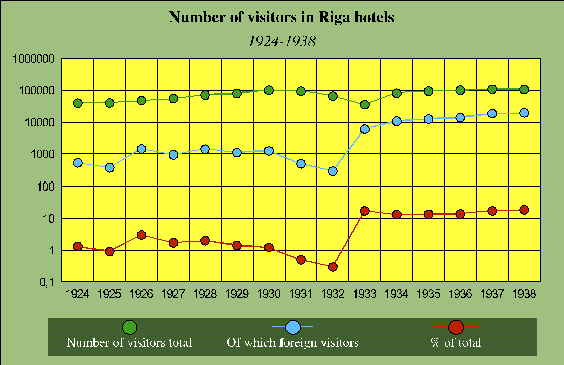 Figure 1. Number of visitors in Riga hotels In 1937 the State Tourism Committee was founded which was formed by representatives of the ministries, offices and enterprises connected with tourism (Ministry of Foreign Affairs, Railway Administration, Municipality department, hotel-keepers, etc.) but in 1939 Tourism Union of the Baltic States was founded. Its aim was to make travelling easier and to co-ordinate tourism work. 3. The Soviet period (1946 -1990) Alongside with great political and economic changes in the country development the Soviet period also brought great changes in tourism. Already in 1940 tourist societies and organizations were closed, during the war tourism infrastructure destroyed and well - established tourism objects were also destroyed. The role of Latvia in European and World tourism system changed. From an open territory Latvia turned into a partly closed territory for foreigners. According to the Soviet tourism system, Latvia tourism organization was changed. Tourism tasks, routes, the flow and amount of tourists also changed. Domestic tourism was governed by Republican Tourism and Excursion Board. Outgoing tourism was governed by Trade Union republican Tourism Board Tourism Department and by Komsomol organization "Sputnik". Incoming foreign tourists were welcomed by state organization "Intourist" Riga branch and "Sputnik". In this period, the same as in the previous one, the main tourism type was domestic tourism and as it was governed by the trade union, trips were available to everyone. Mass tourism in thirties with 200 thousand travellers increased several times during the Soviet period. Unfortunately, the statistics of the Soviet period counted the total number of people served without showing the number of domestic tourists and tourists from other Soviet Republics served by Latvia tourism enterprises. Anyway, the domestic tourism industry was well established because in 1985 there were 7 tourism centres (camping and special tourist houses) in Latvia territory. In summer period they had 1784 lodging places. There were also campsites with several hundred places in tents, hotel "Tourist" in Riga with 454 places. So in summer domestic tourists could use 3 thousand lodging places simultaneously. In 1986 1.5 thousand people were employed in Republican Tourism and Excursion enterprises and in 1988 7.5 million persons were served there - 671 thousand tourists and 6.8 million excursionists. Domestic tourists in Riga were served by Riga Travelling and Excursion office (in 1988 255 thousand tourists and 4.4 million excursionists were served), Riga Tourism centre (17.5 thousand tourists), hotel "Tourist" that served 51 thousand guests. Development of international tourism depended on tourism politics of the Soviet Union, therefore only organized package tours, mainly from the socialist countries, arrived to Latvia. Initially foreign tourists could stay only in Riga, late also in Jurmala and Sigulda. The number of foreign tourists increased from ten thousand in sixties to fifty thousand in eighties. Latvia people were not freely allowed to go on trips abroad. About 10 thousand tourists a year went abroad at the end of seventies and in the beginning of the eighties. They were only organized package tours to socialist countries. The number of hotels did not change in the sixties and seventies compared to the previous tourism period. In 1970 there were 10 hotels in Riga with 1833 beds and the length of stay was 633 thousand person-nights. At the end of the eighties international tourism got more active. Alongside with the development of co-operative movement, new tourism enterprises were founded and in 1989 there were 35 hotels with 3927 beds in Riga and 1.1 million visitor-nights a year were spent there. 4. Nowadays (since 1991) Alongside with the change of the political system, international tourism stopped to be state monopoly and many people chose tourism as business in the beginning of nineties. For example, in 1992 320 tourism firms and travel agencies were registered. At first, work of tourism firms was not difficult as they issued visas for foreign trips and organized shopping tours to Poland and Lithuania. Now, after eight year period, more than a half of the previously registered firms does not exist anymore. Now there are tens of stable tour operators and travel agencies that have taken their role in tourism market, such as "Latvia Tours", "Impro "and others. Analysing work of travel agencies, it can be stated that their work can ensure the dream of the Soviet period - to travel abroad. Only 1/3 of Riga travel agencies welcome visitors here. The amount of incoming tourists served by all Latvia travel agencies reaches 87% of total amount of served persons.
Hotel industry develops as well. The number of accommodation
places has increased from 99 to 220 in the period from 1991 to
1997. There are nearly 40 hotels, guest houses and motels in Riga
now. Hospitality industry quickly responded to the change of customers
and several new hotels have been built or rebuilt according to
European standards in Riga. As a result hotel services are not
acceptable to an average Latvia inhabitant. In 1993 only 1/3 of
hotel guests were domestic tourists. Thus two and three star hotels
have been founded recently. Their services are used by domestic
travellers which constitute 51% of Latvia hotel visitors now.
Riga is the most important city in Latvia tourism industry. Research
carried out by the author shows that the number of domestic visitors
in Latvia could be about 1.5-2 million (including same day visitors)
but data of Central Statistical Bureau of Latvia show that about
1.82 million foreign visitors a year visit Latvia, 635 thousand
of them are foreign tourists, and 580 thousand same-day visitors.
There has not been research carried out how many tourists visit
the capital of Latvia every year. Using statistical data from
hotel industry, surveys data of domestic and foreign tourists,
the author has come to approximate number of tourists in Riga.
In 1997 350 thousand foreign tourists and about 320 thousand same-
day visitors visited Riga. The number of domestic tourists is
about 500 thousand people and the number of domestic same- day
visitors comes to 900 thousand persons (see picture No.2). Thus
the total number of tourists in Riga could be about 2 million.
From 635 thousand foreign tourists visiting Latvia in 1997, 60%
stayed only in Riga or in Riga and other place.
Source: Central Statistical Bureau of Latvia; * estimated by authors research Operation of tourism industry enterprises proves the role of the city in state tourism industry. Although in 1997 there were 16% of Latvia lodging places (36 hotels and other accommodation establishments) and 1/4 of accommodation capacity (5011 beds) in Riga, 48% of all hotel guests served in Latvia were served in Riga, 71% of foreign visitors were served in Riga. Analysing the data of hotel industry in Latvia and Riga in the period from 1994 till 1997, the role of Riga in hotel industry diminishes. It is so due to tourism development in Latvia cities and regions. As a positive tendency in tourism in the country a tendency can be marked - apart from Riga also other territories attract tourists and guests stay there for a longer period because the length of stay of foreign tourists in Riga constitute only 51% from the total number of visitor - nights spent by foreign tourists in Latvia. In 1997 there were 4/5 of the country travel agencies in Riga. The greatest part of tour operators work there. From all the persons involved in tourism organization in Latvia 9/10 worked in Riga. They served 80% of tourists served in travel agencies or 9/10 of incoming foreign tourists. Riga travel agencies welcomed 87% from tourists served at travel agencies - 92% foreign visitors of Latvia or 63 thousand persons. Analysing operation of travel agencies in the period of 1993-1997, it can be stated that Riga travel agencies still have monopoly in tourism and they serve 70-80% from all the tourists. There is a trend observed that the number of domestic tourists served in Riga tourism firms has increased from 12% in 1993 to 31% in 1997, but the share of foreign visitors has decreased from 99 % to 92%. Although Riga City Tourism Information Office has been open since 1996, it was founded on Tourist Club basis which was founded in 1959. It is a municipality enterprise but unfortunately it does not receive financial aid from municipality and is forced to do business. In 1998 3 employees work in Office and files about tourism services and facilities in Riga and Latvia are made. According to Office Head, in the season of 1998 100 to 150 foreign tourists a day are served, and the number of tourists served a year could be from 13 to 20 thousand.
Where do Riga visitors come from? What are their purpose of trips?
Hotel statistics prove that people from CIS (13%), Germany (12%)
and Sweden (11%) stay overnight in Riga. The main tourism markets
for travel agencies are Finland (47% of visitors in 1997), Germany
(33%) , Denmark and Russian Federation.
 Figure 2. Incoming visitors in Latvia
by country of residence Figure 2. Incoming visitors in Latvia
by country of residence
The survey of persons crossing Latvia's border carried out by
Central Statistical Bureau of Latvia proves that 47% of tourists
of Riga are business travellers, 30% have come to visit friends
and relatives and 17% are holiday makers. The questionnaire of
Riga visitors in 1996 and 1997 showed that the purpose of domestic
visitors was also business (22%), shopping (20%), visiting friends
and relatives (16%). It can be stated that although Riga Old City
and architecture of Jugendstil buildings was included in UNESCO
World Heritage List in 1998, cultural tourism, congress and conference
tourism is rather undeveloped. The questionnaire of Riga tourism
and hospitality industry employees in August 1998 showed that
the greatest event of this summer -Song and dance festival, ensured
100% hotel occupancy but travel agencies had only 5-10 % customers
more. As after the World War II mass tourism developed rapidly and its main sight was seaside, geographers paid attention to resorts as tourism centres at first. Parallel research of separate elements of tourism in cities started but up to eighties. The term "urban tourism" was not used but this type of tourism was addressed to as tourism in cities. Only in the eighties of this century tourism was started to be considered as a city function. One of the first researchers of urban tourism G.Ashworth has written that: "Urban tourism is not merely tourist activities that occur in cities. It is both a particular sort of tourism as well as an integral, traditional and proper part of urban life" (Ashworth,1989:50). The term of urban tourism got a new content in the beginning of the nineties when tourism started to be develop in old industrial cities both in Europe and the USA. Ch. Law defines urban tourism as follows: "The phenomenon of tourism in older industrial (or non-tourist) cities has been termed "urban tourism"" (Law,1992: 599). He states that in comparison with historical and cultural cities where tourism has developed historically without much effort, in industrial and harbour cities urban tourism is a special strategy how to renew the city or change its industrial districts. Thus, when the term of urban tourism develops, planning, marketing and city image creation are included in it. In 1992 g. Ashworth acknowledges that "The physical existence of tourism in cities does not itself create an urban tourism.... The special characteristics intrinsic to cities as a settlement type are instrumental in shaping the holidaymaking activity so that a particularly urban tourism emerges: and secondly that the function of tourism is instrumental in shaping important aspects of cities" (Ashworth,1992:3). In 1993 the first monograph in urban tourism is issued. Such definition of urban tourism is found there: "Urban tourism is a complex of activities which are interlinked in a particular milieu and enable cities to attract visitors" (Ch.Law,1994:14). Research of urban tourism includes research of elements and resources of urban tourism taking into account that they are not isolated from each other. To understand urban tourism it is necessary to study geographic features of these elements, to study processes that can influence changes. Studying Riga City development plans for the period of 1995-2005 and its perspectives in 2020 it should be stated that tourism is consider as one of the city functions ranking it in the fourth place after capital, education, culture, health care and highly technological industrial functions. It is also stated that clear tourism development strategy is necessary which would include adequate facilities, accommodation and entertainment. As tourism in cities is developing, its geographic research enlarges and more authors speak about a special territorial space where there are tourists and the function of urban tourism is expressed. This space is called as "recreation business district", "tourist historical city", "central tourist district" or "tourist business district". Studying the main excursion routes offered by tour operators and travel agencies in Riga, the main tourism attractions in Riga, the author states that the most corresponding model for Riga nowadays is Ashwort's historic city model and carrying out the begun tourism development strategy it could become a tourist - historic city but it is too early yet for central tourism district or tourism business district.
Comparing H. Standle's (Germany) stated central business district
(CBD) region borders with the territory of the most tourism facilities
and tourists, a conclusion can be drawn that tourism region occupies
all the Old town but territorially does not overlap all CBD,
especially to the direction of Brivibas Street (north-east). It
forms radial rays to the North direction (the concentration of
Jugendstil buildings in Alberta Street), to the Central Market
direction and forms separate islands that are isolated from the
main tourism region (harbour, Skansen, Mezaparks and Motor Museum).
Krasta region where modern shopping centre and a hotel are being
built and Kipsala with the greatest exhibition centre will be
new regions of urban tourism, but today they are without other
tourism facilities and attractions. Although there are possibilities
to hold congresses and conferences in Riga, there is not a special
congress centre that corresponds to European demands. There are
no modern amusement parks, especially water amusement parks that
could be popular both among tourists and local people.
Tourism is not new function for Riga. Already since the 17-th century there have been tourism enterprises in the city. Four different periods in the development of tourism in Riga and Latvia can be distinguished. They differ in the character of tourism organization, tourism types, tourist flow and amount. It is not possible to evaluate the role of tourism function in Riga city economics within a longer time period as there does not exist common tourism statistics. Different tourist statistics is used in each historic period. The only data that can be used are the number of hotels and their capacity, the number of visitors served. The role of tourism in market economy increases. Analyses of the work of Riga city tourism industry enterprises and the city development politics show it. Unfortunately, Riga Municipality tourism development politics is not co-ordinate with private businessmen involved in hospitality industry. It is possible to state a tourism region in Riga, which according to Ashworth corresponds to tourist- historic city model. Features of urban tourism strategy can be observed but the results are not seen yet. So, urban tourism is in its initial stage in Riga.
Tourism region in Riga is located in Old City, it is partly covered
the central business district, but forms radial rays and isolated
islands. Strategy of urban tourism development is only the development
of some urban tourism elements but a complex territorial tourism
space or region is not planned.
|