|
Mait Rei Abstract Throughout last decades the World has experienced challenging change during which the information and telecommunication industry production has transformed both international and local economies. This paper analyses changes in entrepreneurial and workforce spatial imaginations regarding urban spaces in Estonian major urban areas. Changes in residential behaviour illustrate how information mobility could impact urban culture, space, hierarchy, communications and social processes. Keywords: urban economies and resident’s spatial behaviour, information mobility, transforming of post-Socialist societies, pre-conditions for globalisation Introduction The recent debate on Central and East European transformation economies has paid very little attention to importance of information industry products that are changing enterpreneurs’ spatial imaginations. More attention has usually been paid to big infrastructure development projects such as highway development and urban restructuring. Only few works have opened up deeper analyses in development of telecommunication infrastructure and its impact to power relations and built environment improvement in transforming societies. Very little interest has been shown to issues of changing economic behaviour through new technologies. Competitiveness inside post-socialist World depends very much on deeper knowledge in changing cultural values and accessibility to external World. Purpose of the present work is to find out the most important factors that shape urban spatial behaviour in contemporary World. Recent studies in concept of space are important starting point for deeper understanding of social transformations. Conceptualising information space
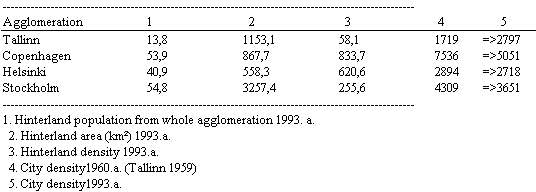
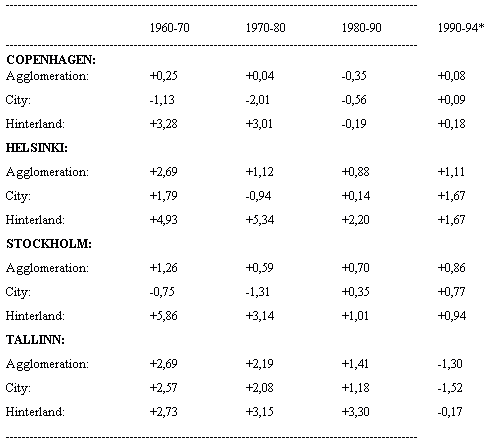
Information networks and space Information networks’ space is unique because it consists of both local and global at the same time. It does not consist spatialities as local, regional or global scale. Information technology facilities are forerunners in globalisation production, because they give almost unlimited access to information in different geographical regions. Information mobility is important factor providing more needs for other global transport infrastructure because it produces better accessibility to external contacts and knowledge. Information infrastructure and technology are becoming relatively cheap compared with other technical infrastructure facilities that makes their use easier in developing Central and East European (CEE) countries. In the mirror of overall global economic transformations the media and information technology users have changed the logic of economic and social behaviours both in developed Western World and CEE countries. The shape of space Idea of space and its shape has been discussed since very early times. Mainly people imagine space as something around us. Modern scientific theory has imagined space as something very mathematical or geometrical that is very easy to measure. Until not so many years ago, the word "space" had a strictly geometrical meaning: the idea it evoked was simply that of an empty area. Concept of space was ultimatively a mathematical one (Lefebvre 1991). During the last twenty years development of telecommunication sector has given possibility to imagine space in several ways. Appearance of virtual space changed traditional understanding of spatial imaginations. Disappearing locations and identities in global telecommunication network opens up different object that is hard to measure both mathematically and geographically. People’s using of virtual space has risen throughout the last decade and it is an important factor for analysing their spatial imaginations and spatial behaviours. Power, knowledge and space During last decades significant change has taken place in social relations because of better availability of information. Generally the information exchange does not mean exactly knowledge exchange, but good information base opens up good possibilities for knowledge development. In opposite way, last development in this field shows that importance of getting information replacing importance having of good knowledge to be successful. These factors are important to understand people’s spatial imagination scales in information presentation. Michel Foucault’s interview (Foucault 1984) opened up large discussion in power-knowledge relations over times. Significant change has happened these power relations during last decades. Globalisation of information exchange has touched only small part of all World population, but growth of possible users have rised in great numbers and people could turn opened up possibilities into their advantages. Doreen Massey (1993) calls this process "the power-geometry of time-space compression" followed David Harvey’s idea that time, space and money could be invested with rather different significances, depending upon the conditions and possibilities of trade-off between them (Harvey 1989). Widening and deepening understanding of entrepreneurial space Every entrepreneur has very different action space, but psychologically they do not imagine spatial scales in this kind of room. Transnational companies have much bigger action space as local shop owner, but their spatial imaginations depend their previous external knowledge. Capital flows between different economic sector concentrate around few key-actors in major urban locations and they will influence most important activities in urban restructuring. Spatial movement, interaction, influence and communication have become so extended, so fast, and so available, that the borderlands and boundaries which once used to define places as distinct and in some degree separate from each other are so often crossed that the notion of place which was previously viable has to be re-thought (Massey 1995). Changing spatial imaginations People are living in different conditions and use different spaces in everyday lives. Spatial imaginations are personal question, because every person imagines it differently. One important difference is imagination of spatial scales. Action scale is important pre-condition to shape economic activities and both personal knowledge and local conditions. Educational system produce more wider scale theoretical knowledge and young people starting to act in such conditions creating wider action space Entrepreneurs should follow widening perspectives what technological tools makes possible. Traditional modern enterprise had quite strict and fixed action area, because it was cost-effective and easy to cover. Recent turbulent working environment needs different approach into action scale question, because fastened personal and information exchange mobility. Globalisation, localisation and trade in information economy sector Each economic sector has certain localisation advantages to achieve better outcomes. Equal distribution of information sector facilities depends not even other supporting sectors, but ability to create competitive and well-advertised products. Classical economic development models between sectors are hard to use in the condition of different sectorial mobilities and it needs for new approach to explain importance of information sector impacts. Peter Dicken suggest to find a new approach explaining global restructuring, because "in unmodified form the traditional explanations of patterns of trade and of the location of production and investment are clearly inadequate to explain the complexities of the modern global economy. Differential labour costs and economies of spatial agglomeration are highly significant influences on global shifts in economic activity" (Dicken 1998). Changing organisational structures in information economy Rising number of information technology facilities will lead fast changing organisational structures in all sectors and the emergence of new information technologies is seen to be heart of this restructuring, leading to a new mode of sociotechnical organisation (Castells 1988). Search for characteristics of this new mode of sociotechnical organisation should start from personal level and finish in global level. Our societies are increasingly structured around a bipolar opposition between the Net and the Self (Castells 1996) Usually entrepreneurs very specialised economy as competitive advantage, but in the condition on continuous fast changes is needed much more complex knowledge to be competitive. Very specialised economy has mainly very strictly planned structures where are clear borders between specialists and top officials. In these conditions is quite hard fast knowledge exchange between both top and down officials or in horisontal level between different disciplines. Flexible organisational structures and subcontracting support more open conditions for creativity. Usually information tends to concentrate in specific closed institutional spaces where public access is limited. Institutional outsiders are more attractive in many ways because they are not tied with whole structure and they differ from other structures or could be more independent. In-betweenness and otherness as competition advantages Information and economic networks Appearance of smaller "global enterprises Information technology has given for smaller enterprises to be "global" even in small size. Sometimes big capital concentration promises even smaller firms or individuals to be competitive in international markets. Anyway they need to have some "motors" what use their services and identify as their "own". Information age companies can be big if they use aggressive methods in all possible information facilities influencing peoples psychologically with continuous advertisements and coping some culturally well known values. Information industry has transformed hierarchical structures between different economic sectors. Rising economic power of information services has shaped both firms internal and external structures. Dependency mainly rise in access to information and experiences and having internationally well-known trademark. Economic dependency still exists because all specific information is not accessible in public sector. From transport to teleport development Significant change has taken place in defining transport facilities. Information exchange and media represent different way of transport – teleporting. By centralising the facilities, teleports provide significant scales of economy to small users who cannot afford private intranet connections. Teleports are seen as the new ‘harbour depots’ of the information age performing the same role as harbours in the age of shipping (Kitchin 1998). Knowledge concentration units are not equally divided. There are some certain "hot spots" where knowledge concentrates into specific innovative milieu. Transport costs are getting cheaper, but possibilities for large-scale international transport are still limited for most of developing World. Information technologies afford better access to outer information. "Virtual travelling" around World propose access to wide publicly open possibilities get needed information. The quality of information depends on who produced it and what kind of purposes it has in different local conditions and contexts. Information agglomerations Agglomeration is traditionally meant to be a quite stable region with very strong ties inside (urban, metropolitan) region or association of productive activities in close proximity to one another which improves their efficiency through the collective use of infrastructure (Goodall 1987). One of the best definitions of agglomeration economies has been provided by Nickolas Kaldor (1970), who states that they are: .nothing else but the existence of increasing returns to scale—using that term in the broadest sense—in processing activities. These are not just the economies of large-scale production, commonly considered, but the cumula-tive advantages accruing from the growth of industry itself—the development of skill and know-how; the opportunities for easy communication of ideas and experience; the opportunity of ever-increasing differentiation of pro-cesses and of specialization in human activities. Regardless of their type, agglomeration economies have three principal causes: labour market economies, scale economies in the production of intermediate inputs, and communication economies (O’Sullivan, 1993). Communication economies are those in which the exchange of ideas, augmentation of human capital, and diffusion of technology come from face-to-face interactions, both formal and informal, among workers from different firms. Communication economies are considered to be related to the rate of technical change: To the extent that proximity increases the rate at which new technologies are developed, the agglomeration of economic activity may generate productivity growth through its effect on the rate of technical change (Ihlanfeldt1998). Information industry has changed ties between firms very different ways made these spatially more difficult to explain. Easiest way to understand these ties is to seek companies action scales, because metropolitan urban environment includes mainly both global enterprise headquarters and small shops with local importance. In this analysis is quite important is to measure capital concentration in certain central spaces and what kind of activities this capital rules. Sometimes should be measured active knowledge capital potential for developing activities or just big external funding of specific actions. 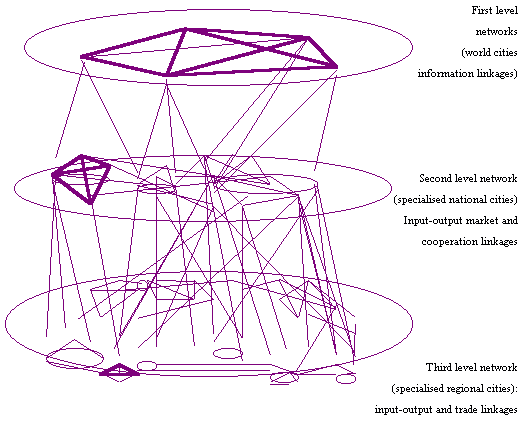 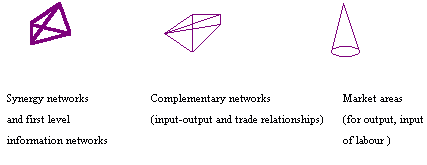 Figure 1. The hierarchy of city-networks according to Camagni (1991) Camagni (1991) proposes that network logic will replace territorial logic and territorial differences are losing its importance in the conditions of rising mobility. Network logic is important only for limited amount of people. Usually, long-route track drivers use more transport corridors names than geographical places where highway density is higher or geographical distances are longer. But the transnational airway networks it still important for only limited amount of people in everyday life. Urban networking is too simplified approach to question of urban development, because even main transnational physical infrastructure as roads, transport linkages or buildings still representing spatial or territorial logic. Capital concentrates around urban areas even though when technology is quite equal both in urban and rural areas. Network is simplified model to illustrate economic relations between large and small-scale enterprises. Synergy networks are not clearly connected with World cities, because big amount of creative people prefers smaller urban areas, but democratic networks in business will never come, because surplus still concentrates around some vital key-actors. Question of power relations is getting more important in urban network building. Changing cultures in urban spaces Transforming urban spaces and "new churches" in urban development Globalisation of information networks has transformed traditional urban-rural differences and inequalities. ‘Urban’ is not definitely connected with urban environment, because urban lifestyle and many traditional urban economic sectors have spread out to rural areas. Metropolitan urban centres are still important, because some key economic sectors need to have central location to attract important key actors into region. City centres are getting similar in modern urbanised countries. Similarity appears different ways in built environment where both multi-cultural services and internationalisation of national cultural heritages make differences in urban architecture and place presentation. As Peter Hall proposes: "The city as a place of congregation and interaction was far from dead: in these emerging fields, as in finance, access to privileged information was all-important (Hall 1996). Historically city centres concentrate important and expensive services. Every age has own "gods" what is important for most of people. Sometimes these activities are concentrated into visually attractive and powerful buildings. Priests were only ones who told to people about the World and very general things in the Middle Age. Church was only "global enterprise", which has very large networks around the World and they had big capital concentrations in certain religious centres. Mostly huge religious buildings represented it. Nowadays global firms are taken this place in some parts: especially in pleasure activities like cost-effective McDonalds networks etc. Visual power of building still exists, but its importance has diminished because increasing mobility, different use of space and spatial representations. Increasing importance have some top officials who could present their ideas through media or trade marks which should present firm in interesting way and what is easy to remember. Big changes have happened peoples use of everyday life routes and even their use of urban landscape. Office locations in city centre are still important, but there’s no need any more for big office space in very expensive locations. If firm clients do not use its services in local landscape then office’s visual power is not so important any more. Media space and its production of urbanisation Media and urban are connected with very strong ties, because only some little minor media production enterprises situating in rural areas or even in smaller urban areas. Media represent mainly (young) urban cultures and its impact to rural population can be very different even though when people lives in very different Worlds during real life and watching TV. These developments could give important impact to further urbanisation or urban lifestyles in long term. People use of time is going to be more centred around media. Usually capital concentration producing media advertisements and gives important impact to urban power relations. Global capital has more possibilities to produce better media product because capital concentration and more cost-efficient for large-scale product. Most newspapers (small, suburban papers are occasionally an exception) profit primarily from increasing their circulation and therefore have a direct interest in growth. As metropolis expands, the newspaper can sell a larger numbers ad lines (at higher per line cost) on the basis of a rising circulation base; TV and radio station are in similar situation (Logan and Molotch 1996). Globalising urban culture and local cultural context Global culture is hard to define easily because it appears in very different ways, but in this case global culture is defined as product what is spread up all around the World through art, media or fashion services and easy to understand most of people. Good language abilities give possibility to get it from primary source and disable possible misinterpretations in local cultural context, but deeper cultural interpretations still need to understand full context and background. The cultural economy of the cities induce high-levels of economic innovation and growth, though not always or necessarily simultaneously. As we enter the twenty-first century, a very marked convergence between the spheres of cultural and economic developments seems to be occurring. This is also one of the distinguishing characteristics of contemporary urbanisation process in general, as Molotch (1996) propose. As capitalism globalises, moreover, the geographic specifity of the cultural economy of cities becomes, if anything, yet more pronounced because (in the light of the observation of Adam Smith (1776, 1970) that "the division of labour is limited by the extent of the market") globalisation enhances the possibilities of vertical disintegration, productive agglomeration and specialisation (Scott, 1988). Our task now is to assess the empirical meaning and theoretical logic of these phenomena (Molotch 1996). Growing importance have cities short-term `mental experience’ in the conditions of rising mobility through transportation and virtual connections. Peoples are commuting between international and national events place image is developing during some days or even hours and some positive or negative details will shape all the experiences about the concrete place. Global governance and globalising identities Last decades has increased institutional and economic globalisation. Wider scale working possibilities strengthen supranational identity development in European, American, Asian or previous Soviet action space. One important tool in identity enlargement is regionalisation of satellite media channels. Emergence of regional cooperation areas inside of Europe has developed through European integration institutionalisation from different historical co-operation areas. Co-operation around Baltic Sea stands into two significant historical networks: previous Hanseatic and Nordic cooperation areas and environmental cooperation. Estonia in post-Soviet urban development context Estonia’s location in the Northern Europe Information industry and telecommunication sector has been quite successful in Nordic countries and usually most of people are dependent using telecommunication networks because long distances. These new possibilities (mobile telephone networks, internet services etc.) are more cost effective, flexible and mobile to provide just-in-time and just-in-case services. Appearance of virtual firms gives even small enterprises possibilities are competitive in international markets. They are very cost effective, mobile and flexible providing high quality services. Estonia has similar conditions where long distances, big territories and small population shapes pre-conditions and modes for further economic developments. Nordic people usually prefer more room around them and are not satisfied to live in very concentrated locations. Estonian most urban and industrialised locations experienced big migration flows from previous Soviet Union areas and it shapes recent conditions for further urban development and makes different from other Nordic experiences. During last fifty years the number of Estonians dropped from 97% to 61% in whole population. This forced migration through Soviet imperialism tradition was important factor in appearance building up several nation states after collapse of Soviet Union. Relatively closed borders to East have replaced recent closed borders to West. Borders, territories and regions and national identity construction Central and East European and Baltic countries are living in challenging transformation period. Appearance of new nation states as "national containers" in Baltic countries is globalisation point of view process what seems to going backwards to "old ideals". Former agricultural society has limited mobility and spatial imagination. Agriculture in early 1980-s in Soviet Union based in big agricultural companies and was most developed and "internationalised" economic branch because big governmental subsidies, small transport costs and comparatively big salaries. Something significant has happened in defining Estonian rural identity in late 1980s. Tim Unwin marked in Estonian identity studies "During the latter 1980s, the independence movement relied heavily on past symbols and conceptualisations of Estonia’s former identity (Unwin 1998)". Independent movement really based on going back to old 1920-30-s Estonia’s ideals when Estonia was independent country, but it was starting point for some other developments that differed from these developments. All these developments which shaped national economic environment had something common: opposition to both colonial-economical practices from previous Soviet Union and Western countries. Estonian Land Reform was developed under old ideals where people got back their small, destroyed farms. Big foreign investments from Western side shaped mainly limited parts in urban spaces, which differed markedly from small farmer and other national economic activities action spaces. Enlarged agglomerations Estonia has successfully entered into international market during last ten years. Foreign investment rate per capita is one of the biggest comparing other CEE countries. Economically Tallinn haven’t equal partner in Estonia and fast developing connection with Helsinki and other major metropolitan areas in BSR has gave to Tallinn better advantages to develop international business. Global investments seeking mainly bigger urban areas and this influence is quite important in developing Estonian urban space. This process could support "enlarged agglomeration" hypothesis depending different entrepreneurial spatial imaginations. National agglomeration has partly replaced by international urban network building. During nation state building these two processes were quite strictly divided from each other, because it was clear border between national and international capitals. Last developments has shown that national and international starting to cooperate with each other to reach better outcome and mainly international capital tend to smelt into national framework. Three Tallinn agglomerations hypothesis Traditionally state institutions are divided between hierarchical system in international, national, regional and local scales. Economical action space are usually seen the same hierarchical system as global international economies, dependent national economies and more dependent rural economies, mainly agricultural sector. Recent developments in telecommunication sector have changed these power relations both institutional and economical hierarchies. Estonian case all these hierarchies between scales were reality in late 1980s and even deepened in early 1990s. Unequal positions and possibilities shaped clear borders between economic activities and deepened differences between national urban-rural and international-national urban economies. Decreasing mobility in rural areas and small possibilities to participate independently in international economic space shaped different movements and oppositions to development of spatial power relations. Changing power relations lead economic equalities between regions where main characteristics were differences between people’s incomes, mobilities, and business climate. Recent development has shown significant change in these conditions. "Survey of Regional Investment Climate" in Estonia pointed "large differences in general investment climate across counties" (The Phare Estonia Regional Development Project 1998). Survey data shows some invisible changes going on entrepreneurial preferences. Telecommunication sector is marked as the most important factor in investment climate improvement and service quality conditions are one of the smallest between regions. It is important pre-condition for equalising regional differences, because it improving both information exchange mobility and business climate. Background studies for "Three agglomeration hypothesis" Empirical data for current studies were gathered during 1994-1997 in Tallinn city, its surrounding areas and Tartu city centre. Data were collected from various research and administrative institutions. Distance between Tartu and Tallinn cities is less than 200 km and they are two main urban centres of Estonia. Tallinn is main metropolitan area, which includes almost 30% of entire Estonian population (almost half a million), Tallinn receives more than 70% of recent foreign investments. Tallinn’s surrounding areas experienced fast development in almost all directions in the end of 1980-s. In the situation of agricultural priority big agricultural companies created new jobs and built good residential infrastructure. It challenged quite interesting process in which workers commuted from Tallinn to surrounding areas. Fast changes in national priorities took place in 1990 when Estonia got independence from Soviet Union. Interest of capital came back to city centre for developing new services, business facilities and urban infrastructure. Surrounding communities were still waiting for continuous population migration from Tallinn’s concentrated suburbs, but limits to build up good local infrastructure let these plans to remain staying only on paper. Deep social and economic segregation and changes in public transport intensity divided possibilities to direct growth into rural areas. Post-Soviet urban development Urban development patterns and policy in Tallinn city and its surroundings Local agglomeration development During last fifty years the Tallinn was Soviet periphery with closed access to Europe. City planning ideology was imported from Soviet Union. Geographical location between Western and Northern Europe and Russia has shaped both political and economical conditions in both past and present. Main characteristics and ideals of Soviet planning were different from that in Western cities where Garden City concept was dominating until 1970s. Tallinn’s hinterland area’s population grew faster than the city’s population, but it wasn’t caused either by such planning policy or "overspill". It was caused rather by the growth of big agricultural companies (sovhoses, kolhoses) in city’s hinterland. Former Soviet cities have found themselves in a new situation during last years. Metropolitan development directions have changed because of the economic collapse in most of the former Soviet Union area. Soviet planning background and current transition from planned economy to market economy are giving reason to compare different on-going processes which those which happened in Western World in 1960-s and 1970-s. Those processes include suburbanisation of people and industries, land price level rise in inner city area, and rise of service sector (Rei 1996 a,b). Estonian and Nordic metropolitan development Estonian cities have experienced development through Soviet city concept after the Second World War when Estonia belonged to the Soviet Union. Differences between Soviet and Western cities’ inner and outer structure development appeared in ideological purposes level (Rei 1996a). Strict differences between urban and rural areas which started to equalise inside 1950-60 suburban process in Nordic countries and developed Western countries, stayed in the same level in Soviet World until late 1980s. Table 1. Tallinn’s and Scandinavian agglomerations development. (Tallinna aglomeratsiooni arengusuundi 1995) Last development data shows differences between Nordic and Tallinn’s metropolitan areas, where all areas in Nordic countries are more attractive to people when Tallinn’s metropolitan area losing people. Official population rate does probably not illustrate the processes going on in Tallinn city development because of several reason like liberal legal base for residential registration, ‘statistical suburbanisation or ruralisation’ when people are registering in rural areas in order to avoid higher communal taxes. Table 2 Tallinn’s and Scandinavian agglomerations comparative analysis. (Tallinna aglomeratsiooni arengusuundi 1995) Other important development in city hinterland is ‘hidden suburbanisation’. Many people had summer cottages inside and outside the city borders and are now starting to rebuild it to ordinary houses (Table 3). It resulted in situation of some unofficial population living entire year in suburban communes. But size of the process is very small comparing whole Tallinn city size. Some new residential districts are showing slow development, but total numbers are still very small to talk about big suburbanisation processes like it was in Nordic metropolitan areas in years 1960-80. Table 3 Official population 1.1 1994/95 and unofficial additional population living in summer cottages (community leaders opinion)
One possible reason is that even relatively rich part cannot afford to build private house to suburban areas (Figure 2). Settlement system was quite stable, because relatively small amount of new buildings. 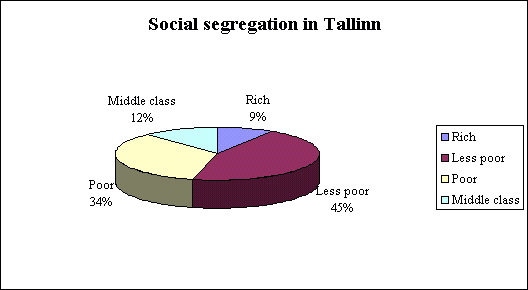
Figure 2 Social segregation in Tallinn city (Tallinn Urban Research Institute 1995) Another reason for the change could be change in residential and cultural preferences. Because of the new services in city centre it becomes a more attractive living place. Suburban infrastructure and service facilities are still quite bad and surrounding communities are rather weak to develop better welfare infrastructure. Several telecommunication, information and pleasure services are better developed in central city suburb districts and these services are important in determining of residents’ preferences and behaviour. Big residential districts inside city limits have ugly urban environment, but well developed cable TV or other communication services and younger people prefer to live there. Residential patterns in Tallinn surroundings Rae and Kose communes are situated in Tallinn city hinterland in direction to Tartu city. Rae commune is the closest one to Tallinn inner city comparing with other surrounding communes while Rae commune attractiveness is not as high as it is in coastal areas. Rae and Kose communes include most important characteristics that illustrate all surrounding areas of Tallinn and they are good reference areas to help generalise larger scale processes. Following models(Figures 3-6) show opposite directions that came out from official statistics is situation where Tallinn and its surrounding areas lost big amount of population 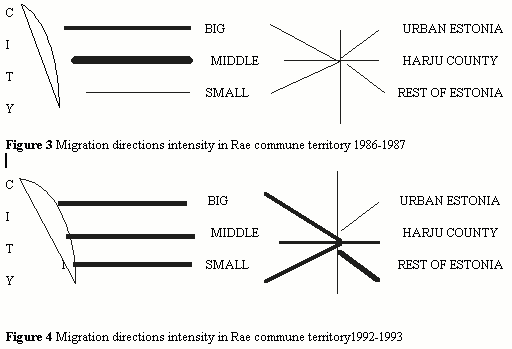 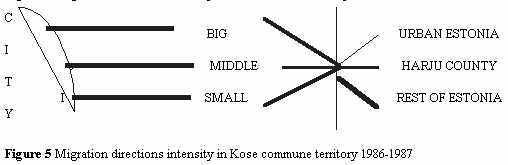 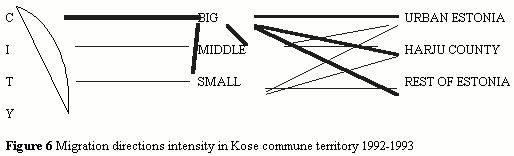
Significant change has happened in residential behaviours before and after the collapse of the Soviet Union. People are concentrating into bigger urban centres in surrounding areas, but distance from city centre is more important in residential preferences than it was before. One possible reason for this is fast economic restructuring in Tallinn surrounding areas. Decreasing of primary sector employment and rising service sector (Table 4) are important sources attracting more people to live in surrounding areas, in more urbanised areas. Table 4 Changes in Economic sector in Tallinn and Harju county 1989-1995 (%)
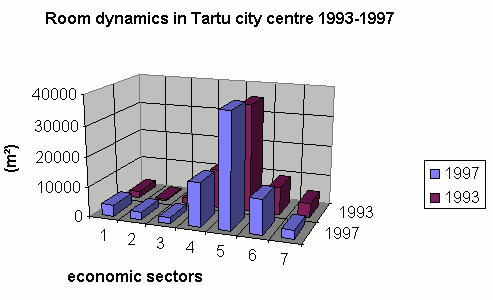
International investments in Tallinn city area International agglomeration development For several years since the collapse of the Soviet Union Estonia has been relatively attractive place for foreign investments. This impact is important for analysing of enterpreneural behaviour in city landscape and for analysing of metropolitan development. In July, 1994 there were more than 7600 foreign companies registered in Estonia. They formed almost one tenth of all enterprises in Estonia, 40% of all privatised large-scale enterprises are owned by foreign investors. Sweden and Finland are the biggest foreign investors comprising together 45,3% of total foreign investments. This makes Estonian economy dependent on economic trends in these particular countries (Harter 1997). Many enterprises in Tallinn have more oriented to closer international markets than to national market. For them it’s easier to find good export conditions because of several competition advantages. Big population and industry migration to outside of Tallinn city has not happened and only few secondary small industries have found good location in outer suburban areas. Reasons for this are missing or unsuitable physical infrastructure, too big needed investments to create infrastructures and small differences in prices of land. Overall situation of big industry is not the best and they don’t have enough capacity to invest to suburban location. Tallinn port is the only area where development is faster than in the city. One major fast developing high technology industry "Elcoteq" (producer or assembler of mobile telephones, modules etc.) preferred location close to city centre because of better public transport facilities, skilled workforce and better organisational conditions (access to ports, airport, etc.). Some primary sector and furniture industries have moved further towards inland, but their importance is in secondary position in total investment rate. Comparative analysis in Tartu city and Tallinn suburb National agglomeration development Tartu is Estonian inland city with 100.000 inhabitants. The most important development factor for the Tartu has probably been the university. Tartu’s academic environment, inactive development policies up to last years and quite bad access to international market have deepened economical differences between Tallinn and Tartu. Investments to built environment of Tartu have dropped dramatically since the collapse of the Soviet Union and foreign investments have been in secondary position in city development. In these days lot of development projects are oriented to attract Tallinn’s capital to come to Tartu, but economic restructuring is still slow (Figure 7). Main financial, governmental, media and research institutions are concentrating around Tallinn city economy and are producing Tallinn-centred information. Even the biggest South-Estonian daily newspaper "Postimees" recently moved its headquarters from Tartu to Tallinn. Tartu could still be an attractive living environment for urbanised Estonian society because of smaller urban size, better residential balance and high level of services. Since the Second World War Tartu city doesn’t have strong and attractive city centre, main business districts were divided into several suburban locations. Recent development has shown that the capital is coming back to the city centre.
1. Bureau 2. Finance 3. Administrative 4. Retail 5. Culture, education 6. Service 7. Other, unknown Figure 7. Room dynamics 1993-1997 in Tartu city centre National dependency or international development In the mirror of global industrial restructuring it seems that Tartu is having a challenging position. Big knowledge potential opens up good possibilities for spin-off of R&D activities in co-operation with the University of Tartu research facilities. "The best outcome of Tartu Science Park is the fact that it still exists" noted previous pro-rector of the University of Tartu. Tartu city government interest to invest into the Science Park has fallen dramatically during last years. One possible reason for this is its "invisible" peripheral location in city’s suburb. Tartu should develop its own business to be competitive in international market and use its knowledge potential. High-level technology, knowledge-based business and industries are possible sources for fast development in future. Conclusion Estonian economy had been very quickly re-oriented from Eastern to the Western markets. This change brought big changes especially to service sector economies. Computers, fastened information mobility and telecommunications services have influenced Estonian urban space and lifestyles in very different ways. Economic and social transformations from planned to market economy changed capital flows directions, where capital accumulation back to the city centres and economy internationalisation has influenced Estonian urban structures. Changes in urban cultures and institutional-economic power relations in different urban spaces need to analyse in larger scale. Significant changes defining new spatial scales for urban economies behaviours need to consist both global and local impacts. Although Estonia have not experienced big metropolitan suburbanisation it cannot exactly follow all those processes which happened in developed countries in 1950-s and 1960-s. Still, fast growth of private cars ownership, disappearing of the strong Soviet housing structure, growing of prices of city apartments and active renovation of summer cottages in coastal areas could cause big suburbanisation in Estonia. Small amount of rich and middle class people, small unemployment rate in the city compared to one in hinterland, relatively small investment rate to hinterland and limited land market compared with Western cities in 1960-s makes large scale suburbanisation impossible in such large scale as it took place in developed Western World. New technologies are some kind of "invisible forerunners" leading these processes and makes it similar to latest developed countries experiences. Strict differences in spatial imaginations between different population groups are getting smaller and better access to information exchange diminishing differences between local and global enterprises competition advantages. Information and telecommunication sector is not the only important development factor in Estonian urban spaces, but this impact is important for long-term development. Fast changing technologies are significant promoters for further urbanisation even changing conditions allow working in rural areas. Hierarchy in information networks building still exists and makes it more cost-effective for urban users. References Camagni, Roberto (1991) "Innovation Networks", London: Belhaven Press Castells, Manuel (1988) "The Informational City: information technology, economic restructuring and urban-regional process". Oxford:Blackwell Publishers Castells, Manuel (1996) "The Informaton Age: Economy, Society, and Culture, vol. I, The Rise of the Network Society, Oxford: Blackwell Publishers Dicken, Peter (1998) "Global shift: transforming the world economy", 3rd ed., London:Paul Chapman Publishing Ltd Foucault, Michel (1984) "Space, Knowledge and Power" in "The Foucault Reader", Toronto: Pantheon Books Goodall, Brian (1987) "Dictionary of Human Geography", London: The Penguin Keith R. Ihlanfeldt (1998) "The Importance of the Central City to the Regional and National Economy: A Review of the Arguments and Empirical Evidence" in Cityscape: A Journal of Policy Development and Research" Vol.3, Number 3 Jauhiainen, Jussi S.(1998) "Urban Planning and Built Environment", 3rd revised edition Jauhiainen, Jussi S., Rei, Mait, Pikner, Tarmo (1997) "Tartu linna üldkeskuse piiride määramine ning funktsionaalne tsoneering", Research report, Tartu: Tartu City Government (in Estonian) Hall, Peter (1996) "Cities of Tomorrow: An Intellectual History of Urban Planning and Design in the Twentieth Century " Updated ed., Oxford: Blackwell Publishers Harter, Michael (1997) "Estonia: Eastern Europe’s Success Story? A Transition Process and its Regional Implications, Department of Geography, University of Toronto Harvey, David (1989) "The Condition of Postmodernity: An Inquiry into the Origins of Cultural Change", Oxford: Basil Blackwell J. M. Herington(1984) "The Outer City", John Wiley&Sons, London Kaldor, Nicholas. (1970). "The Case for Regional Policies," Scottish Journal of Political Economy, vol. 17, pp. 337–347. Kitchin, Robert M. (1998) "Towards geographies of cyberspace", Progress in Human Geography 22,3 pp. 385-406 Kliimask, Jaak, Rei, Mait (1995) "Tallinna aglomeratsiooni arengusuundi", Tallinn: Estonian Institute for Futures Studies (in Estonian) Kliimask, Jaak (1997) "Economic Transformation in Post-Socialist City: The Case of Tallinn" in Åberg, M., Peterson, M. (eds) "Baltic Cities: Perspectives on Urban and Regional Change in the Baltic Sea Area" Lund, Nordic Academic Press Lefebvre, Henry (1991) "Production of space", London: Blackwell Logan John R., Molotch, Harvey L. "The City as Growth Machine" In Fainstein, Susan, Campbell, Scott "Readings in Urban Theory", Oxford : Blackwell Publishers Massey, D. (1995) "The conceptualisation of place" in D.Massey and P.Jess (eds), A place in the world? Oxford: Oxford University Press Molotch, Harvey (1996) "LA as product: how design works in regional economy". In A,J.Scott, and E.Soja (eds.), "The city: Los Angeles and urban theory at the end of the twentieth century", Berkeley: Los Angeles, p. 225-75 O’Sullivan, Arthur. (1993). "Urban Economics". Homewood IL: Irwin. Rei, Mait (1996a) "Tallinna aglomeratsiooni arengusuundi", bachelor thesis (in Estonian) Rei, Mait (1996b) "Restructuring Tallinn’s Agglomeration: A Case Study", proceedings of the VIII EGEA Congress in Vilarinho das Furnas, Portugal Rei, Mait (1997) "Creating local development politics for post-soviet small town", paper presented in post-graduate seminar "Urban growth machine", Turku, January 1997, http://www.ut.ee/~rei Rondinelli, Dennis A., Johnson, James H., Kasarda, John D. (1998) "The Changing Forces of Urban Economic Development: Globalization and City Competitiveness in the 21st Century" in "Cityscape: A Journal of Policy Development and Research" Vol.3, Number 3 Smith, Adam (1776, 1970) "The wealth of the nations", Penguin Books: Harmondsworth Tallinn Urban Research Institute (1995)"Tallinna linnaelanike osalus linna arengu kavandamises", Research report, Tallinn (in Estonian) The Phare Estonia Regional Development Project (1998) "Survey of Regional Investment Climate", Report, Tallinn: Ministry of Economic Affairs Unwin, Tim (1998) "Rurality and the construction of nation" in Pickles, John, Adrian Smith (eds) "Theorising transition: the political economy of post-communist transformations" London, Routledge | ||||||||||||||||||||||||||||||||||||||||||||||||||||||||||||||||||||||||||||||||||||