|
Karin Peschel 1. Introduction Regional (institutional) integration, which has been on the European agenda since decades received a strong push by the fall of the Iron Curtain. In the beginning of the 90es the Scandinavian EFTA countries joined the EU, and negotiations on EU membership of some of the earlier socialist economies have started recently. Besides, the project of an European Economic and Currency Union is well under way - although confined to 11 states only. Not amazingly, as a response to an EU encompassing most of Europe, manifold initiatives for cross-border cooperation arose in various parts of the EU territory, aiming at the building of „sub"regions. One well known example are the Mediterranian countries. In the Nordic countries and in Germany, especially in Schleswig-Holstein, the idea of a Nordic economic area, a Baltic Sea region, a Hanseatic League or however it was called, became prominent. That was not a surprise because the economic fate of the reform countries along the south-eastern rim of the Baltic Sea is of special interest for the Nordic countries and Germany. Correspondingly, since 1990 strong efforts oriented toward political and economic cooperation in this area were made. Meanwhile many organizations and cooperative institutions have been established for example the Council of the Baltic Sea States. As it will be proved later, the intensity of integration between various regions within such a extensive territory as that of the EU varies. However, there is the question if the formation of a Baltic Sea „club" of EU members is an economically vivid concept - even if it is strictly in line with EU regulations and goals - and intertwined with that - which of the states should become a member of this club. I think it is of crucial importance for the answer, how much the actual regionalisation of economic acitivities in western market economies can be influenced by administrative regulations or whether it is predominantly driven by market forces. And in case of dominance of market forces, whether they work in favor of a Baltic Sea region. Certainly, both elements are interdependent. Market forces are working within an institutional and political framework, whereby the latter is undergoing constant changes, and depend on infrastructure of various kinds. Thus, market forces can be strengthened or hindered by political factors.When they are hindered, economic inefficiencies arise. Especially in case of the reform countries, there does exist a scope of actions, because the legal and institutional framework of a market economy is not yet completely developed. However, in the EU the scope of actions for political actors aiming at transnational region building at an EU-sub-level is tight: First, because the EU-Commission puts strong pressure on the political and institutional development of all regions in the EU. From the outset, the European integration process has been driven by economic programmes, especially supporting free trade, aiming at an internal market for goods and services and for productive factors in all member countries. Beyond this, the economy has always been regarded as a motor of political integration. The Economic Union may be visualized as a strategic bottom-up project directed at enforcing a political union. The second reason for a tight scope of political actions is that market forces are characterised by world-wide trends, which pose similar challanges on almost every economy. These trends are: 1. fast and comprehensive technological progress, 2. globalisation of production and markets, i.e. fast increase of trade in goods and services and international capital flows, which imply transfer of technology, of corporate behaviour and strategies, 3. migration pressure because of world-wide raising supply of unskilled labour. In all industrialised countries these trends have global impacts on the market for the less skilled labor force, either enforcing wage decline or unemployment, and upgrade the skilled one, thus enforcing similar political strategies and actions. All these considerations taken together, I arrive at the hypothesis:
In democratic market economies political actions aiming at
region building at a transnational, yet sub-EU-level, can only
be successful if they are in line with the regionalisation of
economic activities driven by economic forces inherent in the
market mechanism, and if they are sustained by an adequate institutional
and legal framework.
In the following, I will begin with a theoretical discussion of
those elements which are in favor of region building on a transnational
level (section 2). Afterwards, the actual development of international
trade in the Baltic Sea area, which can be regarded as an indicator
for (sub)regions coming into existence, will be presented. In
this context a measure for the degree of integration between various
regions and a method for identification of economically highly
integrated regions will be suggested (section 3). Finally, some
implications for economic integration in the Baltic Sea region
are discussed (section 4).
Let us start the discussion with the definition, that I have suggested
earlier: An economically highly integrated area (an economic space) is a region, of which the economic agents are more strongly related to each other than to those of other regions. Such relationships are cause and consequence of trade and capital flows, of the transfer of knowledge and technology as well as of the various forms of communication. They tend to mutually reinforce each other. As it will be proved by empirical data in section 3, the EU member states form an economic space in line with this definition. Certainly, the intensities of interrelation- ships differ between the various members of an economic region. Correspondingly, there exist economic regions (spaces) of different degrees of integration.
According to the definition above, integration is promoted by
those elements, which are working in favor of strong mutual relationships
in the form of trade and commerce, transfer of knowledge and of
technology, mobility of people etc. What are these elements? As
it can be detected in econometric studies there are
four groups of factors which favor international interactions.
What can be said about these elements in case of the countries
bordering the Baltic Sea? Do they promote integration?
Distance and adjacency seem clearly to favor strong mutual relationships among the countries along the Baltic Sea because of their geographical position and because of comparatively cheap sea transport. However, one must also take market size into consideration. Substantial differences in market size exist around the Baltic Sea. Poland is with 38,6 million inhabitants after Germany with 82 million the biggest country by population size, followed by Sweden with 8,8 million inhabitants . Estonia is the smallest one, having just 1,5 million. Additionally, in Germany as well as in Poland the big industrialized regions are not located at the Baltic Sea. There will occur even greater differences if purchasing power is taken into consideration, too.
Market size in combination with adjacency should have negative
impacts on the formation of an economic space comprising all regions
around the Baltic Sea. The reason is that the prosperous German
regions are part of the western European economic core, thus having
their main economic links with their west-European neighbors,
and that Poland's industrial centers are mainly located in the
south-west of the country, thus having much smaller distances
to Germany, Austria and the Visegrad countries than to the North
of Europe.
However, considerable ethnic differences in culture and language
do exist. Whereas it may prove right to speak of a common Scandinavian
identity, the fate of a feeling of regional identity in the Baltic
States has yet to be decided (Zydowicz, 1995). Without any doubt,
the path leading to it would severely be hindered by splitting
the Baltic States into member and nonmember countries of the EU.
Including Poland and Germany into the analysis, I propose the
thesis that "regional identity" surrounding the Baltic
Sea is not a factor which promotes integration. At best, it may
develop during an ongoing integration process.
The very low level of income in all Baltic rim reform countries compared to the „western market economies" along the Baltic rim is confirmed by international statistics. Comparing figures using purchasing power parities reveals that Estonia's and Lithuanias's GDP per capita have been less than one fifth (around 16 p.c.) of that of Sweden in 1996, and that of Latvia was even lower, namely only 13 p.c.of the Swedish one. The differences are even higher if the calculations are only done by exchange rates.
Although Poland and Estonia are ahead of the others countries,
they still have a long way to go before strong similarities in
social and economic life can be attained. Even in an optimistic
scenario, the Institute for Regional Research of the University
of Kiel has estimated that their GDP per capita in 2010 will lie
far below the EU average. I think no discussion is needed to argue
that the Russian regions facing the Baltics do not fulfill the
demands of element 3 „similar patterns of social and political
life" listed above. The best we can hope for is that the
cities of Kaliningrad and St. Petersburg will achieve a certain
degree of economic independence of the Russian Federation and
thus will strengthen the economic linkages with the Baltic Sea
area.
3. Actual development of international trade According to my definition, an economically highly integrated area is characterised by strong mutual relationships among countries belonging to this area. Thus, we have to quantify the relationships, which we think are important and to cluster the countries according to the strength of those relationships to identify transnational regions of high degree of integration. Unfortunately, the data bases for transborder activities is small. Nowadays, only trade statistics satisfy the respective demand. However, foreign trade is the most important transborder activity of all, because in open market economies foreign trade is one of the main sources of income and economic welfare. This is reflected by the European integration process primarily aiming at an internal market for goods and services. I think this statement holds still true although foreign direct investment (FDI) stronger increases than international trade nowadays. However, FDI predominantly aims at the expansion of markets for products and services, therefore international trade and FDI are highly correlated. In Table 1 exports and imports of all states bordering the Baltic Sea are given for 1996. Unfortunately, we do not have sufficient trade figures to seperately analyse the St. Petersburg and the Kaliningrad regions, the 10 „voivodships" and the German „Länder" bordering the Baltic Sea. This may be misleading , because only a small part of Germany's „Baltic Sea trade" deserves this label, as a look at the trade statistics of the German regions bordering the Baltic Sea shows. The highest trade links are to be found between Schleswig-Holstein and Denmark. 24,8 p.c. of Schleswig-Holstein's imports and roughly 8 p.c. of its total exports are linked to Denmark. All other German regions export less than 5 p.c. of their total exports to any other foreign Baltic Sea region. The import shares are a bit higher. Here, Mecklenburg-Vorpommern is ranked first with almost 15 p.c. of its total import coming from Denmark. All other import shares are below 10 p.c. The same observations may hold true for Poland and Russia. E.g. we know that the Kaliningrad and the St. Petersburg regions contribute only around 2 p.c. to Russias total exports. On the other hand , of the German regions bordering the Baltic Sea Mecklenburg-Vorpommern holds with 3 p.c. of its exports and 12 p.c. of its imports the highest shares in trade with Russia. A distinct picture of trade links (exports plus imports) in the Baltic-Sea area is given in Figure 1. Here, exports and imports of the three Scandinavian countries Sweden, Denmark and Norway are summed up. Thus , the overwhelming dominance of the trade links between the Scandinavian countries and Germany, generating a trade volume of 52,2 billion USD in 1996, is to be seen. .A deeper insight into trade statistics (see Table 1) proves that in absolute terms Germany and Sweden are the dominant trade partners in the Baltic Sea region. Figure 1 reveals that the second largest trade volume of 17,3 billion USD is that between Poland and Germany, and the third largest of 11,8 billion USD that between Finland and the three Scandinavian core countries. In contrast with that, the trade volume of 18 million USD between the three Baltic States is low. Figure 2, which represents only trade links with the three Baltic States, Estonia, Latvia and Lithuania, shows that intra Baltic States trade is not intense. Estonia's exports are predominantly oriented to Sweden and Finland, those of Latvia to Sweden and Germany, whereas Lithuania's most important export marakets are Germany and Russia. Estonia imports most of Finland and Russia, Latvia and Lithuania of Russia and Germany (see also Table 1). Comparing trade statistics of 1996 with earlier ones reveals an intensification of Baltic trade of almost all states bordering the Baltic Sea and a strict disengagement of the former Soviet Union. Obviously, Baltic Sea trade is of different importance for the various countries. This can even be better seen when we compare Baltic trade with total trade in every country. The data in Table 1 reveal that the percentage of exports from Germany to the other Baltic Sea states is only 15 of Germany's total export, whereas the respective number for Sweden is 50 p.c. The highst percentage can be found for Estonia with 61 p.c. of its total exports going to the Baltic Sea states. On the other side, we find that in Germany 18 p.c., in Sweden 54 p.c. and in Estonia 77 p.c. of imports originate in the Baltic Sea states. Taken altogether, Baltic Sea trade seems to be especially important for Estonia and Finland. Export- and import shares have two disadvantages when used to judge the importance of trade links. First, the rank order of export- and of import shares differs. Second, no one will be amazed that Germany's share of exports going to the Baltic Sea area is only 15 p.c., when the size of the German economy in comparison to the size of the other Baltie Sea states is taken into consideration (Germany had 82 million inhabitants, the Nordic countries 23 million, the Baltic States 8 million in 1995). And furthermore, simply because of size it is to be assumed that Germany's exports to Sweden are higher than to Estonia. On the other hand, we can assume that Germany imports more from Sweden than from Estonia, simply because Swedens's total exports are much bigger than Estonia's (they are about 21times higher). Thus, absolute trade figures would always propose that countries with bigger markets trade more with each other than with smaller ones. These considerations lead back to the central question of this paper. Can we say that two regions are especially highly integrated with each other when their absolute trade volume is especially high? The consequence of such a proposition would be that a small country like Estonia would never be judged as highly integrated with a large country, even if it should completely depend on the large one, e.g. because the large country is the only supplier of its imports and also the only buyer of its exports. Thus, the problem which comes up is the so called size effect problem, which has to be solved by an adequat method in analysing the trade matrix given in Table1. Accordingly, the definition given earlier has to be qualified as follows: Two countries are higher integrated with each other than with a third one if their mutual trade relations are higher than it could be expected merely because of size (e.g. if Estonia would import more of Sweden than of Germany). An adequate approach has to take the size of all countries represented in the trade matrix into consideration, e.g. the share of Germany's exports going to Estonia depends not only on the size of Germany's market and on the size of Estonia's market, but furthermore on the size of all other countries, which are (potential) buyers of German products. In earlier papers we have suggested to apply the RAS method to correct for size effects. This can be done by adjusting the actual trade matrix
to a constant sum The normalization rule of the RAS method requires that the value of the normalized trade flow between two countries, xij, remains unchanged if country i e.g. doubles its exports to any other country and country j doubles its imports from any other country. The elements of the normalized trade matrix assume values between zero and one hundred. The extreme case, xij = 0 indicates that there are no trade flows between countries j and i, and the other extreme case, xij = 100, means that country i exports only to country j, and country j imports only from country i. Thus, the value of an element is a measure of the intensity of integration, which assesses the importance of a single trading partner for any other country, with its economic size duely taken into account.The measurement results of the RAS method can be termed bilateral integration measures. They show how strongly each pair of countries is integrated by trade flows after the figures have been corrected for the different sizes of all the trading countries. Instead of analysing the normalized trade matrix itself, which is cumbersome, we will use the statistical technique of cluster analysis and thus delineate (groups of) countries,which are more strongly connected by international trade than could be expected merely by market size. The results of the grouping procedure of cluster analysis can be visualized in diagrams. As has been stated earlier, in general in an economically highly integrated area the degree of integration , measured by the strength of the normalized trade flows, varies between each pair of countries. This is quantified by our bilateral integration measure. Beyond this, in our context a measure for the degree of integration of all countries belonging to the same integration area has to be developed. Such a multilateral integration measure has to be selected from a large variety of possible measures according to the required structure. An integration area, for example, may be viewed as a group of countries with strong mutual trade interdependencies or as a circular group of interdependent countries. The degree of international integration may then be quantified by taking the smallest or the average value of the relevant trade structure. These are two simple indices. Furthermore, integration areas may be assumed to be hierarchically ordered or they may be designed as the overlapping layers of different levels. In the following, only the results obtained from the measure, which seems to be the best in reflecting our concept of an integration area and in revealing changes in the spatial structure of international trade, will be presented. It is based on the mutual interdependence gained by international trade and gives rise to the hierarchical clustering of the countries according to their strength of integration. It measures the degree of integration by the critical value of the smallest normalized trade flow between the member countries. This method is called complete-linkage clustering procedure.
To illustrate these ideas about multilateral measurement it is
useful to define an integration area as a complete subgraph of
the normalised international trade network. Integration areas
(or complete subgraphs) identified on the basis of stepwise increased
trade levels are given the value of the weakest link, that is
the critical value at which they would be further split up. This
method corresponds to the wellknown complete linkage clustering
procedure and it generates a hierarchy of integration areas for
the different years under examination.
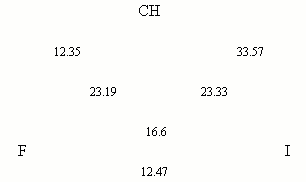 For example, in the sketch above a section of the trade pattern between Italy (I), Switzerland (CH) and France (F) in 1928 is shown. The numbers in the figure represent the bilateral integration values (the normalized trade flows) between the three countries. (The export flows of the three countries do not add up to c = 100, because the other eight countries included in the data set have been omitted). As can be seen, the trade between Switzerland and Italy is the highest clustered and they form the most integrated pair. The degree of integration of this area is measured by the weakest (critical) of their trade flows, that is by the (normalized) export flow from Switzerland to Italy. Accordingly, the value of the multilateral integration measure is 23,33. In the second step France is added to the integration area formed by Switzerland and Italy. The multilateral integration value for the area consisting of all three countries is determined by the (normalized) export flow from Switzerland to France, the value of which is 12.35. Applying the complete linkage clustering procedure to the trade flows of all European countries and the rest of the world for 1995 and 1996 results in two diagrams (see Figures 3 and 4). Groups of countries are distinguished which are more highly integrated through international trade than others and thus form an economic space. In the figures, the weakest links between countries grouped together are always shown. Taken altogether, the results of the clustering procedure are not a surprise for those, who are acquainted with our earlier studies on the spatial structure of international trade (see Peschel, 1985). Those studies arrived i.a. at the result that the regional pattern of international trade links has been highly persistent between 1900 and 1981 (the latest data we have used), whereby the impact of the rise and fall of trade barriers in the context of politically enforced disintegration and reintegration of the world economy can easily be detected. The diagram for 1981 which was based on a data set including the European market economies and the then existing two more centres of the world economy, namely North America and Japan, clearly reflects the formation of the European Economic Community (EEC). A further result of our former studies is the visibly high impact of distance and adjacency (i.e. of communiction costs in the broadest sense of the term) on the regional pattern of trade flows. The neighbouring countries have been the highest integrated ones since 1900. This especially applies to Scandinavia. The results of our cluster analysis for 1996 prove that the Scandinavian countries Sweden, Denmark, Norway, and Iceland are still highly integrated with each other. The same holds true for the core countries of the EU, namely Germany, Netherland, Belgium/Luxembourg and France, only Italy beeing excluded. In my view, the case of Italy reflects that the formation of the EEC and of the EFTA with Italy becoming member of the EEC on the one hand, Austria and Swiss of the EFTA on the other was a political decision not in line with economic efficiency. Now, after the dissolution of the EFTA, Italy is higher integrated with Austria and Switzerland than with the earlier EEC countries.This example is a prove for the correctness of my hypothesis given in the introduction. The data for 1995 and 1996 presented in this paper give some insight into the changes under way, induced by the fall of the Iron Curtain. Completely in line with the earlier results is the importance of distance and adjacency. It are the central-east European countries like the Czech Republic and Slovakia with Poland ahead, which have already dissolved their earlier strong integration with the former Soviet Union.. In 1996 they are grouped together with the western European core of the eleven EU countries, whereas in 1995 Poland, the Czech Republic and Slovakia were still clustered with the Baltic States and Russia. It may be a surprise that Finland is grouped together with the Baltic States, with Russia, Belorussia and the Ukraine in 1996 as well as in 1995. I expect that the trade pattern of Finland and Estonia will change such that both countries will become a member of the Scandinavian cluster in near future.
A global view on our clustering results again gives the impression
that distance and adjacency are by far the most important elements
constituing regional economic integration - after the impact of
the Iron Curtain was abolished.
In summarizing my arguments, I arrive at the conclusion that a Baltic Sea Region as an area of high economic integration comprising all states bordering the Baltic Sea (in my strict definition) is not easily to be visualized in the near future. On the other hand, a Scandinavian-Baltic economic space could come into being, provided Latvia and Lithuania could overcome the difficulties of their transformation processes and Russia's development stays behind. Estonia and Finland already seem to be on their way in becoming part of the existing Scandinavian economic space. Germany and Poland may orient themselves in future stronger towards the other countries bordering the Baltic Sea. However, distance and adjacency favor closer relationships with a possibly emerging middle-east European core, comprising the Visegrad countries and Austria. This developoment may even loosen the existing tight links of Germany with its western neighbours. Certainly, such developments on a state level do not exclude intensifying integration of the German and the Polnish regions bordering the Baltic Sea with a Scandinavian Baltic economic space. Adjacency is clearly in favor of such a transnational region building. However, in the past the economic relationships of border regions have never been stronger with foreign countries than with the domestic economy. And having the four groups of factors promoting (or hindering) integration in mind, one realises which tremendous efforts of political actors in favor of transnational region building have to be made to create a Scandinavian economic space encompassing German and Polish regions - although such political actions would be in line with market forces. Furthermore, it should be stressed that geographic proximity suggests that the Baltic States will still have strong links to their eastern neighbours in future because geographic proximity is in favor of those four elements promoting integration discussed in section 2. Certainly, the catastrophic economic situation in Russia and Belorussia and the prevailing anti-Sovietism set limits today. However, cutting off current economic relationships respectively not developing those would be economically inefficient.
A short remark may be made concerning the EU document „Agenda
2000", wherein Poland and Estonia are noted for membership
in the next round of European Union enlargement, but Latvia and
Lithuania are excluded. The core element of the EU is the common
market. The Commissions's decision seems to be well founded, based
on the application of the criteria „democratic performance"
and „economic situation". Nevertheless, one must ask,
whether this decision is a wise one. Is it not true that economic
forces, set free by the market mechanism, enforce the integration
of the three Baltic States with each other? Certainly, a split
of the Baltic States in member and non-member countries of the
EU cannot be reconciled with the idea of an Scandinavian-Baltic
economic space as an EU subregion with an own identity.
Beckermann, W. (1956), Distance and the Pattern of Intra-European Trade, Review of Economics and Statistics, Vol.38, pp.31-40 Geraci, V.J., and Prewo, W. (1982): An Empirical and Supply Model of Multilateral Trade. The Review of Economics and Statistics, vol. 64, pp.432-441 Lefeldt, M., Warnecke, J. (1974), Handelsintensitäten im EWG-Raum, Wirtschaftsdienst, Bd. 54.pp.408-412 Herrmann H., Schmidtke, W.D., Bröcker, J., Peschel, K. (1982).:Kommunikationskosten und internationaler Handel, Schriften des Instituts für Regionalforschung der Universität Kiel, Florenz Verlag, München Peschel, K.(1993): Perspectives of Regional Economic Development Around the Baltic. In: L. Lundqvist and L.O. Persson (Eds.): Visions and Strategies in European Integration. Springer-Verlag Berlin-Heidelberg, pp.19-31 Peschel, K.(1985): Spatial Structures in International Trade. An Analysis of Long Term Developments. In: Papers of the Regional Science Association, vol. 58, pp.97-111 The NEBI Yearbook 1998, North European and Baltic Statistics, Springer-Verlag Berlin- Heidelberg-New York, pp. 563-618 World Development Report (1997), Vol. 20, The World Bank (Ed.), Oxford University Press Zydowiez, K. (1995): The Baltic regional identity. What kind of species? In: Kuklinski (Ed.) Baltic Europe in the perspective of global change. Oficyna Naukowa, Warszawa, pp.111-115 |


 by applying the biproportional RAS-method where
  represents the export flow from country i to country j. This
approach has several advantages in comparison to the conventional
normalising methods used for the analysis of trade matrices such
as the equal exporter and equal importer approach of Beckermann
(1956) or, more elaborately, the calculation of trade intensities
on the basis of stochastically independent (hypothetical) trade
flows (U.N. 1973; Lefeldt and Warnecke 1974).
represents the export flow from country i to country j. This
approach has several advantages in comparison to the conventional
normalising methods used for the analysis of trade matrices such
as the equal exporter and equal importer approach of Beckermann
(1956) or, more elaborately, the calculation of trade intensities
on the basis of stochastically independent (hypothetical) trade
flows (U.N. 1973; Lefeldt and Warnecke 1974).