|
Christian Frederiksen, Christian Hansen 1. Presenting the Problems Most of the Nordic population is isolated from the Europan Mainland by the Baltic Sea and travel out of the Nordic area is not possible on a everyday basis simply due to distance. External border-region-problems seem therefore not important for the Nordic countries. However the Nordic area share border regions with both Germany and Russia. There is no unique definition of the range of a border region.
Hansen (1977) defines: »special problems of border regions,
which may be defined as subnational areas whose social and economic
life is directly and significantly affected by proximity to an
international border«. More recently Scott and Collins (1997)
refer to »..those whose lives are most directly affected
by international boundaries«. Delimitation of a border region
in terms of distance therefore depends on the problem(s) of interest
and on peoples normal spatial behaviour (Danish Institute of Border
Region Studies 1997). If we are concerned about travel from place
of residence to high-schools in the dense populated European
Mainland a relevant distance may be +/- 10 to 20 kilometres from
the border, whereas in sparsely populated North Scandinavia it
could be 200 kilometres or more for the same issue. Studying other
issues like job commuting, retail trade, business service or environmental
planning in different types of geographical landscapes will result in different limits.
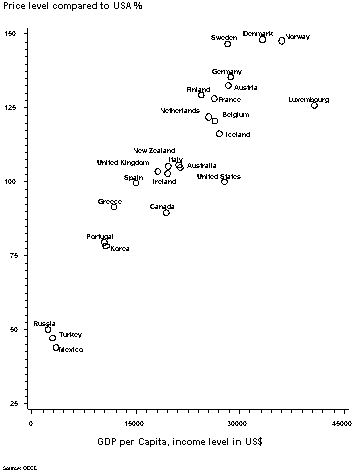 Figure 1. Income and price level in OECD countries and Russia. Delimitation of border regions can change through political, economic as well as technological factors. As a curious example, one could mention national televison whose transmitters on huge masts on hill tops near the border sometimes reached far into the neighbouring country and thus defining a border region area for TV-watching. Until the mid 1980s this meant, that only Danes in border regions had access to other television channels than the one channel provided by the state owned monopoly. People in these areas had better knowledge of the neighbour country language and culture etc. Satellites and TV-liberalisation changed this, and a special border region for the topic of TV simply disappeared. Nowadays we are all much more under the influence of Americanized satellite-TV and Internet than of the near neighbour! In this study we use a pragmatic approach in defining the two Nordic border regions. Denmark's only land border is 68 kilometres long and cross the peninsula of Jutland and divides the historical Duchy of Slesvig into a Danish and a German part. Political the border region is defined (almost) as the historical Slesvig and comprises an area +/- 60 kilometres from the border. This could be consistent with the extent of a functional area in the North European Mainland. 1/4 million people live in the Danish part of the border region, which only correspond to 5 per cent of the total Danish population. The other external Nordic land border goes between Finland and Russia and between Norway and Russia. In this case we are espacially interested in the Finnish-Russian border region of Karelia containing a Finish and a Russian part. In the Finnish part there are about 300.000 inhabitants which is about 6% of the total population in Finland. External border to the two major countries on the European Mainland means that the Nordic border regions were directly and most significantly affected by 19s and 20s century history. The wars and other political mega events of Russia and Germany throughout history have formed the two border regions. Between Denmark and Germany the present border was drawn after World War 1 and between Finland and Russia the present borderline was drawn after World War 2. In both cases former functional regions at the edge of the Nordic area were divided by international borders in the wake of main European revolutions and wars. Proxy to external borders today is a reality for about ½
million Nordic people. This figure, however, only accounts for
2% of the total population. The rest - 98% of the Nordic population
is relatively »isolated« from every-day travel out of
the Nordic area simple due to distance. National as well as common
Nordic policies therefore seldom need to consider border region
problems.
(1) Excl. Greenland, Faro Islands, Iceland and arctic parts or Norway. (2) European part Source: Statistisches Jahrbuch für das Ausland 1997. Nordic people occasionally refer to »the Nordic identity« that may or may not be different from other people's identity. Nordic Council/Nordic Council of Ministers in a brochure identifies the most important shared features as:
2. Religion (mainly Lutheran) 3. Protestantism introduced during the same period 4. Close links between church and state 5. Linguistic ties (»Scandinavian«) 6. Conception of justice 7. Long tradition of democracy 8. Extensive municipal autonomy 9. Mixed economy 10. Gender equalities 11. Social contacts 12. Welfare state solidarity 13. Structures for co-operation At external Nordic borders these features of identity, and their
subsequent importance for actual political, legal, economic and
social life meet with the features of the two major states of
the European continent: Russia and Germany. This means that possible
differences in »Nordic identity« in relation to Russian
identity and German identity must co-exist in the same geographical
space. 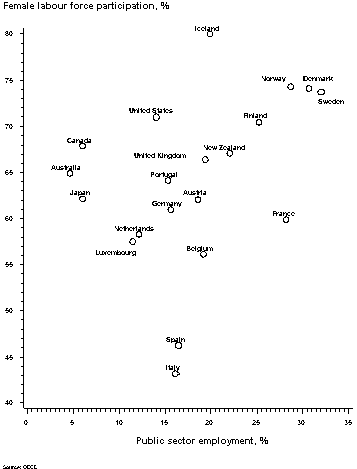 Figure 2. Public sector employment and female labour force participation, OECD countries. In general »identity« is difficult to quantify and thus to compare both between states and between regions. However figure 1 to 5 are attempts to plot indicators for some economic and social differences between the Nordic countries and other countries, mainly covering the points 9-12 on the Nordic Council's list of features above. Figure 1 plots income level and price level in the OECD countries and Russia, according to recent international statistics. The Nordic countries are rich and have been so for decades. In 1995 GDP at current exchange rates amounted to 25.800 US$ per capita in the four non Atlantic/Arctic Nordic counties. This was well about the European Union average, but slightly below USA. Moreover the price level is high especially in Sweden, Denmark and Norway. But all Nordic countries are found in the top of figure 1 slightly above central Europe countries like Germany, France, Benelux and Austria. Russia is in the opposite corner with low income and low prices as in the poorest OECD countries: Turkey and Mexico. Differences on the horizontal axis of figure 1 show differences
in income level and differences on the vertical axis show differences
in the overall price level. Large differences mean large incentive
for cross border activities: Workers will go from low income to
high income areas, and consumers will go from high price to low
price areas if they are free to do so and if the distance is not
too large. Although figure 1 shows national averages for income
and prices that may not precisely reflect the differences in the
border areas, it is likely to conclude that basic economic differences
are huge at the external Nordic border to Russia but relatively
small at the external border to Germany. This of course will affect the two border regions, and the people living in them.
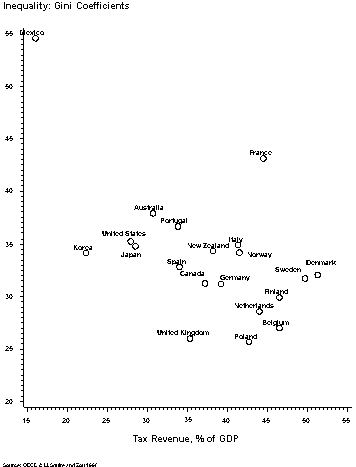 Figure 3. Inequality and tax revenue in OECD countries. Figure 2 shows a plot of public sector employment and female labour force participation. It includes most OECD countries but there are no figures for Russia and the two poor OECD countries. It is obvious that the Nordic countries differ from the central European countries. Female labour force participation is high in all Nordic countries and so is the public sector employment. This reflects central features of the Nordic type of welfare state, where the State provides free or highly subsidized services within child care, health, education and care for the elder and disabled. The number of housewives is low and many Nordic women work in the public sectors with tasks that previously and in most other countries belong to the households, where housewives take care of children and senior citizens. Here we find relatively large differences between Denmark and Germany, which in the border regions could cause tension in the external Nordic border region with Germany. These differences are not found in the internal Nordic border regions. A large public sector of course requires high taxes. Moreover,
taxes and mixed economy with public interventions in the labour
market and in other markets may generate equality. For a great
number of countries Li, Squire and Zou (1998) report Gini coefficients
which are statistical measures for income inequality. In figure
3 inequality is plotted against tax revenue. The Nordic countries
have high taxes but - maybe surprising - not the lowest in inequality.
Apparently we find the same level of inequality in Denmark and
Germany and thus at the Nordic external border to central Europe.
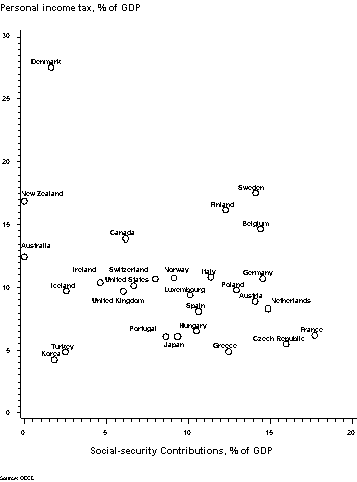 Figure 4.Labour taxes in OECD. However taxes are considerably higher in Denmark. Unfortunately there are no figures for Russia, but it is likely to assume that both taxes and inequality are very different in the two parts of the Nordic external border region with Russia. Taxes can be assessed in different ways. Figure 4 shows plots of personal income tax against social-security contribution. Both are mainly related to the active population, and is to a large extent taxes on labour. But income tax is normally payed at the place of residence whereas the social-security contribution is payed by employees and employers at the place of work. Moreover tax generate collective rights for all inhabitants based on needs or objective measures like age and health, whereas social-security contribution generate individual rights based on previous payments. This may course problems in border regions where people can live in one country and work in another, and maybe move or change jobs over the border from time to time. For these issues there are large differences between Denmark and Germany and thus in this external border region. Figure 5 plots taxes on goods and services against corporative and other taxes. The former are mainly taxes on consumption whereas the latter include taxes on capital and property. Taxes on goods and services are much higher in Denmark than in Germany, which can cause problems in the border region. The Nordic identity leads to Nordic cooperation. Both passport-union
and a free labour market have existed between the Nordic countries
since the 1950s. However there has not been free movement for
goods because the different Nordic countries rely on different
policies for agricultural products, alcohol etc. But the differences
in figure 1-5 between the Nordic countries have co-existed in open internal Nordic border regions for decades.
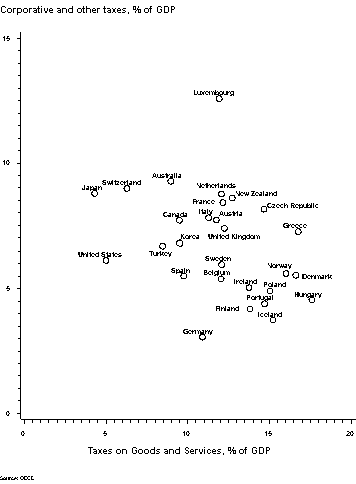 Figure 5. Consumption taxes and other taxes. By and large this also goes for the differences at the external border to Germany, that has only been divided by a inner EU border since 1973. The existing scope of differences between the Nordic countries and between Denmark and Germany can persist with open borders. This however in not necessarily the case if differences are larger. If so, there may be needs for rigid border controls and/or pressure for harmonization of rules. In the following two sections of the paper we first present documentation
for the Danish-German border region and second some indicators
for the Finnish-Russian border region. Emphasis is put on the
Danish-German border region, whereas the Finnish-Russian region
of Karelia will be refered to only briefly. A final section highlights
some destinct features for the two regions.
Geography The Border between Denmark and Germany crosses the peninsula of Jutland, and was set after a referendum in 1920, that divided the historical Slesvig. Today the Danish part of Slesvig, named Sønderjylland has 253.000 inhabitants on an area of 3938 km2 in the south of Denmark. The German part is named Landesteil Schleswig and comprises 434.000 inhabitants on 4177 km2 in the north of Germany. The common border is 68 km. long and has 1 motorway crossing point, 2 railway crossings and 5 open road crossings. History The history of the border region is also the history of Denmark and Germany and thus the history of central Europe. Until 1848 Denmark was a absolute monarchy and the king in Copenhagen was also Duke of Slesvig and Holstein. The revolution in Europe in 1848 resulted in a Democratic Danish Constitution but also in a civil war (1848-1850) about Schleswig-Holsteins relation to Denmark or Germany. The Danish government won. In another war in 1864 Denmark lost to Preussen/Austria and Schleswig/Sønderjylland subsequently became a part of Preussen/Germany. Denmark was neutral during World War 1 (1914-1918), but after the war there was a referendum in Schleswig in accordance with Wilson's principles of self-determination (Fink 1978). Schleswig was divided between Denmark and Germany in 1920, leaving a Danish minority south of the border and a German minority north of the border. During World War II (1940-1945) Denmark was attacked and occupied by Germany. But the 1920-border was not changed, although the Nazis had the opportunity during the war, and the Danes - under the shelter of Great Britain and the allied - probably had the opportunity after the war (Noack 1995). Political Cooperation Denmark became member of NATO in 1949 and in 1955 West-Germany also became member of NATO. In the wake of German negotiation with NATO, minority rights in the Danish-German border region was guaranteed in the Copenhagen-Bonn Declaration. After a referendum in 1972 Denmark joined EEC, as the first Nordic country. Until 1987 regional and local cross-border cooperations took place on an informal level. Specific problems were solved. As an example one can notice that a common motorway crossing point and large mutual customs control facilities were opened in 1978. In 1988 the first common program for development of the border region Sønderjylland/ Landesteil Schleswig was worked out by the regional county council in Sønderjylland and the Schleswig-Holstein government in Kiel. This i.a. resulted in INTERREG I subsidies of 4,9 mio. ECU from Bruxelles covering the period 1990-1993/1995. From 1994-1999/2001 the cooperation continued in INTERREG II which gave subsidies of 11.1 mio. ECU from Bruxelles. A proposal to establish formal cooperation in Euroregion Schleswig led in the winter 1996/1997 to a considerable public debate in the Danish part of the border region, and in some incidents this degenerated into vandalism and threats against leading politicians. Historical feelings against the Germans as well as general Danish resistance to the EU were among the motives behind the debate. The proposal was adopted by a large majority in the County Council in Sønderjylland in June 1997; Euro was dropped from the name, that became: Region Sønderjylland/Slesvig. At the general election to the County Council in November 1997, a new political parti that had the only program point to be against the new region got 5% of the votes and a candidate was elected. The leading party lost but stayed in office. In the short run there is no doubt that the Danish resistance is an embarrassment in the relation between Danes and Germans in the border region. Long term effects are of course unknown, but the incident shows that formalising cooperation in border regions may in worst case be counter productive for peace and understanding. In August 1998 - a year after the decisions were taken - Region Sønderjylland/Slesvig officially opened an administrative office with 3 employees. In his speech at the opening the county mayor of Sønderjylland, Kresten Phillipsen said that so far the cooperation/office had been more in danger of having a parking penalty than of having a penalty for offence of speed limits. The progress in border regional cooperation seems to go with the speed of a snail even in this peaceful, prosperous, old inner EU border region. However, things are moving: Cross border ambulance service has functioned for some years and recently the county council in Sønderjylland decided to send cancer patients to treatment in the German part of the border region. Official meetings with participants from both sides of the border normally takes place with the use of simultaneous interpreting between Danish and German. Many people in the Danish part of the border region do not speak German, and most people in the German part have little knowledge of Danish. Denmark probably had more referendums about the relation to EEC/EU
than any other country, and it is therefore possible to see whether
the people in the border regions have different opinions than
other Danes. The result from 5 referendums are found in table
2. A majority of the people in the border region have been in
favour of Danish EEC/EU membership ever since 1972, and they have
been more positive than the average Danes. The difference between
the border region and the average has vanished - probably mainly
owing to the fact that the differences between urban and rural
regions in Denmark have vanished in general. However, it is not
and have never been the people in the border region that were
most sceptical of Danish participation in European cooperation.
Minorities The 1920 border left a Danish minority south of the border and a German minority north of the border. After the new border was drawn the minorities/authorities organized schools, church service etc. in German for the minority in Denmark and in Danish for the minority in Germany. This took place in the 1920s and 1930s - definitely not without problems and tension between majority and minority, but it never degenerated into violence. Tensions of course increased during World War II i.a. because as the German minority in Denmark was nazified. The present situation is based on the Copenhagen-Bonn declaration from 1955 where minority rights were guaranteed by the two governments. The Germans have kindergartens, schools and high schools, cultural institutions as well as a newspaper - all of them with German as the main language in Sønderjylland, and the Danish minority has the same types of facilities using Danish language in Germany. The minorities have also there own political party and representations in elected local and regional councils. Minority in the Danish-German border region is »who will«, and there are no control of people belonging to the minorities. Therefore there are no statistics of the minority population. Instead table 3 shows the assessments by the Danish Institute of Border Regions Studies. The assessments are based on results from general elections, number of children in minority schools etc. Two facts can be read from table 3: The size of the minorities can increase and decrease as the same people and families in the wake of history actually have moved in and out of the minorities (Noack 1995). The second important fact is that the national minorities are small in number and in no way near 50% or more.
Table 3. National minorities in the Danish-German
border region 1920 and 1997.
Source: Danish Institute of Border Region Studies Cross Border Activities and their Consequences Cross border activities depend on motives and barriers. In the Danish-German border region the actual activities have been studied for several years. The main results will here be presented under the headlines: Goods and commodity taxes, commuting and labour market and migration and living conditions. The aims are twofold. First we want to see whether the open border restricts the Danish Government's possibility pursue Nordic objectives. Secondly we want to see if the border region is developing into a functional region due to the open border. Goods and Commodity Taxes Free movement of goods and services has been a main objective ever since the Treaty of Rome in 1958, and thus the principle objective around the Danish-German border since Denmark became member of EEC in 1973. In reality, however, there has been restrictions especially on goods with high taxes. The evolution of duty-free allowances for one day trips over the border are found in table 4. Until 1973 it was very restrictive and custom control at the border had to be tight. Since there have been liberalizations: The speed has been slow but the direction is clear, and today restriction mainly concerns strong alcohol and cigarettes. Traditionally and present VAT and other taxes on goods and services
play an important role in financing the Danish - Nordic type of
welfare state. For Danes there are tax incentives to purchase
goods in Germany. And Danes most certainly have gone shopping
in Germany, primarily buying bear, wine, cigarettes and - in some
periods petrol - ever since 1973. The ups and downs in border
shopping has very much followed changes in excise duties in Denmark and Germany.
A summit was reached in 1989, when Danes purchased goods worth DKK 3.6 billion in Germany. Germans in Denmark only spent DKK 0.7 billion. People came from large parts of Denmark to take advantages of the lower taxes in Germany, which caused a large loss of tax yield in Copenhagen. For the northern part of the border region the loss corresponded to about 10 per cent of total retail turnover (Bygvrå 1998). From 1990 the Danish Government changed policy. Danish petrol tax was reduced, taxes on cosmetics, TV-sets etc. were removed, and in the following years beer and wine taxes were reduced due to border shopping. It was now clear - also for the Government in Copenhagen - that people's shopping behaviour in the border region put restrictions on the possibilities for independent national tax policy on goods. Border shopping has fallen since 1989 and the most recent figures from 1996 show that Danes used DKK 2.7 billion on border shopping in Germany whereas Germans used 1.7 billion in Denmark (Bygvrå 1997). Present differences in VAT and other taxes on goods and services can coexist with an open border. VAT in Denmark is 25 per cent on all goods whereas in Germany it is only 7 per cent for essential goods and 16 per cent for the other goods and services. Retail trade structure and consumer behaviour in the two parts of the Danish-German border region very much follow their national patterns, and there seems only to be little integration towards common supply of foods, clothes, and other goods. People in the Danish part of the border region have Danish preferences and purchase in Danish shops, which look very much like similar shops in other parts of Denmark. Germans have (slightly!) different tastes, and purchase in German shops south of the border. For goods the open external border to Germany puts limits to national Danish commodity tax policy. However, the border region has not developed into a functional region for the issue of shop and retail trade structure and supply. Commuting and Labour Market Until 1995 when Sweden and Finland joined the EU, Danes had access
to a larger labour market than other Europeans and the labour
market in Denmark was open to more people than other labour markets.
Denmark was namely part of a free Nordic labour market since 1954
and a free EEC labour market since 1973. 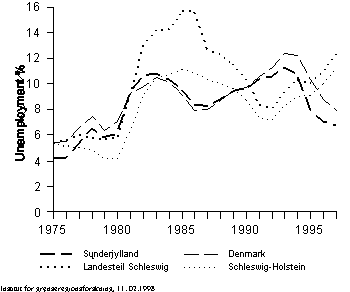 Figure 6. Unemployment in the two parts of the border region compared to Denmark and Schleswig-Holstein. But, both migration and border commuting remained at a very low level (Pedersen 1996, Hansen 1994). In 1995 only 1.300 people commuted from the northern to the southern part of the border region and only 1.000 people commuted in the opposite direction. This is only one tenth of what one could expect if there were no border barriers and if incentives were given by urban structure (Hansen and Schack 1997). The barriers mainly concern culture and language and to some extend tax and social security legislation, whereas work and stay permits, border control formalities and infrastructure cause few problems. Incentives to commute may be found in wage differences, differences in employment opportunities, housing prices and access to amenities and - due to the border - tax arbitrage and speculation. Barriers seems larger than incentives. This could be interpreted both positively and negatively. Small incentives mean that economic and other differences between the two parts of the border region are small and thus do not cause tensions between the populations. Integration, however, requires demolishing barriers. This is an independent EU objective and may lead to economic growth via better exploitation of economics of scale and scope in the border region. Small economic differences could be the results of the same level of backwardness in both parts of the border region. The two parts of the Danish-German border region has not developed
into common labour market in spite of 25 years with a formal open
border. This is illustrated in figure 6 comparing unemployment
in the two parts of the border region. Unemployment in the Danish
part of the border region follows unemployment in Denmark, strongly
indicating that national policies and trade union collective agreements
are very crucial for the people in the Danish part of the border
region. 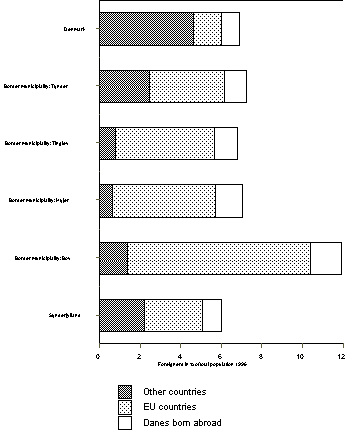 Figure 7. Foreigners in % of total population 1996 The opposite goes for the southern part of the border region: Unemployment follows the ups and downs in the Northern German State Schleswig Holstein, indicating that the dominant influence for the labour market comes from Kiel, Bonn and Frankfurt, and not from their near neighbour. Add to this that taxes and transfers like pensions are matters for the national states, and there is no doubt, that the welfare for most people in the border region is mainly influenced by national decisions and not by regional cross border cooperation. Migration and Living Conditions As mentioned the Danish-German border region was a functional region until 1920. Among other things the new border divided many families and friends. Contact, however, did not disappear and it is therefore to be expected that the border region contains a relative large foreign population. Minorities and their institutions pull in the same direction. Finally, living conditions could be different and people may move to the neighbour country to improve their standard of living. As mentioned there has been a free labour market since 1973, and since 1993 the housing marked has also been open to citizens from other EU-countries. The share of foreigners, however, is lower in Sønderjylland than in Denmark. This is shown in figure 7. Sønderjylland - the politically defined Danish part of the border region - has a much lower density of population from non EU countries but a higher share of people from EU countries, mainly Germany. The Germans in Sønderjylland are concentrated in the four border municipalities, especially Bov just north of the German town Flensburg with almost 100.000 inhabitant: After 1993 Germans purchased houses in Bov and took advantages of the lower prices in Denmark at that time. Today they are the largest group of border commuters. But for the regions as a whole the figures remain small. 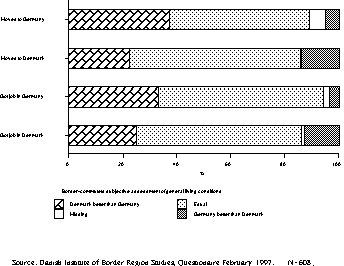 Figure 8. Border Commuters Subjective assessment of general living conditions. What figure 7 also shows is that the challenge from migration is not mainly a border region issue but a national one. Large cities - in the Danish case outside the border region - receive refugees and attract people from non EU-countries. Living conditions and incentives to cross the Danish-German border for work or to live in principle can be studied by looking at differences in wages, unemployment, housing prices and amenities as well as differences in availability of welfare and other services. Indeed the Institute of Border Regions Studies has done such investigations. Another way to put light to this important issue is to ask people who actually know both parts of the border region. That is what we did in a representative questionnaire to 608 border commuters. Their answers are found in figure 8. Most of them found living conditions equal. A relative large minority stated that life is better in the Danish part, and a somewhat smaller minority that the German part is better. The difference could be time dependent - when the questionnaire was made labour market conditions etc. were better in Denmark, but only five years earlier we had the opposite situation. Statistics for the border region population's behaviour as well
as the subjective assessments indicate that the incentives to
cross the Danish-German border for work or living are relative
small. Geography Describing Karelia today administratively one would have to include the since 1994 excisting regional councils of North Karelia and South Karelia in Finland, whereas the Karelian Republic can be seen as the »successor« on the Russian side of the border. The northern part of Leningrad oblast could maybe also be viewed as a part of Karelia. These areas are large but only sparsely populated. In Northern Karelia and South Karelia the number of inhabitants is i.e. only about 314,000 living on an area of 28,821 km2 (including 5,365 km2 of lakes). This makes a population density of about 11 inhabitants per km2. In the Karelian Republic the number of inhabitants is about 785,000 living on an area of 172.400 km2 which makes a population dencity of only about 5 inhabitants per km2. As a comparison the County of South Jutland i.e. has a population dencity of 64 inhabitants per km2. Past and Present Around the year 1000 Karelia appeared on the north-western shores of lake Ladoga and on the Karelian Istmus as a fusion between a local East Finnish population and immigrated Western Finnish Tavasts. Kexholm (now Priozersk) formed the centre of this early culture which later on expanded towards the White Sea. Generally speaking, the historical landscape of Karelia could therefore be described as an area reaching from the White Sea in the north to the Karelian Istmus in the south, and from the Saima lake system in the west to the lakes Ladoga and Onega in the east. Many border lines have been drawn during the years. The first border line was drawn in 1323 by the Peace of Nöteborg (Pähkinäsaari) allowing Sweden to take possession of Western Karelia with the city of Viborg (now Vyborg) as centre. The Peace of Stolbova in 1617 pushed the border further to the east. In 1809 Sweden lost Finland to Russia which meant that the whole Karelian population came under the same flag, with Finland, however, becoming an autonomus Grand Duchy within the Russian empire, and in 1917 Finland gained full independence in the wake of the Russian Revolution (Lind, John 1998). During all these years the everyday contacts between people on the changing borders were commonplace, and in this respect the border did not play any significant role. People crossed the border trading or looking for work. However, the Russian Revolution and the birth of an independent Finnish state changed this. The border now clearly came to seperate the Finnish and the Russian part of Karelia. For the new Finland the border to the Soviet Union became an important part of the identity-building process of the young state. In this respect Karelia played an considerable part as border land to bolshewism/communism and as an mythological example of the »arche-Finns«. The mythological meaning of Karelia for Finland was e.g. further underlined by the Finnish nationalepic »Kalevala«, which had been collected and written down by the Finn Elias Lönnrot during the first half of the 17th. century, and which had its origins in the (Eastern) Karelian legends and poems. In Soviet Russia the border was also an important ideological mark which was used for building up a Soviet nationalist feeling. The Winter War 1939-40 and the Continuation War 1941-44 did alter this situation, but merely moved the border to the west. Finland had to cede much of Finnish Karelia to the Soviet Union, and more than 400,000 Finns/Karelians were forced to leave their homes and moved to other parts of Finland. The Soviets re-populated the decerted parts of Karelia with Russians, Belorussians and Ukrainians, and as for population Russian Karelia today therefore hardly has any connection to the Karelia of the past (Laine, Antti 1994, Paasi, Anssi 1994). The Finnish-Russian border became a tabu in Finnish politics - that is in official Finnish-Soviet relations. In 1994 the Finnish historian Juhani Suomi was able to bring to light the fact that Finland's president Urho Kekkonen (1956-81) between the mid-1950s (when he was still Prime Minister) until the 1970s several times took up the question of the return of Karelia to Finland with the Soviet leaders. Even the Finnish Foreign Ministry had no knowledge of Kekkonen's discussions. The most promissing talks were held during the reign of the Soviet leader Nikita Chruschev (1956-64). In 1962 official negotiations resulted in the lease of the Saima channel, and the channel was re-opened in 1968. However, no further agreements were made. The one very characteristic feature about the Finnish-Russian border region of Karelia in this century has therefore been the very clear division in a Finnish and a Russian part whose development has deviated dramatically from one another. From the 1970s certain Finnish-Soviet cooperation projects across the border can be found, but is was only after the collapse of the Soviet Union in 1991 that contacts again began to flourish. Major social, economic and cultural differences suddenly became visible - differences which appear so much stronger considering the close contacts earlier on. Minorities After the exodus following the Second World War the Soviets re-populated the deserted parts of Karelia with Russians, White Russians and Ukrainians resulting in a cultural gab between the two sides of the border. Today the Karelian Republic contains a range of different nationalities, and one could in many ways speak of a multi-cultural region. Russians constitute the largest part of the population, namely about 73,6 %, whereas the Belorussians and the Ukrainians make out respectively 7 and 3,6 % of the 785,000 inhabitants in the Karelian Republic. Approximately 10 % of the population are Karelians, whose language is close to the Finnish, while the Finnish part makes out roughly 2,3 %. The Veps, a minority which for centuries has lived south-west of Lake Onega, constitute only about 0,8 % of the pupulation of the Karelian Republic (others 2,7 %) (Oksa, Jukka et al. 1994). On the Finnish side of the border Finns constitute most of the population. Economy and Infrastructure On both sides of the border Karelia the primary sector and the forest industry plays an important role in economic life and employment. In Northern Karelia on the Finnish side the forest industry e.g. accounts for about 60 % of exports in the region, although the plastics and metal industries have also been successful in recent years (NOGRAN 1997). Also the Karelian Republic has traditionally been a major wood and paper producer, and no less than 148,000 of its 172,400 km2 (about 86 %) are covered by forest. This corresponds to more than half of the forest area in Finland. However, due to rather different methods of silviculture and forest utilisation, cuttings are only about 10 to 15 % of the Finnish cuttings (Eskelinen, Heikki et al. 1997). There are, however, signs of growing production within the metal industry and the energy sector, but not within the important forest industry. Here also foreign investments are lacking. In 1995 only about half of the 408 registered foreign companies (joint ventures or 100 % foreign owned companies) were operative. The rest had either run into juridical problems or they were waiting for a more favourable economic situation to emerge. Most of these companies were working within other fields than the forest industry, and though the relative number of foreign companies is higher in the Karelian Republic than in the rest of Russia, the typical investment volume per inhabitant is not that much higher than the Russian one (Eskelinen, Heikki et al. 1997). During the Soviet period infrastructure in the Karelian Republic had a low priority, and even today's infrastructure in the Karelian Republic is underdeveloped creating difficulties concerning border-crossing. Also the environmental situation in the Karelian Republic is a problem, and common spatial planing and environmental problems have therefore been put on the Finnish-Russian agenda discussing the establishment of a range of »development zones« along the Finnish-Russian border (Finnish Ministry of the Environment et al. 1997, Eskelinen Heikki et al. 1997, TACIS 1996 & 1997). Outdated Russian legislation and confusion concerning the division of competences between Moscow and Petrozavodsk also causes problems (Kortelainen, Jarmo 1997). Cross-border Activities - EU, INTERREG and TACIS The very gloomy situation of Russian economy today restricts the possibilities of the Karelian Republic to participate in cross-border activities. However, the economic situation and the many other difficulties caused by the huge differences between the two sides of the border has not hampered the wish to cooperate across the border. Since 1990 Finland has had a bilateral cooperation with Russia, and between 1990 and 1997 the Finnish government spent about 60 mill. ECU on over 130 projects in North-Western Russia (Finnish Ministry for Foreign Affairs 1997). Also the establishment of the Barents Euro-Arctic Region (BEAR) in 1993 has been an important step in the creation of Finnish-Russian cross-border cooperation. In 1995 a new actor entered the scene along the Finnish-Russian
border for real - the European Union. Finland's EU-membership
means that Finland has now also gained access to financial means
trying to promote direct cross-border cooperation with the Russians.
However, most of the EU-funds are directed towards more nationally
oriented regional measures (objectives 2, 5b and 6). Between 1995
and 1999 Finland receives approximately 1,700 million ECU from
the Structural Funds. About half of these funds are directed at
regional objectives - objective 6 receiving about one third of
the total funding (Finnish Ministry of the Interior, 1997). Cross-border
cooperation is especially attached to the Community Initiative
INTERREG (II). Here the three Finnish-Russian programmes, Barents,
Karelia and South-East Finland, receive around 35 mill. ECU between
1995/96 and 1999. However, INTERREG money can only be applied
in EU countries, and therefore a special part of the EU TACIS
programme of the EU - namely TACIS-CBC - has been devoted to cross-border
cooperation. In 1996 and 1997 the TACIS-CBC programme for North-Western
Russia has each year made 13-17 mill. ECU avaliable on the Russian
side of the border, but the budget has not been fully applied
(TACIS 1996 & 1997), and the coordination of the two programmes
has also proved to cause major difficulties. This is due to different
national Finnish/Russian and EU administrative routines, but besides
that also the Russian economic situation has hindered the success
of especially TACIS-CBC as Russian co-financing in some cases
has been difficult to arrange - even when TACIS funding has been
available (Crotty, Jo et al. 1997, Kortelainen, Jarmo 1997). However,
important problems such as infrastructure and environment are
now being addressed even more strongly thanks to these programmes,
and much has already been improved. Certain Finnish politicians have used the term »soft border« describing the Finnish-Russian border. However, though the border may be »soft« from a political and military point of view, the economic, social and cultural border in many ways still resembles a »hard border«. And though the bilateral projects and the INTERREG and TACIS programmes address the problems of the border region directing much of their attention towards solving problems of infrastructure and environment, the real problems lie deeper - namely in the major economic and structural differences between the two parts of Karelia, probably demanding much more -especially in the Karelian Republic - than bilateral and EU funded projects can achieve. From a military point of view the external border to Germany has been a soft border at least since Germany jointed NATO in 1955. Moreover, as Denmark became member of the EEC in 1973 the border became more open for goods, labour, services etc. However, the two parts of the border region continued to develop differently, following their national patterns respectively in terms of unemployment, female labour force participation, welfare service etc. Neither the first INTERREG from 1990, nor the Single Market of 1993 brought any real common feature into the socioeconomic development of the two parts of the Danish-German border region. After more than two decades EEC-membership Sønderjylland is still a Nordic Welfare Society with high female labour force participation, low wage dispersion, public child care and other welfare services, high income taxes and high VAT that produces welfare for all citizens. Landesteil Schleswig is a region in the West German Socialstat with: Many housewives, large mandatory contributions to social security that produces individual rights for wage-earners, but relatively low income tax and low VAT. The welfare or social states, that have developed inside many European national states, continue to be the most important frames for peoples lives. This also goes for border regions, that have only been divided by open inner EU borders for decades. With peace and prosperity in both parts of a border region, the border can be open and some differences in taxes, welfare, inequality and ways of life can coexist. This leaves much scope for different priorities in national policies. Bibliography: Becker-Christensen ed. 1995a: Grænsen i 75 år.
Danish Institute of Border Region Studies. Becker-Christensen ed. 1995b: Sønderjyllands Amt 1970-1995. Danish Institut of Border Region Studies. Bode, Eckhardt et al 1991: Struktur und Entwicklungsmöglichkeiten der Wirtschaft in der deutsch-dänischen Grenzregion. Institut für Weltwirtschaft an der Universität Kiel. Bode, Eckhardt et al 1994: Cross-Border Activities, Taxation and the European Single Market. Institut für Weltwirtschaft an der Universität Kiel. Crotty, Jo et al.: »Protecting the Environment by Cross-Border Cooperation«, in Kortelainen, Jarmo (ed.) 1997: Crossing the Russian Border. Regional Development and Cross-border Cooperation in Karelia. University of Joensuu. Departement of Geography. Publications No 3 (TMR Course Report). Danish Institute of Border Region Studies (1997): Grænseregioner i den europæiske integration - en forskningsstrategi. (Border Region in the European Integration - a research strategy). Eskelinen, Heikki et al. 1997: The Emergence of Foreign Economic Activity in Russian Karelia. University of Joensuu. Publications of Karelian Institute No. 119. Finnish Ministry for Foreign Affairs 1997. Department for External Economic Relations: Figures on Finland's support to the process of transition in CEEC/CIS 1990-97. Finnish Ministry of the Environment, Building Committee (Goosstroi) of Russia 31.05.1997: Spatial Planning Cooperation Between the Border Regions of Finland and Russia. Finnish Ministry of the Interior 1997, Department for Regional Development: Regional Development in Finland. Hansen, Christian 1995: Die sozio-ökonomische Situation in der deutsch-dänischen Grenzregion 1988-1994 - Stand und Entwicklung. Danish Institut of Border Region Studies, Notat no. 62. Hansen, Christian 1993: Tønder 1970-1992. Industri og service i byen ved grænsen. Danish Institut of Border Region Studies. Hansen, Christian og Michael Schack: Grænsependling mellem Landesteil Schleswig og Sønderjylland. Danish Institut of Border Region Studies. Hansen, Niles (1997): Border Regions: A Critique of Spatial Theory and a European Case Study. Annals of Regional Science Vol 11 pp.1-14. Kortelainen, Jarmo 1997: »Crossing Borders - Accumulating Regional Capital«, in Kortelainen, Jarmo (ed.) 1997: Crossing the Russian Border. Regional Development and Cross-border Cooperation in Karelia. University of Joensuu. Departement of Geography. Publications No 3 (TMR Course Report). Laine, Antti 1994: »Karelia Between Two Socio-Cultural Systems«, in Eskelinen, Heikki et al. (eds)1994: Russian Karelia in Search of a New Role. Karelian Institute. University of Joensuu. Landesarbeitsamt Nord 1996: Statistische Ergebnisse 1995 Kiel. (And other publications) Lind, John 1998: article about Karelia in Den Store Danske Encyklopædi. Vol. 10. Noack, Johan Peter 1995: Da grænsen »lå fast« - grænsestriden efter 2. verdenskrig. In Becker Christensen 1995a:Grænsen i 75 år. NOGRAN 1997: Nordic Regions in Profile. Nord 1997:6. Oksa, Jukka & Eira Varis 1994: "Karelian Republoc: Publation, Settlements and Administration", in Eskelinen, Heikki et al. (eds) 1994: Russian Karelia in Search of a New Role. Karelian Institute. University of Joensuu. Paasi, Anssi 1994: »The Changing Meanings of the Finnish-Russian Border«, in Eskelinen, Heikki et al. (eds) 1994: Russian Karelia in Search of a New Role. Karelian Institute. University of Joensuu. James Wesley Scott and Kimberly Collins (1997): Inducing Transboundary Regionalism in Asymmetric Situations: The Case of the German-Polish Border. J. of Borderlands Studies Vol., XII 1&2. Statistisches Landesamt Schleswig-Holstein (1996): Statistisches Jahrbuch Schleswig-Holstein 1996. Kiel. (And other publications) Statistics Denmark: Databases and publications. TACIS 1996: European Community Programme. 1996 Cross Border Cooperation Programme. November 1996. TACIS 1997: Tacis Programme. 1997 Cross Border Programme. September 1997. | ||||||||||||||||||||||||||||||||||||||||||||||||||||||||||||||||||||||||||||||||||||||||||||||||||||||||||||||||||||||||||||||||||||||||||||||||||||||||||||