|
Urban Networking in the Baltic Sea Region - Ulf Forsman, Bo Forsström Oy Data City Center AB Box 102, FIN 20521 Turku, Finland
Abstract The challenges of the information society is the focal point of profound changes in the processes of economic transformation and strategies for regional regeneration.Technological innovation including the World Wide Web as a growing powerful institution has lead to a paradigm shift where smoke-stack industrial growth processes are replaced by a more "evolutionary economic" rationale concerning development of new industries based on technological innovations and on networking and clustering of economic actors (Schienstock et al 1997). This evolutionary rationale includes a new qualitative step in understanding product and system development carried out in close cooperation with the customer and based on the understanding of changing demands. This implies that technology a must have a face where users and producers of technology meet (Kuusi & Neuvo 1996). But the evolutionary approach also includes the understanding of Internet as a new technological frame for information processing, where the applications have virtual presence and the nature of services change towards a more generic transmission of information and media planning (Lyytinen 1997). So, there is a change in the conditions and possibilities of the technological set-up of this (inter)face. In the brave new Internet world one should speak of media technology instead of information technology. Needless to say, this will have strong impacts on the competitive conditions and profitability of many business-to-business transactions and services producing "mediaobjects". This paper will examine the theorethical context of understanding the production of mediaobjects in a global-local deployment and design discourse. In the first part of the paper the urban networking approach is introduced. In this approach (Camagni 1993 and Vartiainen et al 1998) a "network logic" is seen as the main organizing principle of inter-urban links. These links open up for local economic development and the idea of learning-by-interacting. In the second part a brief outline of the deployment and design discourse producing mediaobject is described (Forsman 1998). The dynamic relationship between deployment and design discourses beeing a pre-requisite for a positive development process. The concept "mediaobject" is used in it`s general and abstract context symbolizing the generic architecture of the product palette in a "information society fitted" service-based firm. In the third part the importance of mediaobjects in the learning process is highlighted using integration of research & development and marketing & sales activities in service-based firms as one example. A model of the deployment and design discourses is sketched embedding mediaobjects "on-stage" and "behind the stage". Finally in the fourth part some ideas on the role of the virtual service-based activities for a further learning process in the BSR are put together. These ideas have been introduced in a regional context in the South-Western part of Finland in the province of Varsinais-Suomi. Here a "information society" strategy programme3 have been applied as an overall image for the orientation of regional strategic planning.
Introduction The starting point for this paper are some basic ideas of the research programme "Urban networking as a learning process in the Baltic Sea Region" that started as a joint Nordic project in 1996. The objective of this programme was to develop the idea of innovative networks in the BSR introducing a proposal for a concrete research programme, based on the Baltlab-concept. This concept is based on the idea of a laboratory of regional research and development processes reflecting the need to strengthen cooperation and learning processes of contemporary strategic policies of cities and other urban actors in the BSR. The context of this paper is planning understood as a learning process both locally and between transnational actors and partners. This learning perspective emphasizes, in particular the process of learning-by-interacting, that can be seen as an extension of the networking paradigm in industrial studies and economic geography (cf. Healey 1995a; Cooke & Morgan 1993; Morgan 1995; Dupuy & Gilly 1996; Vartiainen 1997). The objective of this paper is to highlight and integrate some of the elements in the state-of-the-art approach that was used as a common framework for urban networking in the Baltlab process (Forsström et al. 1996). This integration is done by introducing an actor perspective to a deployment and design discourse producing media objects. The dynamic relationship between deployment and design discourses are seen a prerequisite for a positive regional development process. The concept media objects (MOs) is here used as an abstraction for various kinds of media devices, computer applications, multimedia presentations, etc. What MOs have in common is that they more or less form a unity of a certain information content and the handling techniques for this information and that they constitute the production palette in "information society fitted", service-based enterprises (Forsman 1998). The challenge of this paper rises from some of the preliminary indicative results in the Nordic study "Urban networking as a learning process in the BSR" concerning obstacles and barriers for transborder cooperation in Europe (Geenhuizen et al. 1996). Instead of truly interactive and horisontal cooperation, actual partnerships between local authorities still seem to be constrained within the hierarchical structures of state administration and to be of one-way communication and resource transfer by nature. This is particularly applicable to the relationships between the Nordic and the Baltic countries (Vartiainen 1998). The approach – looking for the virtual service-based enterprise Today it seems much more fruitful to analyse small technology and knowledge intensive enterprises involved in b-to-b trade as service-based rather than industry-based activity. This stems from the fundamental problem of efficiently transferring technology and know-how to the customer and from the need for effectively embedding this technology and know-how into the business and working practices of the customers. This paradigm shift which is based on two profound interrelated steps, is truly changing the competitive conditions for this kind of enterprises. In essence, the first qualitative step was expressed by two Finnish professors (Kuusi & Neuvo 1996) in this way: "For high-tech companies technological sophistication also includes knowledge and appreciation of different cultures. Understanding technical equations is not enough. Technology has a face, and we must never forget people and different cultural values… Our product and system development is always carried out in close cooperation with the customer and based on the understanding of the changing demands." This "humanistic" interpretation of technology is emphasizing the deployment of technology in a specific cultural-economic context, where users and producers meet. Technological development is essentially a preparation for this rendez-vous. (Fig. 1). Figure 1: The Service Paradigm The other qualitative step has been formulated by another Finnish scholar (Lyytinen 1997) like this. "Internet is radically changing the conditions for producing and constructing the future data processing… Internet is a new "technological framework" for data processing… It is probably the most profound change in the architecture of data processing since the introduction of the personal computer. It is not only a question of doing old things in new ways, but above all of the ability of doing new things… The applications will be present all over, and the nature of services will change into communicative media design." Where Kuusi and Neuvo are emphasizing the importance of understanding technology in a user-producer perspective, Lyytinen is heading for the technological conditions and demands, i.e. the fulfillment of this meeting. When entering the Internet era, we should, instead of information technology, speak of media technology! Producing service-based transactions at the "moment of truth" Providing services in this kind of specific context must be seen as a process of social interaction, where the service providers and users meet in person. At this "moment of truth" they jointly produce an outcome, a service of a specific and immaterial kind. The provider is preparing himself "off-stage" for the "moment of truth". Services produced are designed and deployed in such unique interactive settings. A service-based activity is implemented as various improvised communicative and reciprocal person-to-person settings. These social relationships are by nature immediate or mediated by a medium. In service-based business, these relationships are mostly a combination of both types. In service an enterprise as an economic entity is positioned qualitatively in quite another way than in industry. The border line of an industrial firm relates to the position of "our firm" to "they" outside, including customers. For a service providing firm the world appears as one social and cultural context, where service users and providers share this same inseparable context. From an economic point of view, all relevant and decisive events occur when the parties meet "at the moment of truth" "on-stage". The discussion above on the qualitative steps and the inseparable context raises some very challenging questions concerning the business of an ISSE:
Producing and embedding MOs In order to give an answer to these four questions, a model for a transactional business discourse must be introduced. In this discourse we are dealing with the creation of collective meanings between interacting partners. The collaborative activities of MO producers and users "on-stage" appear as a deployment discourse. The producer activities "off-stage" appear as a design discourse, i.e. as a preparation for the "moment of truth". This discourse advances in a specific socio-cultural context which can be analyzed in layers or different levels of abstraction. At the immediate level, MOs will gain meaning in a certain deployment and design context. This first level of abstraction represents the everyday working routines, which are embedded in a higher ontological context. This second level of abstraction, generally articulated in the business and growth ideas of the enterprise, is embedded in an even higher level, the socio-cultural context. On this third level of abstraction the transactional business discourse is anchored and positioned into the universal "world of discourses". (Figure 2)
Figure 2: The Transactional Business Discourse The gray line between the deployment and design discourses in figure 2 emphasizes their dynamic reciprocity, i.e. character of a developmental spiral. A successful design discourse is founded on an interpretation and understanding of the deployment discourse. The success of the latter depends in turn on how effectively one can influence the creation of collective meaning concerning the MOs in question, i.e. persuade the user party in a desired way, and, on the other hand, on how efficiently one can embed the MOs in the deployment discourse, i.e. in the everyday work routine of the user party. The dynamics of this reciprocal relationship suggests that it could be conceptualized in classical rhetoric terms and it is argued that this should be the next step in analyzing further the transactional business discourse of an ISEE. Designing on-stage & off-stage work practices Figure 3 addresses the second and third question put above, i.e. the challenges concerning research & development and marketing & sales of an ISEE. The levers "pushing" forward the dynamic reciprocity between the deployment and design discourses were schematically defined above by the consecutive terms interpretation understanding embeddment persuasion (re)interpretation... This dynamic reciprocity does not work without the ISEE, not only exposing itself, but above all being physically and virtually present in the deployment discourse. Traditionally research & technology development (RTD) efforts and marketing & sales (M&S) efforts are looked upon as separate reasoning and working practices following the principles of an efficient division of labour. According to the prevalent product life cycle model, product innovations rise from ideas and inventions in the R&TD process. Design and marketing efforts are usually introduced at a very late stage of product development. Sales efforts follow when a product is to be introduced on the market. This sequential reasoning and working practice that still hamper many industrial enterprises does not fit very well to ISEEs. As an alternative for these service-based enterprises a concurrent reasoning and working practice is suggested. In this approach RTD and M&S efforts do represent two intertwined and parallel modes of being simultaneously present "on-stage" as an active party in the deployment discourse of MOs, and, on the other hand, of preparing oneself "off-stage" in the design discourse for this "moment of truth". It is argued that this two-channel exposure and presence could be better understood as a role play than as a division of labour -setting. This concurrent reasoning and working practice is structured layer by layer according to the deployment and design context seen as everyday work. This kind of institutionalization of working practices is based on the principles of mass customization of MOs, where the starting point and the end result of MO innovations appear on the deployment layer. The competitiveness of the producer of MOs is a function of how responsively (s)he can translate this starting point in terms of information content to a relevant end result for the "readers" of the produced MOs. In the same way the profitability of the producer of MOs is a function of how productively (s)he can transform this same starting point in terms of information handling techniques to a deployable end result for the user of the produced MOs. In the ontological context, the business idea is the representation of M&S by which collective and unique meanings are effectively created based on generic meanings in a interactive discourse "on-stage" between the user and producer of MOs. The growth idea is the representation of RTD by which these generic meanings are created in a historically emerging interactive discourse culture. The business idea grasps the discourse partner as a concrete customer while the growth idea grasps her/him as an abstract customer. Every concrete customer is an instance of the abstract customer for whom the generic meaning given to the MO during the design discourse is externalized. At the same time, meeting the concrete customer is an experience that makes an abstract customer more vivid. The generic meaning given MOs in the design discourse will be enriched by internalizing such experiences. Figure 3 suggests even a third channel of exposure and presence at the deployment layer. I*Net refers to a medium where Intranet, Extranet, and Internet form an integrated whole. The two-channel translation and transformation between vertical layers and the horizontal coordination of these translation and transformation efforts is "materialized" as documents and messages mediated in some way. An I*Net seems to be the proper medium for such a spatio-temporally asynchronous documentation and communication. It seems also to be the mean by which the division of labour can be dissolved and replaced by a role play. From foreign trade to multicultural trade From the point of view of ISEEs involved in b-to-b trade, a traditional marketing perspective based on the prevalence of local, national and international markets seems rather dull, since the business of such an enterprise a priori is conducted in a "global village". So the business relationship between the producer and the user of MOs is basically the same where ever they are located, whether they are on the other side of the road or the globe. Both the producer and the user are conducting business nowadays in more and more less asynchronous spatio-temporal settings, i.e. they are located in different spaces and/or in different times. On the other hand, the "global village" is anything but homogenous, although a globalisation trend, through the dominance of transnational megafirms, obviously is growing in strength. Enterprises conducting their business in Internet, are faced with a serious strategic choice in relation to their deployment discourse: the choice is between "unicultural" or "multicultural" marketing strategies. Hitherto, the Internet business has been mainly "unicultural", since business transactions are more or less mail-order based. Here the business communication is purely focused on logistic messages like order, invoice, and payment. In service-based business this kind of "unicultural" transactions are rather one-dimensional, since service-based business is founded - as suggested above - on the creation of collective and unique meanings by those MOs that are traded. This business is in other words a priori "multicultural". The strategic choice of ISEEs is essentially about what kind of "multiculturality" is included in the transactional business discourse. E-commerce is one of the big issues of today. The discussion above, however, suggests that, from the viewpoint of ISEEs involved in b-to-b trade, e-commerce is just the top of the iceberg. The logistic messaging, although of course important, is actually quite a trivial problem. A more essential problem is how to organize (and institutionalize) the virtual collaboration between parties involved in a "multicultural" transactional business discourse outlined above. In South-West Finland we have for some time been searching for solutions to this problem. We have been working on four levels simultaneously:
The term solution refers here both to the MO and the institutional aspects of solving the problem in question. In this regional RTD initiative MOs are seen as essential means in creating a local MO-economy in a mondial perspective, where these four levels of development are integrated. MOs are - besides being objects of trade - also means of trade and, above all, means for networking. B-to-b networking is here viewed on three levels of consolidation: (1) the level of joint libraries; (2) the level of mutual collaboration; and (3) the level of virtual enterprises. Challenges for the learning process The discussion above is pointing at many challenges for the learning process between urban actors in a BSR context. Some of the indicative results from the Nordic study (Vartiainen 1998; Vartiainen et al. 1998) points at some obstacles and barriers encountered in European transborder networking. Firstly, the international activities, apart from the traditional twin-city relations, are very new even for the rather "internationalized" and proactive cities. Secondly, the spatial reach of urban networking is still very restricted and reflects the actual partitioning of the BSR into different sub-regions. Thirdly, instead of truly interactive and horizontal cooperation, actual partnerships between local authorities still seem to be constrained within the hierarchical structures of state administration and to be of one-way communication and resource transfer by nature. The urban networking process in the BSR is obviously still in a start-up phase, but network structures between Nordic and Baltic countries are emerging simultaneously along with their national system. Networking will be an essential element in the spatio-temporal processes of a functional BSR. Urban networks have one important function for the learning process, i.e. they act as a conduit for the transfer of knowledge and best practice, stimulating innovation in technology and policy. Our experience in implementing the regional RTD initiative referred to above suggests: that the emerging information society theme could be a fruitful starting point and platform for tuning up the Baltic orchestra on a "multilocal" basis; that the target of creating media object dominated economic structures with emerging information society embedded enterprises, complementing more traditional economic activities and bringing forth the strengths of the different urban actors into a multicultural and mondial context, could provide the essential content of such a strategy; that the role and positioning of local authorities should profoundly change, when implementing this strategy, from being isolated "satellites" of the state administration into more proactive catalysts for the creation of top-down interactive planning processes (including SMEs in general, and ISEEs especially); and that that this kind of strategic approach (towards a more entrereuneurial local economic development policy) is essentially a learning process where a shared consciousness and a collective will is enhanced and accumulated. References Cooke, P. & K. Morgan (1993). The network paradigm: new departures in corporate and regional development. Society and Space 11:5 , 543-564. Dupuy, C. & J.P. Gilly (1996). Collective learning and territorial dynamics: a new approach to the relations between industrial groups and territories. Environment and Planning A 28: 1603-1616. Forsman, Ulf (1998). Virtuaalinen palvelutoiminta verkossa - "tietoyhteiskuntakuntoisen" palveluyrityksen tunnusmerkkejä etsimässä. In loppuraportti: Internetexport 1997 - Internetin käyttö ohjelmistoviennissä (http://www. ttlry.fi) Forsström, B. & P. Vartiainen & H. Andersson (1996). Urban networking as a learning process in the Baltic Sea Region. In Graute (ed): Vision and Strategies Around the Baltic Sea 2010 and their Relevance to Central and Eastern Europe. IÖR-Schrift 17. Dresden. Van Geenhuizen, M. et al. (1996) Trans-border European networking: shifts in corporate strategy? European Planning Studies 4:6, 671-682. Healey,P. (1995a). The argumentative turn in planning theory and its implications for spatial strategy formation. In T. Pakarinen & H. Ylinen (eds): Are Local Strategies Possible - Scrutinising Sustainability. Tampere Univeristy of Technology, Department of Architecture, Urban Planning, Publications 29. Kuusi, Juhani & Yrjö Neuvo (1996). In Nokia Company Finance 1996. (http://www.nokia.com /company/finance/1996/annual96/essay.html). Lyytinen, Kalle (1997). In MicroPC 12/1997. Helsinki. Morgan, K. (1995). The learning region: institutions, innovation and regional renewal. Papers in Planning Research No. 157, Department of City and Regional Planning, University of Wales, Cardiff. Normann, Richard (1983). Luova yritysjohto. Weilin+Göös. 3. ed. Espoo. (1. ed., 1975) Vartiainen, Perttu (1997). Urban networking as a learning process: an exploratory framework for transborder cooperation in the Baltic Sea region. In Graute (ed): Sustainable Development for Central and Eastern Europe - Spatial Development in the European Context. Springer, Berlin. Vartiainen, Perttu (1998). Urban Networking as Learning Process. In Baltic Cities - Global Aspects on Urban Settlements in the Baltic Sea Region, The Swedish Council for Building Research, Stockholm. |
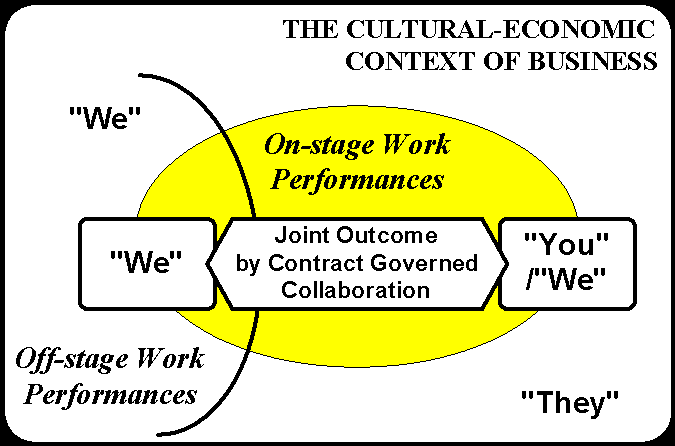
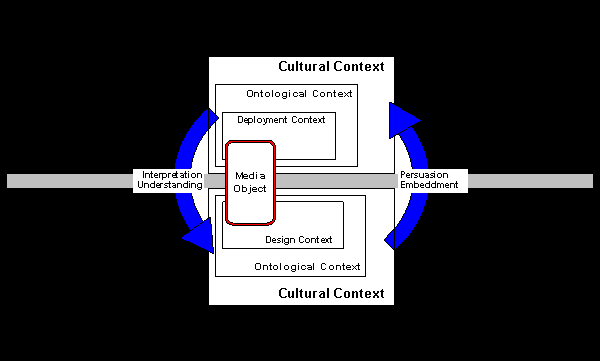
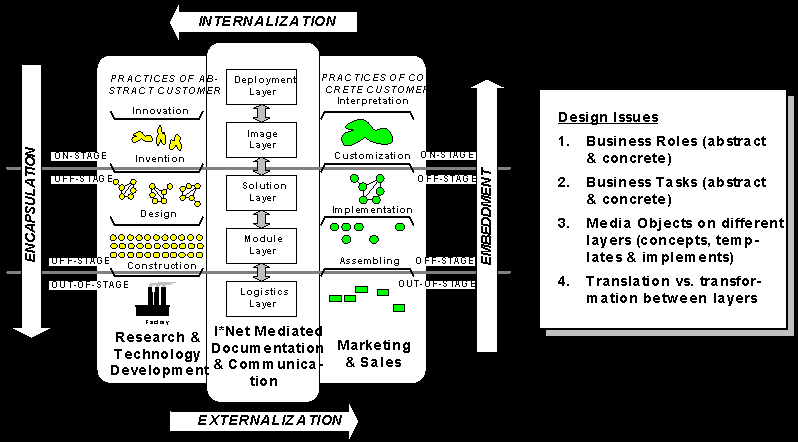 Figure 3: The Three-channel Exposure and Presence of an ISEE in the Deploymen Discourse