|
the institutional approach Raigo Ernits 1. General characterization of the Estonian mono-functional settlements There are 34 so called mono-functional or one-enterprise settlements in Estonia. The official criteria for these termini are:
By the Ministry of Interior Affairs of Estonian Republic exists the program of the mono-functional settlements which as the executor of the politics of Estonian Republic about the mono-functional settlements has the goals to diversify the structure of the mono-functional settlements, to create the new jobs, to promote the use of existing capabilities and skills of workers, improve the infrastructure of settlements, to improve the connection with hinterland and local centers, to increase the enterpreneurity of the inhabitants, to improve the qualification of labor force and to create new ideas to develop the mono-functional settlements. With the resources of the program is financed the business projects in settlements, the projects improving business environment in settlements and research projects about the settlements. (Madalik 1996) These settlements are located in all districts of Estonia; anyway
they are at mostly concentrated into the Central Estonia around
the Tartu-Tapa railway and into the most eastern region of Estonia
- Ida-Virumaa (see figure 1). 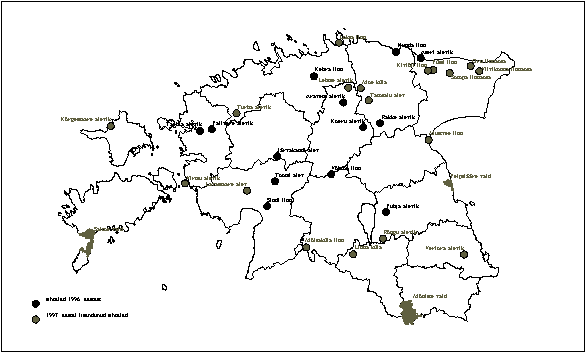 Figure 1. The mono-functional settlements in Estonia 1997 The average number of population in these settlements is (by different
data) ca 1800-1900 (1997), the smallest was Moe with 300 inhabitant
and the bigger was the town Kiviõli with 9017 inhabitant.
Together lived 1997 in Estonian MFS-s more as 61 000 people (4.3%
of the total population of Estonia) (MFA profiiliuuring 1997).
The source of data: (MFA profiiliuuring 1997) * Because of the data of the Estonian official statistical accounting is not very adequate have been used the data collected with questioning the officials of the local municipalities. However we must be critical also about these data as there are several problems caused by incomplete survey of the local government about the inhabitants of their district. This must be taken into account also by rest data originating in the same source. The share of working population are 38 - 66% (MFA profiiliuuring 1997) with arithmetical average 53% which is to some degree smaller as the Estonian average (57%). From these 32 are the urban settlements, 3 are the rural municipalities consisting of the small villages. The structure and size required in criteria is measured for the settlement as whole. In the soviet period was in these 34 settlements in 8 the dominating activity the food industry, in 5 the peat industry, in 5 wood industry, in 4 the production of building materials, in 2 metallurgical, mining or textile industry and in 1 cellulose and paper industry, shipbuilding or mechanical engineering. Because at moment is the situation somewhat different because many enterprises are closed we cannot to fix the dominating branch of economy nowadays but The estimated unemployment is 2.2-33.6%, arithmetical average 13.4%, which is a bit more as Estonian average but the problem is actually bigger because of specially high unemployment in some such settlements and the danger for other to fall into similar situation. Some of these enterprises are created in 19th century but the most part is created at the soviet period, especially in 1950-1960 years. The settlement is in many cases created or significantly grown as the workers living place of enterprise. The main reason to choice of location was the nearness of some raw material or energy resource. In the soviet period was the deciding factor sometimes also the subjective decision of bureaucrats. The districts dominated the industrial activity incurred into difficulties due to the closing of factories and large number of unemployed industry-workers in Western countries in 70-ties (Massey 1988) while had taken place:
The main problems of the industrial districts have in general been:
The smaller one-enterprise settlements are more critical as large declining districts because of following aspects:
Two of Estonian mono-functional settlements, Võhma and
Oru, have 1996-1997 gone through a significant crisis gone with
the bankruptcy of the dominated enterprises. (About
reasons and for to find possibilities for mitigation the crisis,
as well as for to avoid analog crisis in the future, have an order
for Ministry of Interior made a research project (Ernits et al
1998), results of what are used in this paper.)
For the stable economic environment in the so-called mono-functional economy is very important the role of the dominating branch in the economy. It has the determinative importance for the economy as whole because rest branches (enterprises) have the role to service the dominating branch (production activity) or the people occupied in the dominating branch. The certainty of production requires the adequate position in the markets (as in input as in output markets) or the possibility to find quickly a new market in the case of falling off some market. The finding the new market is possible with the same production (in the same field of activity) or with the new production (in new field of activity). The possibility for non-painful restructuring requires the fewer specialties. So there exist the strong relationships between the certainty of the market and the possibilities to specialize. At the micro-level between the enterprises are these relationships treated in the framework of the Institutional Economics (called also New Institutional Economics - NIE). It is a new paradigm in the economics, which deals with economy using the certain new conceptions (Ricter, Furubotn 1996, Sepp 1997) which makes this approach much more realistic as the traditional microeconomics which uses instead of these concepts the unrealistic assumptions. The additional reason for institutional approach is the smallness of Estonian mono-functional settlements. In small district have besides the branch-specific factors the higher importance the reasons proceeding from single institutions (enterprises) and individuals. The NIE-conceptions of our interests are the conception of the transaction costs and the conception of property rights. Transaction costs are the costs arising from the coordination between partners in economy (as inside the enterprise as outside from the enterprise); property rights are in terms of Institutional Economics all kind of decision possibilities over the use of resources. The part of our interest of Institutional Economics research tradition is the transaction cost economics. By Williamson depends the costliness of transactions principally on 3 dimensions (Williamson 1989):
In the case of uncertainty we cannot evaluate the probability
of potential results. Often recurring transformations make optimal
the different mechanism of coordination in comparing seldom or
once acting transactions. (Williamson 1985, 1989) Asset specificity has reference to the degree to which an asset can be re-deployed to alternative uses and by alternative users without sacrifice of productive value. This has a relation to the notion of sunk cost (Williamson 1989). Several authors since XIX century have spoken about specific human capital (Marshall 1948, Becker 1962) or about specific physical capital (Marschak 1968). Since the alternative fields of use of these resources are much less profitable, are the investments into specific asset or into scholarship the sunk costs. This gives to the partner the opportunity to appropriate the whole quasi-profit. (Williamson 1985) The resource, which has the special value in the fixed relationships with the fixed partner, is called the transaction-specific activa. Investment into such kind of resource is called the transaction-specific investment. (Williamson 1985) Williamson distinguishes 5 kind of asset specificity (Williamson
1989):
Specializing often assumes the transaction specific investment. Hence the relationship mentioned above is important. With creation of the transaction specific activa are restricted the profitable fields of use. Such kind of purpose can make the use of asset in the narrow field of use more profitable but at the same time is decreasing the profitability of alternative fields of application. We can summarize that with the increasing the rate of specificity are:
With the transaction-specific investment happens the fundamental transformation of competition conditions. He evaluates from the point of view of the temporal continuation the transaction specific human resource more essential as the specific capital. (Williamson 1985) On the level of district (region, settlement) we can use the analog, observing all factors and circumstances needed for economic activity as production factors. We call them here the components of the entrepreneurial environment. There is several kind of classifications of these components. Here we present the list of Porter (1990), called by him as determinants of national advantage:
Classifications of other authors include principally same factors (Hayek 1960, Adams, and Hall 1993). We can summarize that the functioning of production system is influenced by 4 components:
From the point if view of Institutional Economics we can observe the production system in the district as institution which has 3 main to some extent contradictory aims (Williamson 1985):
The production system has to find the optimal way between the 3 aims. Determined by the economical environment have the different aims the different importance and vary in time and in space. This determines also the existence the different systems of production. We must here observe one pseudo-difference between the conditions on micro-level and interregional level. The enterprise can on the micro-level diminish the uncertainty with contracts, including the fusion. On interregional level cannot the subjects of the region as whole to mitigate the uncertainty with formal contracts. Determinative importance has the actual position on the market. Nevertheless, this difference is only formal. Also between enterprises determines the nature of the contact (and the advantages and limitations resulting with this) the actual position on the market. However, in reality sometimes takes the subject with contracts for him the restrictions or obligations, which are not necessary, but this is explanatory with disadvantageous position in the field of information. The actual difference between micro-level and interregional level is that on micro-level will the relationship of positions take the juridical form, but on the interregional level not. However, we have some differences comparing the initial micro-approach. For an economical district is the existence and functioning the goal in itself, for a single enterprise it is not (at least for the national economy). So enterprise and region have different choice possibilities. The second difference is that we have the conversely problem. As in initial approach the enterprise choices the form of contract respective the transaction costs, than the choice the branch of activity in the district depends on the position on the external market. Similar approach, the modeling the transaction costs in the given institutional framework, is used by Gould (1968) for research the adjustment and investments in the enterprise (Richter, Furubotn 1996). For research the relationships between different links in a mono-functional settlement we can use the Williamson's model of Company Town (Williamson 1985). Although Williamson notes, that the increase of mobility thanks to development of technique is greatly alleviated the contracting-problems described in the model and he attaches importance foremost to the analytical value of the model ("… remote mining communities may present still other issues for which careful comparative institutional assessments will be needed" (p.37)), has in our circumstances predictably more direct applicability. In the model of company town exists the branch- and site-specific physical capital with high alternative cost and ex-ante non-specific labor force, what the enterprise have to change to site-specific ex-post (p.35). Principally the similar situation is in case of branch-specific human capital but in Estonian mono-functional settlements we have at present to do with ex-ante specificity (as site- as branch-specificity). The labor force changing specific after the making the contract (ex-post) needs ex-ante the guarantees against opportunistic behavior of the entrepreneur. (The possibility of giving the guarantees in Estonia is discussing later.) The example of housing and department store are not the most actual but there are several other dependencies of employers in the mono-functional settlement, first of all the dependence on dominating enterprise as the main demander of labor. Williamson notes also that the increase of mobility of labor force diminishes the transaction-specificity of this (p.37), and that the regulation with contracts works not perfectly. The employers usually underestimate the uncertainty ("An objective assessment of employment hazards that should have preceded any employment agreement thus comes only after disappointment"(p.38)). Employers don't as well always have the adequate understanding about the influence of guarantees. (p.37-38) Mono-functional or one enterprise settlements have been in the focus of many researcher, included Jarmo Kortelainen (1991). These declining settlements may be also curious result of the 1950's 60's regional policy: decentralization - creation of industrial growth poles - and rapid rationalization of primary production, and are particularly characteristic for the Nordic countries (Oscarson 1989). Looking the industrial growth poles in context of the transaction cost economics we see that the growth pole structure assumes the stark hierarchy and the fixed production. This structure does not make possible enough flexibility in markets and in productivity. Local integration between the industrial systems did not take place and was far in guarantying openness and adaptiveness of the local economy. In order to generate indigenous self-sustained development, staple economies should be capable of providing adequate links around the staple production in order to achieve higher value added activities. Watkins (1963) introduced the original idea of linkage effects in economic development (Hisrchmann 1958) to the staple theory. The formation of linkages in the services and manufacturing and to the local demand multiplies the staple economy by enriching the structure of production. An appropriate linkage formation may increase the potential of the economy to generate indigenous development (Peltonen 1984). As opposite of the economic area creating adequate linkages for indigenous innovations and growth and for self-sustained development is the area with dominating staple branches. Because the dominance of outside located enterprises and investors, local networking is purely developed and emergence of new synergies: company/NGO spin offs, new enterprises, partnerships, cluster, etc. remains limited. Value added and knowledge intensity remains very low within this type of economies. The technological development increases productivity in staple branches and causes loss of jobs within that sector. Unemployment pushes emigration and other economic branches, mainly local based service enterprises will lose their clients and are forced to reduce the turnover. Drudy described this as a cumulative decline cycle (1989). The patterns of social relations are specific to particular places, and therefore to the history of each district. Social relations specific to each village, clan or family, and the specific, local cultural foundations cement them, underpin the economic organization of each district: they act as a system of for the exchange of economic information that in its turn feeds into and promotes the circulation of products throughout the entire district (Piore and Sabel 1984). Finally, we may speak about "studied trust" (Sabel, 1992, which benefits a locality due to the lower level of transaction costs and increased flexibility and productivity due to the very high specialization of local industries (Piore and Sabel 1984).
Porter (1990) described spatial clustering of industries and the
necessity of local collaboration and public action, e.g. various
enterprises support services provided by regional authorities.
Further developing, we can speak about the concepts of learning
economy (Lundvall 1992) and regional innovation systems (Cooke
1998). These concepts are stressing on knowledge intensity of
the production and restructuring of historically characteristic
production trough innovation, specialization and marketing.
Table 2. Estimations of problems in the Estonian mono-functional settlements in 1997* (number of settlements)
* Estimations are collected with questioning of the officials of local government. Source: (MFA profiiliuuring 1997) We see at the table 2 that the lack of enterpreneurity is by estimation of local municipality critical problem in 2 settlement, a big problem in 17 and a middle-sized problem in 11 settlement. There was no one municipality where it was estimated as small problem. The out-migration of the qualified labor force was estimated as a critical problem in 5, as big problem in 7 and as small problem in 6 settlement. There exist 3 settlements where as unemployment as lack of workers was estimated as a critical or big problem. This is a sign about restructuring difficulties. Thereby is significant that though the narrow specialty of labor force was evaluated as a big problem in ca 1/3 of the whole number of settlements, as critical problem was it estimated only in 2 settlement. The possibilities of public transport are quit seldom the restrictive circumstance. For the mono-functional settlements is usually characteristic the low level of entrepreneuring activity. The main reason for this is the learning towards specific field of production having by districts covered by the mono-enterprise. For the rest production fields there is the lack of specific physical capital, the labor force with adequate qualification and the traditions. (MFA profiiliuuring 1997) The development of small entrepreneurship is often restricted by disadvantageous location of settlement, by too small local market and sometimes also by opposition of the dominating enterprise. The mono-enterprise often has control over the infrastructure of the settlement, it can to restrict the access to the resources needed for activity of other enterprises. The restriction can be both direct and indirect (price discrimination and other unfair competition measures). The agents of the dominating enterprise often have the majority in the parliament of local municipality that makes for them possible to control the decision process about the development of entrepreneurship. (MFA profiiliuuring 1997) However, in Võhma wasn't any relationship between enterprise and local municipality. The owners living outside the district did not consider with special locality of enterprise and municipality government was not aware of the situation in enterprise. Also in Oru was lack of the co-operation between the enterprise and municipality. (Ernits et al 1998) In the typical mono-functional settlement exists any alternative production activity or is it represented very weakly. The main 2 employers are often the mono-enterprise and local municipality government. The rest enterprises are connected with the service of inhabitants (trade, servicing) or mono-enterprise (transport, subcontractors). In such kind of settlement involves the shutting down of mono-enterprise the total crisis - enterprises connected with dominating enterprise cannot re-specialize, because of the growth of poverty decreases the turnover of the enterprises servicing inhabitants', decrease also the revenues of the local government. (MFA profiiliuuring 1997) From Oru settlement was to the corresponding financial fund not submitted any business project or application for scholarship of enterpreneur, thereby are been to some extent used possibility of the scholarship of different wage earner professions. (Ernits et al 1998). In respect of scholarship dominates the skeptical position because it is in settlements known that there is a lack of employers. (Ernits et al 1998) New enterprises are the lack of capital. In many problematic settlements has not formed the environment favoring the enterpreneurity, doesn't arise the synergy developing enterpreneurity, as restrictive can influence also the bad image of settlement, which can make difficulties also for workers of former mono-enterprise to find the job outside the settlement. (Ernits et al 1998) However, some mono-functional settlements have successfully restructured. There is (on the basis of former mono-enterprise) originated several small enterprises adapting better with changing of the economical circumstances. However, they are often servicing centers for the agricultural area surrounding the settlement. This creates the potential problems in the future deriving the problems of agrarian activity as the staple branch. The additional problem is that new enterprises cannot guarantee the former level of employment, besides this cannot the local government to manage the infrastructure managed by the mono-enterprise before. Hence the development of enterpreneurship cannot solve all problems deriving from the former mono-functionality of settlement, though by formal criteria is the settlement more not mono-functional. (MFA pofiiliuuring 1997)
The mono-functional settlements are divided by the probability
of the crisis in the dominating enterprise and by the share of
the dominating enterprise (dominating branch) in the whole number
of working places of settlement. Besides these are considered
the actual share of the unemployed and the dependence of the infrastructure
on the dominating enterprise. By these criteria are the settlements
divided into the 4 groups with 3 subgroup in everyone.
2. The settlements with assumptions of the crisis
3. The declining settlements
4.Developing/successful settlements
The declining settlements are the settlements without clear crisis assumptions but with high level of unemployment. Nowadays have shut down 3-4 of the main enterprises in Estonian mono-functional settlements. Besides this are due to problems in the dominating enterprise 17 (50%) settlements accounted as the settlements with crisis assumptions. The reasons for difficulties are several: the non-stability or uncertainty of the production market, the problems with privatization or with restructuring (here restructuring of leading), the lack of investments, the political uncertainty or disadvantageness of Estonia, too strong or unfair competitors, the incapacity of the management to manage in new conditions (the wrong allocation of liquid assets, unadequate contracts etc.), the owners of the enterprise are living outside the district and don't consider the special situation in district, the raw materials are exhausting, many of the enterprises are doing in branches depending a lot on whether. Exclude the last three all reasons we can summarize as the reasons caused by transition economy. Only at one case is the direct reason the disadvantageous location of the enterprise. Usually exist several above-mentioned problems as complex. The location is although the indirect reason for problems in several cases. Namely, at the time of establishment the enterprise were important the different factors as nowadays. The criteria for choice the location were often the closeness to resource of raw material or energy or sometimes even the subjective decision of state officials. Anyway, there are not enough by the choice of the location taken into consideration the factor of human capital. Often have the analogous enterprises in bigger centers been notably more successful in comparing the enterprises in peripheral settlements without advantageous environment and synergetic effects. In the problematic settlements we can notice the cumulative effect: the best specialists are leaving for bad conditions and only the worse are staying through which the problems are more increasing. (Ernits et al 1998) In the group of the declining settlements is the main problem that the reconstructed enterprises using the new technology cannot to employ all the former labor force. This is the similar symptom with the staple-branch areas. Also we have to note, that in this group are many enterprises about which the official program of Estonian Republic dealing with mono-functional settlements do not have the adequate information about the situation of enterprise.
In the group of successful settlements (7 settlements, ca 20%
of whole number) is the main reason for success that the mono-enterprise
has received to significant extent the investment of international
capital. In 5 settlement have considerably created new enterprises
(mainly on the basis of former mono-enterprise). But no former
mono-enterprises based on international capital neither new enterprises
cannot restore the former number of employment. In 4 settlement
of 7 is the additional factor securing the success (may-be also
securing the foreign investment) the nearness of some bigger center. We can see from the analysis of mono-functional settlements that there exist usually the production systems following the model of growth poles theory based on strong hierarchy and fixed relationships. The development at least years shows us that in the conditions of the transition economy cannot this kind of production system guarantee the certainty which were adequate the rate of specificity. From the non-ability to find the new partner or the new field of activity in case of problems coming outside of the settlement is it clear that such kind of production system cannot guarantee neither the sales market for the mono-enterprise of the settlement as well as the input or sales market for service enterprises of the mono-enterprise or the job for the workers of mono-enterprise and of subcontracting enterprise. Hence we must consider the imperfect guarantees and the strong relationships ex ante. At the same time have several studies shown the existence of objective alternative development assumptions. Hence we can suppose that there is primarily the subjective non-ability to find new more profitable and certainty guaranteeing activities deriving the non-ability of the leaders of mono-enterprise to re-specialize and from the non-ability of other connected, dependent, entrepreneurs and of predominant mass of inhabitants of settlement to find new partners, field of activity, new jobs. The passivity of people we can notice with term the low enterpreneurity. In the language of Institutional Economics there is foremost the specificity of the dedicated assets (we can speak even of conventional or "habitual" specificity), of fewer cardinal importance have there the site specificity of the workers (the insufficient possibilities of the public transport was evaluated as critical problem only in 1 case), the site specificity of the enterprise (only in one case was the location of enterprise the restrictive factor for development), the physical asset specificity of enterprise and human asset specificity of inhabitants (only in 2 cases were the labor force evaluated as too specific). This conclusion is also supported by the circumstance that Estonian mono-functional settlements are usually the districts of the staple branches or production links following immediately the staple branches having low rate of added value and low level of knowledge. Mentioned links are by external partners easy replaceable which leads to the one-sided dependency. The production links basing on staple production and having too few internal demand (in settlement) are not capable to ensure the necessity for the whole system of production which develops as the result of cooperation and competition of demand and supply-side. Because of low entrepreneurity and dominance of mono-enterprise is characteristic also the lack of internal competition. The low level of knowledge intensity and the lack of internal competition cause the low level of innovativity. Here we must consider that speaking about the low level of enterpreneurity we are dealing the so-called "proletarian" mono-functional settlements. The situation is somewhat different in the rural settlements where exist besides the dominating activity (represented by mono-enterprise and its subcontractors) the self-sustained natural agrarian one-household farming. However this natural farming-activity is not able to integrate into the networking systems guarantee openness and this way the effectiveness of the local economy. As for both group of non-successful settlements is also characteristic the leaving of younger and more active people as well as the loss of jobs in former dominating sector due to the increase of productivity due to establishment of more contemporary technology, we can conclude that in these settlements is proceeding the cumulative decline cycle described by Drudy. In the cases of successful settlements we have mostly dealing with the successful dominating enterprise which is changed the owners and leaders and received the large investment of foreign capital. It allows to suppose that new development capabilities arise outside the present relationships. In the conditions of the transition economy may present traditions of production and the production systems based on strong hierarchy be even a factor restricting the development. Hence the utilizing the theories of indigenous economic development based on local spatial clustering (Porter 1990), concept of learning economy and concept of regional innovation systems do not in the conditions of transition economy in districts with one-sided dependent economy based on strong hierarchy and low level of knowledge promote the successful development. Here we should notice that the owners Estonian owners of mono-enterprises living outside the settlement at most have not could to ensure the success of the enterprise. The former mono-enterprises based on international capital have in some cases (2 cases) originated from the synergetic effect, from the agglomeration effect have in settlements originated also alternative enterprises, often even competitors of the former mono-enterprise. It can to ensure for settlement the long run economical functioning even in case the leaving of the initial mono-enterprise. Only in 2 cases (Aravete and Palivere) has the local new entrepreneurship (though based on former mono-enterprise) well developed and guaranteed the functioning economical environment. In the case of Aravete we have a little bit different initial situation, the success of Palivere we can observe as the stochastic exception. In the Estonian mono-functional settlements based on strong hierarchy and fixed relationships exist usually the production systems following the model of growth poles theory. This kind of production system cannot in the conditions of the transition economy guarantee the certainty of market, which were adequate to the rate of specificity. However, there exists rather the specificity of dedicated assets ("habitual" specificity) than physical asset specificity, human asset specificity or site specificity of the enterprise or of the workers. The production systems dominating in the Estonian mono-functional settlements is not capable to create adequate linkages in order to generate indigenous self-sustained development. This leads to one-sided dependency. Low level of entrepreneurial activity and dominance of mono-enterprise determine the lack of internal competition. The lack of internal competition and the low level of knowledge intensity cause the low level of innovativity. As supplementary factor is added the loss of jobs due to the establishment of more contemporary technology which leads to the cumulative decline cycle.
In the case of successful mono-functional settlements we are done
with the former dominating enterprise which is changed the owners
and leaders and received the large investment of foreign capital.
It allows to suppose that new development capabilities arise outside
the present relationships. In the conditions of the transition
economy may present traditions of production and the production
systems based on strong hierarchy be even a factor restricting
the development. The former mono-enterprises changed the owners
and leaders and received the investment of foreign capital have
in some cases created the synergetic effect for develop the economy
in settlement. Adams, G.; Hall, G., Influences on the Growth of SMEs: An International Comparison. Entrepreneurship & Regional Development, 1993, 5, pp. 73-84. Becker, G.S. Irrational Behavior and Economic Theory. - Journal of Political Economy, 1962, 70, pp. 1-13. Cooke, P. Reinventing the Region: firms, clusters and networks in economic development. - The Global Economy in Transition. P.Daniesl and W.Lewer (eds.) Harlow, Longmann, 1996. Drudy, P.J. Problems and Priorities in the Development of Rural Regions. - Regional Policy at the Crossroads: European Perspective. London, 1989, pp. 125-141. Ernits, R.; Madalik, P.; Raagmaa, G.; Rõigas, A.; Seepter, J. Võhma ja Oru kohalike kriiside analüüs. The Analysis of the Local Crisis of Võhma and Oru. Ministry of Interior of Estonia. Un-published manuscript. Tartu 1998. Gould, J.P. Adjustment Costs in the Theory of Investment of the Firm. - Review of Economic Studies, 1968, 35, pp. 47-55. Hirchmann, A. The Strategy of Economic Development. Yale University Press: New Haven. 1958. Kortelainen, J. The Development of the Uimaharju Mill Community. - Envolving Regional and Local Development. N:o 18, Joensuu 1991, pp. 60-72. Lundvall, B.A. National Systems of Innovation. Towards a Theory of Innovation and Interactive Learning. Printer Publishers, London, 1992. Madalik, P. Monofunktsionaalsete asulate programm. Ministry of Economy of Estonia. Un-published manuscript. Tallinn 1996. Marschak, J. Economics in Inquiring, Communicating, Deciding. - American Economic Review, 1968, 58, pp. 1-18. Marshall, A. Principles of Economics. 8th edn. Macmillan. New York, 1948. MFA profiiliuuring (1997) The Profile of Mono-functional Settlements 1997. The Program of Mono-functional Settlements. Ministry of Interior of Estonia. Un-published manuscript. Tallinn. Monofunktsionaalsete asulate programm 1997. The Program of Mono-functional Settlements. Ministry of Interior of Estonia. Un-published manuscript. Tallinn 1997. Oscarson, G. Regional Policies in the Nordic Countries. - Origin, Development and Future. The Long Term Future of Regional Policy - A Nordic View. OECD and NordREFO. 1989. Peltonen, A. "Tapuliteoria" ja Suomen kaupunkijärjestelmän kasvu. In Reuna-alueiden kehitys. Teoreettisia, metodisia ja empiirisiä näkökulmia. Reports of the Research Institute of Northern Finland, University of Oulu. Oulu, 1984. Piore, M.; Sabel, C. The Second Industrial Divide. Basic Books, New York, 1984. Porter, M.E. The Competitive Advantage of Nations. The Free Press. New York, 1990, 855 p. Richter, R.; Furubotn, E. Neue Institutsionenökonomik. Tübingen: J.C.B. Mohr (Paul Siebeck), 1996, 555 S. Sabel, C. Studied Trust: Building New Forms of Co-operation in Volative Economy. - Inustrial Districts and Local Economic Regeneration. F.Pyke & W.Segenberger (eds.) International Institute for Labour Studies. Geneva, 1992. Sepp, J. Institutsiooniökonoomika. Tartu, 1997, 174 p. Watkins, M.H. A Staple Theory of Economic Growth. - The Canadian Journal of Economics and Political Sciences, 1963, 29, pp. 141-158. Williamson, Oliver E. The Economic Institutions of Capitalism. New York:The Free Press, 1985, 450 p.
Williamson, O. Transaction Cost Economics. - Handbook of Industrial
Organisation, Vol.1, Elsevier Science Publishers B.V., 1989, pp.
135-182. |