|
Raul Eamets Introduction Each production input plays an important role in determining the competitiveness of a country. The production input here are all main production factors: labour, capital, and natural resources. The aim of this paper is to give a short overview of the competitiveness of the Estonian labour force as compared to other Eastern European countries. We have used different statistical databases, varying from the OECD labour market database to those obtained from labour force surveys carried out in Estonia. There are problems involved in comparing Estonia to other Eastern European countries. Since the surveys are carried out at different points of time in different countries, and the particular age or education groups do not always coincide either, it is hard to draw direct comparisons. This is one of the reasons why results from labour force surveys have been used. The methodology of labour force surveys is virtually the same in all Eastern European countries, since they are carried out according to the methodology and definitions of the International Labour Organisation (ILO). This enables us to compare at least main categories and tendencies. In order to analyse the structure of labour force it is not sufficient to fix the state in the labour market at a given point of time. We have to assess the pace and direction of changes in order to be able to predict future tendencies. The choice of the period observed in this paper (1989-1994) is due to the character of the Estonian Labour Force Survey carried out at the beginning of 1995 (ELFS 95). The ELFS 95 contained a retrospective part that included questions that went back in time to 1989. In that way, retrospective information was gathered about the transition period – an important period for Estonia. The data of these years include labour market changes in the pre-transition years (1989-1990), the years of radical changes (1991-1992) and the first years after the economic reform (1993-1994). We can divide economic activities into the following groups, according to changes in employment (see Tables 1 and 2). The first group is comprised of agriculture, fishing and manufacturing, i.e. industries in which there has been a steady decrease in employment. These processes can be considered natural, since the reason for the decrease was their former importance in Estonian economy. The large share of these economic activities, especially of agriculture, was due to the economic policy of the Soviet Union at that time, not so much to the natural development of the Estonian economy. The second group comprises the industries where employment decreased until 1991 or 1992, and has been increasing since. Into this group belong the following activities: real estate and business activities, public administration, education, and other personal services. This kind of change in employment can be explained by the change in the overall economic situation. If we look at real estate and business activities, these institutions had not fully developed before 1992. In the conditions of command economy there was practically no real estate market, and consequently no need for institutions intermediating and offering the related services (real estate agencies, consulting companies, etc.). There were certain state institutions (e.g. communal authorities) responsible for these matters. In the case of public administration, the changes in employment are mostly due to political reasons. After the re-establishment of the Republic of Estonia, several public structures necessary to a politically independent state had to be built up. Estonia did not yet have its armed forces, border guards or customs service. The police force needed also profound reformation, as well as the system of imprisonment institutions and rescue services. The administrative reform demanded large financial and human resources. The third group comprises the economic activities in which employment has been increasing during the whole period under observation. Here belong banking, trade and electricity. There was a 0.8 per cent decrease in 1991 in the latter economic activity, but the change was not substantial. Banking was one of the most centralised industries during the Soviet period, and the Estonian banks were actually branch offices of big pan-Soviet banks with no economic independence. Banks did not operate as economic enterprises striving for profit, but were institutions where financial resources were re-distributed. The re-distribution was carried out according to the plans that were previously worked out by the Planning Committee. This is further illustrated by the fact that all administration and documentation inside banking system was in conducted Russian. Centralisation and administration in Russian was one of the reasons why major personnel changes were needed in the banks that developed from the former Soviet banking system. The increase in employment in the field of banking after 1993 can thus be explained by personnel renewal, development of the network of branch offices and the growth of other institutions connected with banking. The development of trade has been fastest because of the economic reforms. In fact, economic changes in Estonia started from the changes within the field of trade, for after the system of command economy grew weaker at the end of 1980s, entrepreneurship started to develop intensely in different forms of trade. First, trade developed in co-operatives that were the first representatives of market-economy entrepreneurship in Estonia. Since a command economy resulted in shortages of many groups of goods, it set up preconditions for the development of trade. Now we have developed wholesale and retail trade system compared with 1991-1992, that is specialising in certain goods, and we have the respective chains of wholesale and retail trade. The fourth group comprises construction, and transport and communications. These fields are characterised by an increase in employment until 1991 and a steady decrease thereafter. The main reason for the decreasing employment in construction was the decrease in the general standard of living and in economic development, which brought along a decrease in both the private and state construction market. By now, we can notice that the decrease in employment in the field of construction is slowing down. On the other hand, the changes in employment in the field of construction compared to the change in the GDP show that the productivity of construction has increased, since the gross product of construction in the GDP has decreased less than employment in this field. Thus, we can speak of a certain qualitative development in the labour force within the field of construction. At the same time, we can notice an increasing large hidden economy in Estonia. Construction is an industry where the share of unregistered employment is relatively high. By 1994, total employment in construction had decreased by 15.8% as compared to 1989. One of the reasons for the changes in employment in the field of transport and communications is probably the increased use of technology – the communication systems of today are more automatic and need less human involvement. At the same time, we can speak of the influence of the general economic situation. If we take a look at the change in the GDP during the given period (1991–1994), it is characterised by a steady decrease. The increase in employment in 1994 is, however, a sign of an economic improvement. In order to analyse the changes of the whole transition period in a given industry, we need longer time series that would bring out the changes that have taken place since 1994. The fifth and final group is made up by the rest of economic activities whose changes in employment have been of cyclical character. Employment increased in 1991–1992, decreased thereafter and then increased again. Here belong economic activities like mining and quarrying, hotels and restaurants. If we divide the economy into three sectors - primary, secondary and tertiary - it is clear that there has been a decrease in the share of primary and secondary sectors, which is quite logical, considering the past inheritance of the Estonian economy. Following the norms of Soviet central planning, several heavy industries were built in Estonia which functioned on imported raw materials and the production of which, as a rule, was transported out of Estonia. In most cases it was accompanied by an imported labour force. Employment in agriculture was influenced by collectivisation. Estonian agricultural production had a clear Soviet orientation in order to supply other Soviet provinces nearby with foodstuffs. Since income in agriculture was higher than the average in the republic, the number of people employed in agriculture was relatively high. Figure 1 helps illustrate the latter statement. In conclusion, we can say that out of the 15 industries, 8 have reached or topped the level of 1989 by 1994, as far as employment is concerned. This kind of change is only natural for a transition economy, for in most cases the pre-reform structure dates back to the system of command economy. If we look at possible future changes in employment by industry and take into consideration the competitiveness of Estonia, we can say that the share of employed persons in the service sector will probably continue to increase. The pace of increase in employment will certainly slow down in industries like trade and banking where swift increases in employment were mainly due to relatively low starting levels. However, employment in these sectors needs not decrease in numbers. In the industries of the fourth group (transport and communications) we can predict a certain increase in employment. It concerns specifically the field of construction, since - as a rule - economic growth brings along the increase of construction activities. The decrease in employment in the field of agriculture will continue until certain protection measures or support projects are applied. Effective agricultural production that is based on high technology and will take the number of employed persons lower, demands great investments and state support programmes which are quite obviously beyond the reach of the finances of Estonian Government. 2.1. Changes in employment by industry In the following, we shall take a look at the changes in employment in Estonia as compared to changes in other Eastern European countries. We have used the respective labour market databases of the OECD (OECD, 1997). We have observed Estonia’s closest neighbours Latvia and Lithuania, our companions on the way towards the European Union - Hungary, the Czech Republic, Poland, and Slovenia, and from the so-called second division of EU accession of Eastern Europe we have observed Romania. When possible, we have also used the results of the Russian labour force surveys (the database has, however, its shortages). If we start with agriculture, we can say that Estonia is strongly on her way towards the employment structure characteristic of the more developed countries of Europe (see Tables 3 and 5). In comparison with our closest neighbours, agriculture in Estonia has undergone the largest decrease in employment. The number of employed persons in 1996 as compared to 1992 has decreased by 55.7%. During the same period, employment in agriculture in Latvia has decreased by 11.3% and in Lithuania it has increased by 10.1%. This tendency is the result of the quick restructuring of agriculture in Estonia, by means of shock therapy. Another question is how strong and effective are the new economic structures (mostly small farms) that replaced the former system of collective farms. The low employment in agriculture in developed countries is based on high effectiveness, while in Estonia we are simply dealing with decreases in production. If we look at the share of employment in agriculture (together with forestry and fishing), in 1996 it was 10.0%. This is more or less at the same level as Slovenia and Hungary (in the case of Slovenia we have used the data of the II quarter of 1996). The largest decreases in employment in manufacturing during that 4-year period have taken place in Latvia and Lithuania. In Estonia, the decrease in employment in manufacturing has been substantially smaller - 14.7% (see Table 3). On the other hand, a smaller decrease means that Estonia has a larger share of employment in manufacturing from total employment than the other Baltic countries. As far as employment in manufacturing is concerned, Estonia is comparable to Poland and Hungary in a term of total share of employment in manufacturing. In Estonian economy, there has been a relatively large decrease in construction. At the same time we must say that as compared to 1995, the increase in 1996 was 3.5%. One of the reasons for decrease was definitely the fact that the ELFS 95 (1989–1994) and ELFS 97 (1995–1996) were carried out on different samples. This also resulted in relatively big differences in the data from 1994 and 1995 in the case of several industries (including construction), which in its turn influences the indicators of changes. At the beginning of 1996, the share of employment in construction in Estonia was 5.7 %. The share in 1996 was the same in Latvia, Hungary, and Slovenia. In the Czech Republic the share was 9.5%. The fastest increase has taken place in the trade (including hotels and restaurants). In Estonia, the increase in employment during those 4 years was 15.4% and the share of employment in 1996 was 16.0%. Other Eastern European countries observed here are at about the same level, except for Lithuania, Poland, and Romania. Compared to other Baltic countries, employment in banking (together with real estate and business activities) has increased greatly in Estonia. During 1992–1996 the increase in Estonia was 14.3%, while Lithuania has retained her level and in Latvia employment has decreased by 9.4%. At the same time, the share of employment in banking in Latvia was 6.5% and in Estonia 6.0%. Thanks to the fast increase in the field of finances, Estonia has gained a certain advantage as compared to her neighbours. This is shown by the intervention of Estonian financial institutions on Latvian and Lithuanian financial markets and by the fact that stock exchanges in Riga and Vilnius are influenced on Tallinn Stock Exchange. An earlier development in Estonia also means that financial crises are likely to occur earlier in Estonia and after a certain period in Latvia and Lithuania. Among the Baltic countries, the share of employment in public sector is largest in Estonia (5.4%). Comparing it to other Eastern European countries, we can see that in Hungary the share is larger (7.3%). At the same time the increase in employment in public sector in Latvia was 133.3% (37.9% in Lithuania and 7.9% in Estonia). In conclusion, we can say that the share of employment in service sector is largest in Hungary, next come Estonia and Latvia. Estonia is closest to Hungary, as far as employment structure is concerned (see Figure 5.2). The share of employment in primary sector from total employment is 11.4% in Estonia, while the same share in Hungary is 9.3%; the share of employment in secondary sector is 32.1% both in Estonia and Hungary, and in the service sectors 56.5% and 58.6% respectively. Considering the general competitiveness of Estonian labour market, we can bring out as an advantage the fact that quick restructuring has taken place in economy, as far as employment is concerned. Compared to the other Baltic countries, Estonia is the country where changes in employment structure by industry have been fastest during the last years, approaching the average indicators of the European Union. Another positive tendency for Estonia is that employment in industry has decreased less as compared to other countries and that the fast increase in employment in financial sector is a sign of the fast development of the particular sector. A negative fact is that the fast decrease in employment in agriculture may give rise to additional social problems in rural areas. If we compare Estonia to the developed countries in Europe, we can see that the share of employment in primary sector is even smaller there. In Denmark, for instance, the share of employment in primary sector in 1994 was 5.1 %, in Holland 4.0%, in Italy 7.7%, in Germany 3.3%, in Finland 8.3%, in Sweden 3.4% (see Figure 3). The age and sex distribution of employed persons plays an important role in assessing the potential of labour force. Employment of the young (people aged 15-24) in Estonia was on the average level of Eastern Europe at the beginning of 1995 (see Table 4). Unfortunately we cannot compare the data to those of Lithuania (data missing), but compared to Latvia, employment of the young is on the same level. The Czech Republic and Romania stand out from the general picture, the share of young men in employment being over 60%. The main age group makes up 60–80% of total employment in the Eastern European countries observed. Estonia is situated at the lower end of the scale, which indicates that the share of older people in the labour market is relatively high. If we compare the employment changes of different age groups in 1989-1994 to changes in total employment during the same period, we can see that the largest increase in employment has been in age groups 40-44 and 20-24 years; in the latter, however, the increase is mainly due to the fast increase in the employment of men. Based on the same data, another tendency can be seen. The employment of women aged 55 and more has steadily decreased (particularly in the age group 60-65 years), while the employment of men of same age has increased during the same period, i.e. 1989-1994 (Eamets, Kulikov et al, 1997, p. 27). The share of the young (aged 20–24) in employment will probably decrease in the long run, since the number of new jobs will decrease and it will be harder and harder for the young to find jobs. It is in a sense inevitable, for in most European countries the unemployment of the young is 2-3 times higher than that of the main age group. Educational systems of different countries are different, which makes the data hard to compare. In Estonia, the share of employed persons with higher education is relatively high - 18.9% (see Table 5). At the same time the distribution of our employed persons by education is quite similar to that of Latvia, and to a certain extent also with that of Russia. This is due to the common educational system of the former Soviet Union. Regardless of the largest share of employed persons with vocational education, we must admit that in a society where changes in economy are swift, changes in the educational system cannot keep up with the needs of the economy. Structural unemployment is characterised by the mismatch of people’s skills and the actual needs of economy. Since most unemployment in Estonia is structural, the only conclusion can be that vocational secondary education and job training have not been flexible enough to satisfy the needs of the labour market. Our data show that Estonian firms as sub-contractors makes up a relatively large part of employment in manufacturing, which is an indication of a relatively high qualifications of our labour force, since the production is aimed at the EU market. Another important factor is the low cost of labour as compared to Scandinavian countries. In the future, the share of employed persons with higher education will increase in Estonia, mainly due to the larger number of institutions of higher education and to the various educational opportunities. The share of employed persons with vocational secondary education will probably decrease, mainly due to the contraction of the system of vocational education. The system of vocational education needs reforming, and the reformed system will supposedly be better and more flexible at educating specialists according to the needs of the market. One of the indicators of the quality of labour force is the share of entrepreneurs in the labour market and the structure of entrepreneurship. Entrepreneurs are employers with paid employees as well as the self-employed and farmers. In the case of Estonia it is worth mentioning that the share of entrepreneurs in the labour force is relatively small compared to other Eastern European countries (see Table 6). At the same time we can see that a relatively large part of entrepreneurs are involved in the service sector. In other countries (except for the Czech Republic) most of the entrepreneurs are involved in agriculture, i.e. they are in most cases farmers (90% in Romania), while 41.6% of the entrepreneurs in Estonia are involved in the service sector. For comparison, in Latvia the percentage of entrepreneurs in the service sector is 23%. In our comparison group most of the employers are men, except perhaps in Romania where the ratio between men and women is in accordance with the overall population structure. Generally, we can see that the lower the share of entrepreneurs in agriculture, the larger the share of men among entrepreneurs. This can be explained by the fact that outside agriculture, business is dominated by men. From the point of view of competitiveness the relatively small share of entrepreneurs from labour force is a negative factor. At the same time this is compensated by the fact that a large part of entrepreneurs are involved in the service sector, not in agriculture. A large share of entrepreneurs in agriculture (farmers) is characteristic of less developed countries. Great changes took place in the structure of forms of ownership in most countries during the transition period. The forms of privatisation vary in different countries, but most of the economic institutions are privately owned by now (see Table 7). In Estonia for instance, 88% of registered enterprises are private, which means that joint stock companies, joint ventures and other forms of businesses (i.e. practically all profit-oriented economic activities) are private. However, the share of the public sector as an employer is relatively large, since the state is the main employer in such fields as electricity, gas and water supply, education, health care, public administration etc. The share of employment in private enterprises in 1996 was 63.1%. Comparable data from the OECD database were accessible only for Poland, Estonia and Romania. Compared to the above-mentioned countries, Estonia has the largest share of private employment in the service sector. This is explicable by the fast decrease in employment in agriculture on the one hand, and the vitality of the private sector in service activities on the other hand. If we take a look at the share of private enterprises in the primary sector, we can see that in Poland and Romania the share is 85%, in Estonia 81.7%. In almost all industries the share of private sector was very high. Both in agriculture and manufacturing (together with construction and electricity, gas and water supply) the share was over 80% from total industry employment. Even in the fields of service where the public sector has a large share, the share of the private sector was almost a half. If we take a closer look at industries, in 1996 the share of private sector in employment in Estonia was largest in the following fields:
The share of the public sector was larger in:
From the point of view of economic competitiveness, the relatively large share of the private sector in the economy is a positive. As a result of quick privatisation most profit-oriented enterprises are in private ownership. Similarly to the employment of employers, we can say that the largest part of employed persons in the private sector are involved in service sector. The share of the private sector in employment will probably increase in the near future due to the decision to privatise several big infrastructure firms such as the power stations, telecommunications and railway transport. 3.1. Overview of unemployment statistics in Estonia Labour market - and unemployment as a part of it - is under close attention in most countries regardless of their stage of development, size, wealth, or location. All the more attention should be paid to this problem in transition countries where, in the course of economic restructuring, a lot of people are often made redundant. In order to analyse the situation in the labour market and to develop programmes that could influence the labour market, adequate information is needed about the processes in the labour market. Unemployment statistics have not been standardised in Estonia. Due to lack of terminological and legal regulations several different unemployment rates have been published, varying from 1.5% to 11%. At the given moment the most comprehensive overview of the present situation of unemployment comes from the statistics of the State Employment Board, showing how many unemployed jobseekers have been registered and how many people are seeking job through state employment offices. The statistics of the State Employment Board are valuable mainly because of their comprehensiveness. They enable us to analyse regional aspects of unemployment as well. In January 1995, some changes in the Unemployed Persons Social Protection Act took effect. According to this act, an unemployed jobseeker is a person who is seeking a job, whether he or she receives the unemployment benefit or not. A jobseeker starts receiving unemployment benefit 10 days after registration at the employment office. But if the jobseeker left his or her previous job by his or her own request or was dismissed because of his or her own actions, the unemployment benefit is due only 2 months after the registration. Since the regulations of the registration of jobseekers were changed, the official unemployment statistics changed too. The number of those receiving unemployment benefit is between 15,000 and 18,000, while the number of registered unemployed jobseekers is about twice as large. Some factors what cause big difference between open and hidden unemployment are following:
Unemployment rate in Estonia has been and is calculated as the ratio between the number of registered unemployed jobseekers and the working-age population. According to the ELFS, 22.4% of the working-age population were non-active at the beginning of 1995, and this is not reflected in the calculations of unemployment rate in international statistics. Thus, a 1.5-1.8% unemployment rate is not comparable with similar indicators for other countries in the international context. A rather complete picture of the situation in the labour market could be presented by the statistics of vacant jobs. Unfortunately, the particular field of information has its shortages, mainly because enterprises do not report that kind of data. A Labour Force Survey enables us to present an unemployment rate (the share of all the unemployed seeking work from the labour force) that is in accordance with international standards. Unemployment data from the ELFS 1995 and 1997 are used in this overview. Unemployment in Estonia has not exploded. According to the data of the 2nd quarter 1997 (ELFS 97), actual unemployment is about 10.9%. As a comparison, unemployment in Finland in 1996 was 17%, the average of the European Union about 10% and in Latvia actual unemployment is over 20% (according labour force surveys). There has been a discussion in the literature concerning unemployment in Eastern Europe and the fact that different countries have developed differently. We can bring out three main areas where the depth and pace of reforms have caused later differences in the labour market:
In general, these studies perceive unemployment as a gap between the speed at which the state sector is shedding labour and the speed at which the private sector is absorbing labour (Chadha, B., Coricelli, F. et al, 1993). Following this approach, low unemployment rates may simply reflect continued labour hoarding in the state sector. Alternatively, they may indicate a successful transformation where workers laid off by state enterprises have found new jobs in the private sector. Finally, they may mirror a decline in participation rates, resulting, for example, from a tightening of eligibility rules for unemployment benefits (Cornelius, 1995). In Estonia, unemployment emerged in the period of transition from one economic system to another. This kind of emergence of unemployment is similar to most Eastern European countries. The reasons for transition unemployment are economic, social, and psychological in their background. In addition to the macroeconomic shock we can bring other examples: people’s passive attitude towards retraining, low mobility, and difficulties in psychologically adapting to the conditions of market economy. The following factors have helped to prevent the explosion of unemployment in Estonia.
If we compare unemployment indicators in Estonia to those of other Eastern European countries, we can see that our unemployment is more or less on the same level with the other countries in the comparison group. From among the countries brought out in the table, only the Czech Republic (3.5%) and Slovenia (7.3%) had unemployment rates lower than Estonia, while in Latvia unemployment rate was remarkably higher (22.2%) (see Table 8). If we compare the share of men and women in unemployment, we must say that in the Czech Republic and Poland, the number of unemployed women is larger than the number of unemployed men, in other countries there are more unemployed men. An interesting fact about Estonia is that in registered unemployment, the share of women is considerably higher than the share of men. The difference is due to Estonian legislation – under certain circumstances (children aged under 7 etc.) women can register themselves as unemployed repeatedly. At the same time men lose the right to register after a certain period of time and thus are excluded from registered unemployment. The unemployment rate among the young is traditionally high in all the countries under observation. Many of the young in this age group are studying (and thus inactive) and they are not included in the calculations of unemployment rate. If we take a look at the share of the young people from total unemployment, we can see that it is between one fourth and one third (except for Romania). In Estonia, the share is one of the lowest - 25%. At the same time the share of people close to pension age in total unemployment is rather high in Estonia - 13.1%. However, we must take into consideration the fact that this age group is not very comparable by country, since pension age is different in different countries and consequently the groups are of different size and importance. If we analyse the unemployed by the sector of their last job, we can see that compared to other Eastern European countries, a relatively large part of unemployment in Estonia has come from the primary sector - 17.7%. The share of unemployed people from manufacturing is 34.3%, which is the lowest from among the observed countries. Another interesting fact is that employment flows in service activities are relatively active. But as we have seen from several other surveys, the largest number of new jobs are created in the service sector and it has also the largest labour turnover (inflow and outflow) (Eamets, 1997). Unemployment duration is an important factor in unemployment analysis. Particularly important is the share of long-term unemployment from total unemployment, because long-term unemployment erodes human capital. A person loses some of his/her skills and knowledge if he/she does not find a job within a year. The relatively high unemployment rates in Europe (as compared to USA and Japan) are largely explained by an increasing share of long-term unemployment. At the beginning of 1995, the share of those who had been seeking a job for more than a year from total unemployment was 30% in Estonia (see Table 9). This is the lowest share from among the observed countries. Next come Latvia and Lithuania. From here we can detect another explanation to why unemployment as a whole in Estonia is not a very serious problem. Unemployment in Estonia is relatively short-term; short periods of unemployment are most common. This can be seen when the data of the ELFS 95 are processed econometrically (Eamets, 1997). In conclusion, we can say that we have mostly structural unemployment in Estonia. This means firstly that the skills and knowledge of people do not match to the needs of the market, i.e., better qualifications are needed. Secondly, the needs of labour force differ by region. There may be surplus labour in one area, but a shortage in another. For several reasons, labour force is not mobile enough in order to move to the vacant jobs in another region. The mobility of labour force is hindered by purely economic reasons (insufficient development of real estate market in the periphery, great costs of moving), but also by social-psychological reasons (family and relationship ties, a strange environment etc.). Low mobility is an inhibiting factor for economic competitiveness of whole country. Unemployment in larger urban areas is not a problem. On the contrary, we can say that the small size of the Estonian labour force and the concentration of investments near the capital may result in problems finding highly qualified specialists in this area. There has been no explosion of unemployment and the consequent social explosion in Estonia. Estonian labour market indicators in ratios are quite good, as compared to other Eastern European countries. But if we look at absolute numbers, what comes to the force as a negative factor is the small size of Estonia, which generally means the limited dimension of the local market rather than a small-sized labour force. The latter becomes a problem in the case of highly qualified specialists when the limited number of people may start to set restraints on economic development as a whole. In conclusion, the positive and negative aspects of employment and unemployment in Estonia from the point of view of competitiveness of the labour market are brought out in Table 10.
Boeri, T. Labour–market Reforms in Transition Economies. - Economics of Transition in Estern and Central Europe. Ed. by Ch. Allsopp, H. Kierzkowski. Oxford Review of Economic Policy, 1997, Vol. 13, No. 2, Summer 1997, pp. 126–140. Boeri, T., Scarpetta, S. Dealing With a Stagnant Pool : Policies for Coping with Long–term Unemployment in Central and Eastern Europe. - Transforming Economies and European Integration. Ed. by Dobrinsky, R., Landesmann, M. Edvard Elgar Publishing Company, 1995, pp. 231–262. Burda, M. Unemployment, Labour Markets and Structural Change in Eastern Europe. - Economic Policy, 1993, No. 16, pp.102–137. Chadha, B., Coricelli, F., Krajnyak, K. Economic Restructuring, Unemployment, and Growth in a Transition Economy. - IMF Stuff Papers, 1993, 40, No. 3, pp. 744–780. Clark, K., Summers L. Unemployment Insurance and Labour Market Transitions. - Workers, Jobs, and Inflation. Ed. by M. N. Baily. Washington, D.C.: Brooking Institute, 1982. Cornelius, P.K. Unemployment During Transition: The Experience of the Baltic Countries. - Communist Economies & Economic Transformation, London: IEA, 1995, Vol. 7, No. 4. Eamets, R. Gross flows in Estonian labour market and transition probabilities across labour market states. Paper presented in OECD conference “The Use of Labour Force Surveys in Policy Making”, in Tallinn, Oct. 27-28 1997. Eamets, R., Philips K., Kulikov, D. Estonian Labour force Survey. Structural Changes on Estonian Labour Market in 1989-1994, Statistical Office of Estonia. Tallinn- Viljandi 1997 Eamets, R. Piliste, T. Estonian Labour Force Survey 1995. - Eesti Statistika Kuukiri, 1996, nr. 9, lk. 34–36. Eesti, Läti ja Leedu demograafiakogumik. Eesti Statistikaamet (ESA), Läti Statistika Keskbüroo, Leedu Statistikaamet. Tallinn: ESA, 1996. Estonian Statistical Yearbook 1997. (1997) Tallinn: Eesti Statistikaamet (ESA), 1997. Estonian Statistical Monthly Bulletin. (ESA), (1997) Tallinn: Eesti Statistikaamet 1997. nr. 10 Eesti tööstus ja transport 1997. Tallinn: East Tööstuse ja Tööandjate Keskliit, 1997. Estonian Economy 1996–1997. Tallinn: Ministry of Economic Affairs, 1997. Gottvald, J., Pederesen J.P., Simek, M. The Czech Labour Market in Transition - A Descriptive Analysis of a Micro Data Set, CLS Working Paper 94–10, August 1994. Green, W.H. Econometric Analysis. Prentices–Hall, Inc., 1997. Labour Market Database 1990–1996. No 1.OECD–CCET, Diskettes, 1997. Macroeconomic Indicators of Latvia. Central Statistical Bureau of Latvia, Quartely bulletin, 1997, No. 1. Pettai, Ü., Eamets, R., Piliste, T., Servinski, M. Estonian Labour Force Surveys 1995 Methodological Report., Tallinn–Viljandi: Eesti Statistikaamet, 1997. Piliste, T.; Katkosild, K.; Marksoo, Ü.; Samsonova, N Estonian Labour Force Survey 1995.Estonian Labour Force at the Beginning of 1995 and General Changes in 1989-1994. Statistical Office of Estonia. Tallinn- Viljandi 1997 Statistical Yearbook of Latvia 1996. Riga: Central Statistical Bureau of Latvia, 1996. Statistical Yearbook of Lithuania 1997. Vilnius: Department of Statistics, 1997. Unemployment in Transition Economies. Transient or Persistent? Ed. by Boeri. Paris: OECD, 1994. Unemployment, Restructuring, and the Labour Market in Eastern Europe and Russia. Ed. by Commander, S., Coricelli, F. Washington D.C.:The World Bank, 1994.
Sources: Estonian labour force surveys 1995 and 1997 Figure 1 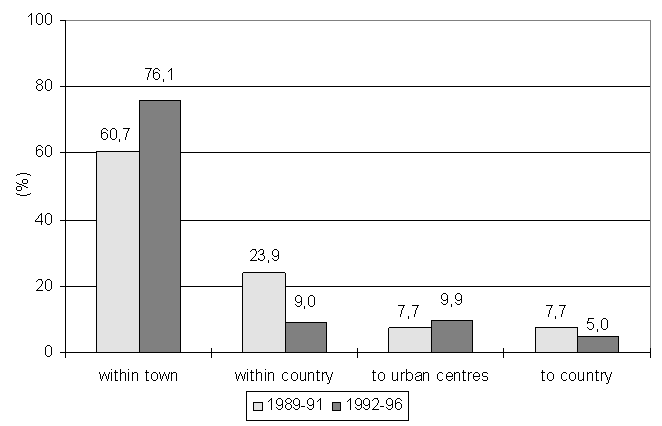 Sources: Estonian labour force survey Table 2. Employment by industries in some East European countries %
* According OECD classification: Agriculture includes fishing, trade includes hotels, finances includes real estate and business services, health care includes education Sources: Estonian labour force survey, OECD data, own estimations Table 3. Employment change by industries in the three Baltic states , 1992-1995 for Estonia and Latvia and 1993-1996 for Lithuania
* According OECD classification: Agriculture includes fishing, trade includes hotels, finances includes real estate and business services, health care includes education Sources: Estonian labour force survey, OECD data, Lithuanian Statistical Office, own estimations Figure 2. 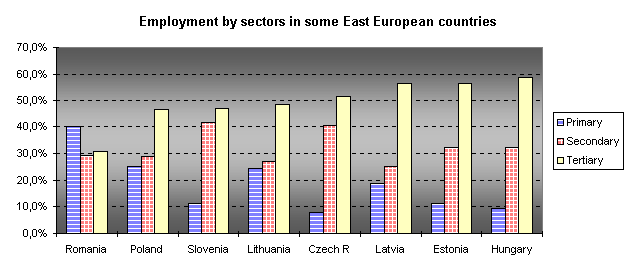 Sources: Estonian labour force survey, OECD data, authors estimations Figure 3. 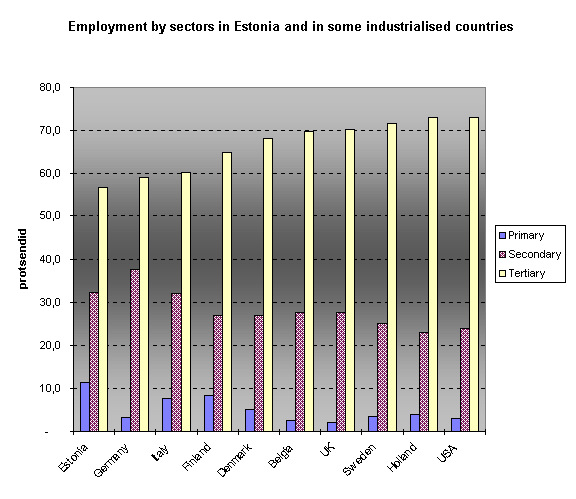 Sources: Estonian labour force survey, OECD data, authors estimations Table 4. Employment by age and gender %
Notes: * Russia 16-24; ** Hungary 25-54; *** Hungary both sexes 55-59 (female pension age 55); Poland: females 50-59, males 50-61; Slovenia: females 50-60, males 60-65; **** Romania: females 57, males 62, Hungary both sexes 60-74; Slovenia: females 61, males 66; Poland: females 60, males 65, Estonia: females 55-69, males 60-69 Sources: Estonian labour force survey, OECD data, authors estimations Table 5. Employment by education %
Sources: Estonian labour force survey, OECD data, authors estimations Table 6. Entrepreneurs by gender and sector. %
Sources: Estonian labour force survey, OECD data, authors estimations Table 7. Employment in private sector by sectors 1996.a.
Sources: Estonian labour force survey, OECD data, authors estimations Table 8. Some characteristics of unemployment in East Europe and in Estonia %
Sources: Estonian labour force survey, OECD data, authors estimations Table 9. Unemployment by duration %
Sources: Estonian labour force survey, OECD data, authors estimations Table 10. Positive and negative aspects of employment and unemployment changes in Estonia Plusses
Minuses
| |||||||||||||||||||||||||||||||||||||||||||||||||||||||||||||||||||||||||||||||||||||||||||||||||||||||||||||||||||||||||||||||||||||||||||||||||||||||||||||||||||||||||||||||||||||||||||||||||||||||||||||||||||||||||||||||||||||||||||||||||||||||||||||||||||||||||||||||||||||||||||||||||||||||||||||||||||||||||||||||||||||||||||||||||||||||||||||||||||||||||||||||||||||||||||||||||||||||||||||||||||||||||||||||||||||||||||||||||||||||||||||||||||||||||||||||||||||||||||||||||||||||||||||||||||||||||||||||||||||||||||||||||||||||||||||||||||||||||||||||||||||||||||||||||||||||||||||||||||||||||||||||||||||||||||||||||||||||||||||||||||||||||||||||||||||||||||||||||||||||||||||||||||||||||||||||||||||||||||||||||||||||||||||||||||||||||||||||||||||||||||||||||||||||||||||||||||||||||||||||||||||||||||||||||||||||||||||||||||||||||||||||||||||||||||||||||||||||||||||||||||||||||||||||||||||||||||||||||||||||||||||||||||||||||||||||||||||||||||||||||||||||||||||||||||||||||||||||||||||||