|
Juan R. Cuadrado Roura 1. INTRODUCTION The empirical evidence demonstrates that over the last few years important changes have taken place in Europe. Certain regions, which are not always the most developed ones, show high rates of growth and a very positive dynamics of development. However, others, which are not necessarily the less-developed or peripheral ones, show at the same time a more negative dynamics of development with rates of growth clearly below the mean. All of this reflects processes of convergence and divergence which take place in a more and more competitive and globalized context. Therefore, different traditional methods are necessary to capture, at least in a partial way, the complexity of these processes. A possible approach is to study the impact of the important economic transformations of the last few years on the productivity of the European regions using an alternative model. Productivity plays a key role in the evolution of regional economies, as evidenced in a great number of studies. However, when we refer to productivity growth, it is difficult to explain the large geographic variability within the restrictive framework of the neoclassical model. In fact, the gains in productivity are the result of a complex process of technical and structural changes that include, from the incorporation of technological progress or the introduction of new methods of production and new products, to the intra and intersectorial reassignement of resources. All in all, it is not an easy task to capture the array of factors that cause variations in productivity, nor does a standardized method exist in order to deal with it. Normally, a study of individual cases is required to understand the implications of these changes, which is clearly not the aim of this research. Productivity embodies a group of factors which are not easily differentiated. Nonetheless, these same factors play an important role in the explanation of the dynamics of development of regional economies. It does not mean that other variables such as capital, technology, or infrastructure are less important when trying to analyze the causes for which regions have different results. On the contrary, the best way to approach the topic would be to analyze all the factors that contribute to productivity gains. Unfortunately, the lack of homogeneous information on all these factors at the European regional level impedes a global approach like this and stands out labour productivity as the most viable alternative. One additional and more important reason is that our main aim is to analyze three variables (gross value added, employment, and labour productivity) using a more interesting and not conventional approach in order to know the convergence across European regions. Its interest derives from the fact that it permits a classification of regions according to their labour productivity and to the subsequent standardization of our model. The study is organized as follows. First, we will consider the main characteristics and problems of the database. Second, taking as starting point the results of a conventional analysis of regional productivity convergence of which we will explain synthetically its theoretical basis, we justify the need of an alternative approach. In the fourth section we will explain the theoretical aspects of the alternative model as well as the main results obtained; which are the leit motiv of the paper because they show heterogeneity as the most relevant point of the evolution of labour productivity in the European regions during the period 1980-1993. Finally, the last section underscores the main conclusions. To study of the evolution of regional productivity in the European Union, the only available statistically homogeneous information found is the REGIO database, which is provided by Eurostat and in which data are grouped by regional employment and gross value added at market prices from 1980 to 93 (see box 1). The data have been collected according to the European System of Integrated Economic Accounts (ESA), which constitutes the reference for the definitions of the aggregates used. In our case, data have been taken by branches of activity (NACE-CLIO, RR17). Through a process of aggregation we have obtained the gross value added and employment figures, always excluding the product assigned to banking services from the total product (see table 1).
In the Economic Theory the concept of productivity appears to be associated to technical efficiency between the available technologies for different time periods or for different economic agents. The empirical application could be calculated precisely using the productivity of a factor, generally labour or total productivity, although in the latter case the measurement create certain problems. Due to this fact it is common to choose labour productivity (as defined by the amount of output per unit of labourr) as the indicator, and under the unrealistic assumptions of homogeneity of the factor and of the use of a fixed quantity of the remaining productivity factors. Setting aside the theoretical implications of the validity of the previous assumptions some problems must be underlined when dealing with the calculations: 1. Regarding the variable output, a double alternative appears: gross domestic product and/or value added. We have chosen the second since it has the advantage of not double-counting the intermediate goods. Nevertheless, the availability of information obliges to make the calculations at market prices, instead of at factor costs, more advisable when establishing comparisons between different country regions with non-homogeneous indirect taxes. 2. In relation to the labour measurement, although production per hour has been the most suitable indicator, we have had to use the total number of persons employed due to database restrictions. This do not allow us to differentiate between country labour regulations. The selection of productivity in terms of gross value added per worker is justified because it reflects the relative speed of adoption of innovations within a country or region. In fact, the processes of innovations increase productivity by reducing the purchases of intermediate goods and employment, while, on the contrary, product innovations imply an increase of real production and/or prices per unit. 3. Finally, with respect to the conversion method of all the statistical information into a single currency, two possible alternative systems exist: use of productivity in nominal terms in "Ecus" and/or in terms of purchasing power parity (PPP). We have adopted the former under the consideration that, although the distortions originated by differences in the formation of prices are not eliminated, we indeed succeeded in obtaining data for the total G.V.A. for sectoral aggregation without having to assume that prices evolve equally in all sectors. Table 1. Nomenclature of branchs R3-R6-RR17 (NACE-CLIO). (Source: Eurostat)  European regions show clear differences in terms of area, population and level of government autonomy. As an example, it is sufficient to point out that the average surface of regions NUTS 1 is bigger than 33,000 km2, although this fact hides important differences: 215,000 km2 of the central region of Spain (Castille-Leon) against Brussels (Belgium) with 200 km2. It is also possible to detect disparities in terms of population: in Île de France there are more than 10 million inhabitants compared to the 115,000 inhabitants of the Valley of Aosta (Italy). Nor is it easy to compare the political-administrative regimes. In the European Union, federal states (Germany and Belgium) and regional states (Spain and Italy) coexist with more centralized states (United Kingdom, Ireland) and with some centralized states with another type of political-administrative regionalization (France and Portugal). These differences and the availability of data are important restrictions to be considered when adopting a homogeneous classification. Consequently, we have selected regions according to the possibility of comparing levels of self-government--for decentralized states--and, for the rest, the criteria refer to similarity in area and population, giving priority to the former. The resulting classification is the following (see Table 2):
2) NUTS 1 for Germany--excluding the new Eastern länders due to the lack of data--(11), United Kingdom (11), The Netherlands (4), Belgium (3), and Portugal--except overseas territories (5) 3) The whole country in the cases of Denmark, Ireland, Greece, and Luxemborg. A total of ninety-seven European regions have been selected for our analysis. Their labour productivity (1980-1993 has been calculated from the original series of G.V.A. at market prices and with the total number of persons employed. The existing information does not allow to extend the study to Austria, Sweden, and Finland, since data do not cover the entire selected period for our analysis.
3. INTERREGIONAL LABOUR PRODUCTIVITY CONVERGENCE IN EUROPE. The main purpose of this section is to confirm whether there is or there is not convergence in productivity, using a data panel referred to GAV of the group of selected European regions during the period 1981-1990. The possibility of having time series of a big number of regions allows to contrast two concepts of convergence that are well-known in the literature of regional growth: the absolute beta convergence (also called non-conditional beta convergence) and the conditional beta convergence, with which we will deal next. Convergence tries to contrast whether or not a situation of relative lag in a given moment tends to decrease when time goes. In other words, whether or not the regions with low levels of labour productivity have higher rates of growth than regions with high levels of labour productivity, in such a way that "catching-up" effect takes place. Convergence can appear either in a conditional or a non-conditional way. In the latter case only when the variables that determine the stationary state of the regional economies are controlled. The first case addresses the absolute convergence, that includes a series of implicit assumptions based on the notion that the regional economies do not differ significantly in their economic foundations. This fact reflects a capacity of the regional economies to converge to the same long-run equilibrium value and at the same speed. This implicit assumption of the absolute convergence does not necessarily have to appear in reality. The regional economies can differ quite significantly in the economic structures and in their infrastructure funding and other resources, providing that the process of economic convergence would neither have to evolve to the same point, nor should it conduce to the same long-term levels of equilibrium. These assumptions can be tested by using models in which the variables appear in such an explicit way that they are considered determinants of the stationary state of each economy. In other words, equations of convergence could be calculated where all the parameters considered could differ for each of the considered regions. The denominated conditional convergence is placed in this scheme. The presence of absolute or conditional convergence is not only a question of methodological or econometric discussion. The policy implications that are derived from both are completely different. If we admit the existence of different regional realities that determine different long-run trends, we are providing a wide field of action for public policies than if the non-conditional economic convergence is verified. In the first case, economic policies can or should be guided toward eliminating the obstacles that may be impeding or hindering the speed of advance of a region or a reduction of its level of relative backward state. These obstacles have to do with its productive structure, but also with deficits in infrastructure materials, human capital, availability of some factors, etc. In the second case (non-conditional convergence) the role of economic policies would remain merely circumspect to that which guarantees the smooth running of free markets. These definitions of convergence are not exempt from criticism. In fact, some authors have discussed the interest and the interpretation of the results obtained, arguing that the estimate of this type of convergence could be subject to the well-known Galton´s fallacy, as with this method we can not find polarizations in the per capita income distribution or in the labour productivity. The methodology that is applied to estimate convergence differs significantly from the original formulation, since it combines cross-section data with time series using a data panel for the European regions for the period 1980-1991 Estimating absolute means that we test the level of significance of the parameters of the following equation: 
In the first member of the equation differences in productivity growth (or labor productivity) are analyzed for region i with respect to the national growth. In the second member of the equation the value of the European mean is compared with the one of region i. The estimate of conditional convergence results from the following equation: 
The modeling of specific regional factors is carried out by using dummy regional variables (i), through a model with fixed effects, which makes possible the estimate of different stationary states, without the need of having the data of the variables which determine it. The utilization of the econometrics of the panel data has the advantage of allowing to estimate the regression coefficients which would not be estimated with a different type of data, time or cross-section. In effect, using a panel makes possible to test hypotheses which are intrinsic to the analysis of the absolute convergence: a unique speed of convergence for all regions (i=) and/or the existence of a regional parameters which define the same level of productivity in the long run (i=). This estimation approach has the advantage, as previously mentioned, that it is not necessary to establish assumptions about the variables determining the stationary state of each one of the regional economies considered. Additionally, it intends to save the drawback of the absence of regional data which allows an adequate estimation of these variables. Nevertheless, it shows a a big disadvantage when trying to interpret the value of fixed estimate effects since these constitute a "black box" which requires "deciphering" with a complementary analysis and that represents, in a way, the "ignorance" of the economist. The basic results of the estimate may be summarized in the following points:
Source: Own Calculation. 2. The analysis of conditional convergence by country using a model of fixed effects of dummy national variables leads to reject the hypothesis that national factors influence regional convergence in Europe (see box 1). 3. The analysis of conditional convergence by region using a model with fixed regional effects leads to different results (see table 4). First, because the model is statistically more consistent. Second because the value of is bigger (about 17%) and, finally, because a number of important regions display clearly disparate behaviors. Three groups of regions can be distinguished: Table 4. ß - Convergence. Regional Fixed - Effects model (1981-1990) Dependent variable : 
F-stat for Ai,B=Ai,Bi : F(96,679) = 1.0315 P-value = 0.4051 F-stat for A,B=Ai,Bi : F(96,775) = 1.5154 P-value = 0.0018 Hausman test of FE vs. RE : CHISQ (1) : 35.562 P-value = 0.0000 Source : Own Calculation. The previous results allow us to reach an important final conclusion. Within the 1980-1991 period a relative process of convergence has taken place between European regions in terms of productivity. However, this process of convergence hides a good number of regional peculiarities pointed out by the analysis of conditional convergence, through the value of the fixed regional effects. Nevertheless, it is necessary to take into account that an analysis of these characteristics deals with two important constraints. First, the economic convergence is basically a long-run process, in which the use of a relatively short time series makes difficult to properly appreciate the underlying trends of the regional economies growth. Second, the economic convergence continues being just a simple result of economic processes, of different nature, which demands a more detailed analysis. All in all, due to the complexity of these processes, the subject must be approached from a convenient alternative method such as the one outlined in the following section. Then the purpose is to try to establish some type of behaviour pattern within the observed regional heterogeneity. The alternative method which we propose has as its goal, to reach a typological framework for the selected regions, through the study of the annual cumulative real rates of three variables: gross value added at market prices, employment and apparent labour productivity. Later, to make an analysis of similarities we will use the technique of hierarchical clusters with the aim of offering a classification which, although less detailed, comes to be more objective than the grouping made in the first method. The combination of the annual cumulative real rates of three variables: gross value added, employment and apparent labour productivity allows us to get two typological models which we will briefly describe:
1.Comparing the growth rates of regional labour productivity ( a) Virtuous circle (first quadrant of figure 1.): It represents the best position because the growth of productivity and employment at a regional level is higher than the European average. b) Restructuring via productivity (second quadrant of figure 1): It is the reflection of a situation where the regional productivity growth is higher than the average European growth but where the employment growth at a regional level is below the European mean. c) Vicious circle ( third quadrant of figure 1): Represents a situation of economic decline. It is the worst position in which a region could find itself since the registered growth rates for both variables are lower than the average European rates. d) Restructuring via employment (fourth quadrant of figure 1): regions located in this area show an employment growth rate higher than the mean and a productivity growth lower than the European values. 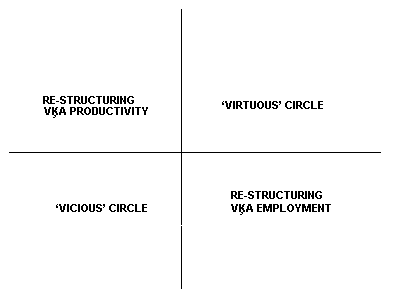 Figure 1. Regional typologies (I) Source: Own Calculation. 2. Comparing the regional productivity and employment growth including in the analysis a new variable: the growth of the gross value added ( The typology that we present offers a reasonably realistic but simplified theoretical representation of the true tendencies. In practice, the frontiers are not as clear and can coexist with different models within the same regional economy, in different sectors or in distinct subregional areas. Reality presents quite a notable variety of possible situations and whichever attempt to establish a specific number of homogeneous categories of structural behavior is inevitably, a simplification.
* This typology only appears when country cases are considered. Source : Adapted from Camagni and Capellin (1985) The best possible situation corresponds with the cases that we have named "virtuous" growth and reconversion (see figure 2, they both are in quadrant I). The first is, of course, the very best, given that the three variables submitted to test, reach regional levels greater than the average of the European economy. Usually, regions within this category correspond with lagged or developing areas, but which have the capacity to introduce rapidly processes of innovation and reorganization of their productive systems in a way that, in the long-run, the output growth influence positively the evolution of employment and productivity. 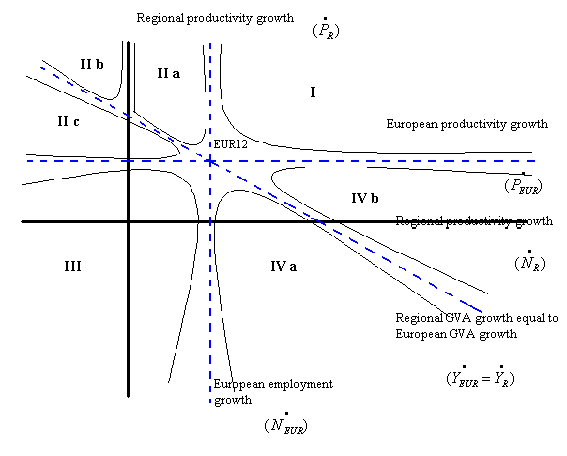 Figure 2 Regional typologies (II) Source : Adapted from Camagni and Cappellin (1985) In the typology of reconversion, the behaviour of these three variables is likewise positive, but the growth of regional employment, while still superior to Europe, shows a negative value, which can indicate a reassignment of resources until lagged sectors become advanced sectors, which generally are demanding less labour as they have higher capital/labor ratio and a technological component also higher. The next quadrant (see Fig. 2 quadrant II), devoted to "restructuring via productivity" can be conceived as a preliminary step to to a situation of "virtuous" circle. It is subdivided in three categories, although they offer notable differences between themselves. The first category dynamic restructuring should be identified with the case of the regions where growth of gross value added contains gains in productivity, although the employment growth is less than the European average. The next two categories (relative or absolute restructuring) have to do, fundamentally, with the evolution of employment. For the first, the relative gains in productivity come from increases in value added which are higher than the European average. In the second, the variable grows below the average, with the existence of processes of elimination of inefficient productions and, consequently, labour adjustments, which mean reduction of employees. All in all, in the case of absolute restructuring the loss of employment is far higher than that of relative restructuring.. The situation of economic decline (fig. 2 quadrant 3) implies the existence of a "vicious" circle with variations of productivity, gross value added, and employment below the respective European averages. It must be considered indeed, as the worst position within the established typological quadrants, although realized because the process of decline is defined in relation to European mean values. Normally, within this category there are regions which have had a high dynamism in the recent past thanks to the existence of a strong industrial sector specialized in activities of very positive behaviour but which, with the impact of the crisis of the seventies, have suffered a very important fall in their levels of production. Within this category there could also be regions which, without having a developed industrial sector, have had a productive structure which has dominated activities with very weak gains in productivity and/or with little capacity to generate employment. They are for example, areas with a rural sector strongly specialized in "traditional" productions and with a weakly developed service sector. Finally, the subdivision which appears in the typology included within the model of restructuring via employment (Fig. 2, quadrant IV), corresponds with those cases in which the production adjustment has coexisted with an improvement or with the maintenance of the level of regional employment. In other words, they are regions where the adopted growth model has been most intensive in the use of the labour factor than the European average, generally for external reasons of varied character. Therefore the increases in registered productivity have to be small and lower than those of the European mean. The conservative restructuring (IVa in figure 2) has been very common but not the only one in the "old" industrialized regions, where the maintenance of employment has been an important objective even though this might bear losses of efficiency and might suppose the maintenance of little competitive sectors especially in comparison with other areas. The intensive restructuring (IVb in Fig. 2), ceteris paribus, is a situation with gains in terms of production, though regional productivity remains remarkably below the European because the employment keeps a great importance. In this case we can find regions from the "old" industrial kind as well as "emerging" regions where the intention is not to protect existing employment for social reasons, but to facilitate the development of new activities which have the capacity to generate employment, although those regions have not yet reached the adequate conditions to place their productions in more competitive markets. This methodology has been completed through the analysis of hierarchical clusters (see Hair and others, 1995). This multivariate technique applied to our objective of study reveals what regions show big similarities and differences regarding the joint-behaviour of productivity and employment. Consequently, the fact that some regions fit into one or other possible clusters offers a classification, probably less detailed, but also less subjective than the one coming from the alternative technique (see box 2). Hierarchical cluster analysis. This technique classifies objects (regions in our case) into groups according to a multivariate group of available information on them (we have opted to select only two: productivity and employment), in a way that the objects of a same group show the greatest possible degree of similarity (internal homogeneity) and that objects located in different groups have the highest degree of disparity (external heterogeneity). The groups or clusters are not determined a priori. They are formed according to the data and observations that limit them. This technique of analysis begins making up as many groups as existing objects, and through an iterative process, step by step, succesive groups are formed until there is only one final group or cluster. In this way, it can be determined which are the most different objects- they come together always in the final stages of the process-as well as the number of groups that seem most fitted according to the magnitude of the difference of the conglomerates that begin to surface in each stage, and that are represented in the so-called dendogram or tree-graphic. In order to reach a classification, it is indispensable to use some measure of multivariate similarity or dissimilarity (differences or distances between cases) and an algorithm of classification. There are several possibilities to carry it out. In our case, we have decided for practical reasons to use, as measure, the square of the Euclidean distance and as algorithm the centroid link. The use of this algorithm implies considering as a distance between two groups the one existing between their centres of gravity (defined by the arithmetic means for each selected variable of the objects that form a cluster). According to the literature, this allows to get more robust results and it is especially indicated for our analysis where atypical cases derived from the disparate behavior of some regions appear. Finally, we want to remark that we have not used a predetermined number of groups or clusters. Instead of that we have acted according to each selected object, taking into account that in the final decision three fundamental aspects have been taken into consideration:
1. Examination of the obtained coefficients of agglomeration Consequently, the initially obtained clusters have been re-specified in order to obtain the final groupings which are represented together with the results of the joint- analysis of the variations of productivity, employment, and value added. This is a more objective as well as complementary means to provide the results obtained from the typological characterization since clusters always fit in one of the defined categories and, allow to detect regions with the most differentiate behaviours, and therefore constitute independent clusters. 4.2 Main results A first global vision of the values obtained for European regions allows to observe an apparent concentration of regional economies around the center of gravity near the mean values (see figure 3). Nevertheless, we focus our attention on regions located in the marked frame in figure 3. This scattered-diagram must be qualified when analysing each quadrant separately (see figure 4).  Figure 3. Regional typologies for European Regions 1980-1993 Source: Own Calculation  Figure 4. Regional typologies for European Regions 1980-1993: Square detail Source: Own Calculation. In the first quadrant, there are twenty European regions that have simultaneously registered a higher-than-the-mean growth in productivity, production and employment. They are are located clearly within the virtuous circle's typology. The most relevant issue is that not all the regions of this quadrant belong to the group with the highest level of income. In addition to these, we find others which can be characterized as intermediate (in terms of G.V.A. per capita). The cluster analysis allows to differentiate, within each typology, regions with more homogenous behaviours with respect to the two variables of reference. Regions with urban nucleus of medium size (centers of regional growth) appear together with regions with large metropolitan centers (capitals, financial centers, or industrial centers). Madrid (E), Luxembourg, Berlin (D), Lazio (I), Bayern (D) or Catalan (E), are some examples. Other groups of regions considered intermediate also appear within this virtuous group: Baleares and Canaries, with a strong specialization in services, or the typically industrial regions Baden-Wutenberg, Hesse or Schleswig-Holstein. Opposite to the previous are those regions situated in the third quadrant, labeled under the name vicious circle or economic decline. The distinct characteristics of these economies are that their productivity growth, G.V.A. growth, and employment, fall below the European mean. Twenty-two European regions are located in this typology (see figure 6). The first characteristic to stand out is that among them, there is a more defined spatial pattern than in the previous case. Regions in economic decline belong mostly to France or England, and they are characterized by a very accentuated predominance of the industrial sector. In other words, these are old industrialized regions, such as North (UK), Scotland (UK), or Lorraine (F), or the Belgium regions of Walloons and Brussels. The comparison of the results corresponding to these two quadrants highlight also a fact that has its reflection within each country. The technological and organizational changes in the economic activity and, mainly, in the industrial activity have assumed a challenge that has been confronted in an uneven way for most of the more advanced regions. On the one hand, there is a group of regions that have known how to adapt well to these changes by taking advantage of, maybe, certain economies of diversification or by specializing in activities with great growth. On the other hand, the regions in decline are an example of little diversified economies where the loss of economic activity in certain sectors has not been compensated by an economic dynamism in other activities. That is, their own industrial specialization has stopped the necessary changes needed to adapt to a new economic scenario. This differential behaviour between the regions, according to the typology in which they are framed, complements the previous analysis of convergence. Therefore, the small gains in productivity in the British regions mean that the negative results, in terms of convergence, are hidding a panorama of diversity. This verifies that convergence could have been achieved as a result of a process of "catching-up" of the most lagged areas -mainly areas of intermediate dynamism- but it also could have come from the fact that a good number of the most advanced regions suffered the negative impact of the economic crisis with the consequent structural changes. The selected time period for the analysis is representative of a process of deep changes at the European level. Very important political and economic changes, as a result of the international crisis and European economic integration, translated, in our case, have as result that the great majority of European regions are immersed into a process of restructuring. In fact, more than fifty percent of the selected regions are located in the second or fourth quadrant. This shows that they have been involved in processes of restructuring, with important increases in productivity, or with growth in employment over the mean in detriment of gains in output or productivity. Concretely the forty regions situated in the second quadrant show higher productivity growths at the expense of lower employment or at the expense of employment losses (restructuring via productivity)(see figure 7). Nevertheless, adding a third variable (G.V.A.), three typologies can be differentiated. The first - restructuring via dynamic productivity (IIa)-concentrates regions with a level of income higher than the European mean or the most dynamic regions from peripheral countries. So, for example, Hamburg (D), Rheinland-Pfalz (D), Navarra (E), and Umbria (I) make up, together with other regions, the same cluster, and Aragon (E), Lombardia (I), and Tuscany (I) form part of second different group within this same typology. Productivity and G.V.A. growth rates are superior to the mean thanks to clearly divergent employment behaviours, (fig. 7). In spite of the fact that they appear in the area of restructuring via productivity, we can not compare the positions of certain Italian regions (Liguria, Molise, or Piemonte, for example) that form only a cluster within quadrant IIb (relative restructuring) with important employment losses; with other Italian areas, such as Tuscany (I), Campania (I), or D'Aosta Valley (I), the latter in dynamic restructuring and, therefore, with an improvement in employment along the period of analysis. Finally, another group of regions is found inside a third typology, which we have previously qualified as absolute restructuring (IIc), characterized because productivity growths are higher to the mean thanks to a reduction of significant employment and to the growth of the G.V.A. below the European average. Those within this category are industrialized regions of intermediate development, like Asturias (E), Cantabria (E), Pais Vasco (E), which have suffered difficult processes of industrial reconversion in the eighties, together with other regions without a clear industrial specialization, Limousin (F), Poitou (F), or Castille and Leon (E), but that have also suffered a negative employment behaviour. In the fourth quadrant (see figure 8) which we have named restructuring via employment, fifteen European regions appear with certain behaviour patterns. All the Dutch regions are located in this category together with the rest of the British regions not included in other typologies. A detailed analysis permits the differentiation between restructuring via conservative employment (IVa) or intensive (IVb), depending on the regional output behaviour with respect to the European average. Most of the regions are located in the first typology, with rates of employment growth above the European mean, but with lower G.V.A. and productivity growth rates. Yorkshire and Humberside (UK), Wales (UK), East Midlands (UK), SouthWest and SouthEast (UK) for the United Kingdom are located in this position, together with all the Dutch regions with the exception of ZuidNeederland. On the other hand, East Anglia (UK), Languedoc-Rosellon (F) and Berlin (D) are regions inside the group of intensive restructuring but near to the area of the virtuous circle. Employment creation in these regions was higher than the G.V.A growth. Therefore productivity growth rates are lower than the European average.  Figure 5 Regions included within the "virtuous circle typology" (quadrant I) Source: Own Calculation  Figure 6 Regions included in the "vicious circle" typology (quadrant III) Source: Own Calculation  Figure 7 Regions incluided in the typology re-structuring via productivity (quadrant II) Portuguese regions and Ireland have been excluded Source: Own Calculation  Figure 8 Regions included in the typology of re-structuring via employment (quadrant IV) Source: Own Calculation. 5. MAIN CONCLUSIONS The main conclusions which are derived from the analysis completed could be summarized as follows: i) Advanced regions with good results (employment creation and productivity and G.V.A. growth rates above the European mean). They are economies with a diversified and solid productive structure. They have financial or industrial clusters of international and European relevance. Hesse (D), Luxembourg or Lazio (I) are representative examples. Most of the regions included in this group are located quadrants I and IIa. ii) Dynamic intermediate regions. Included in this group are regions with an intermediate development, located in the geographical peripheries, like the central areas the European Union, which have enjoyed an important dynamism in terms of productivity and employment. The structural changes of the past few years are reflected in an adequate process of adaptation or in a strategy of growth based on dynamic activities (some of the branches of manufacturing and the third sector in general). Once again the core-periphery scheme shows a rupture since there are central regions such as Baden-Wuerttember (D) or Lombardy (I), periphery regions such as Canary Islands (E), Navarra (E) or even, intermediate regions such as Tuscany (I), all of them located in quadrants I and IIa. iii) Intermediate regions with less dynamism where it is not possible to say that there is a catching-up effect in productivity or employment. The cases of Liguria (I), Emilia-Romagna (I), Basse-Normandie (F), or País Vasco (E) illustrate this situation. Generally, they are located in quadrants IIb, IIc, and IV. iv) Declining regions which correspond with central regions of old industrialization with problems of reconversion or lacking in activity. A good number of cases in regions from France and Britain constitute the most representative of this group (quadrant III). v) Finally, there is a group of heterogeneous clusters consisting of regions with an independent behaviour. Portuguese regions, with the exception of Lisboa and Norte, and Holland are representative of this group. They show the disruption of over simplified schemes such as wealthy regions/poor regions or core regions/periphery regions. In conclusion, the study we have made reinforces the complexity when trying to analyse the European regions' behaviour in terms of labour productivity. At the same time it helps to a better knowledge of the changes suffered by European regions. However, we realize that our analysis leaves some questions unanswered which could only be addressed using particular sectoral studies and region by region analysis of cases.
Arellano, M. (1992) : "Introducción al análisis econométrico con datos de panel". Working paper 9222. Servicio de Estudios. Banco de España. Arellano, M. (1993) : "On the Testing of Correlated Effects with Panel Data", Journal of Econometrics, 59. Arellano, M. and Bover O. (1990) : "La Econometría de Datos de Panel", Investigaciones Económicas, 14. Barro, R.J. Y Sala-i-Martín, X. (1991) "Convergence across states and regions"; Brookings Papers on Economic Activity, 1, pp. 107-182. Baumol, W.J. (1986): "Productivity growth, convergence and welfare: What the long run data show"; American Economic Review, vol.78,n.5,pp.1155-1159. Camagni, R. y Cappellin, R. (1985) : La productivité sectorielle et la politique régionale; European Commission. Bruselas. Chaterij, M. (1993) : "Convergence clubs and endogenous growth", Oxford Review of Economic Policy,8, 57-69 Cuadrado Roura, J.R.; Mancha Navarro, T. y otros (1990): El crecimiento regional español ante la integración europea; Instituto de Prospectiva. MEH. Cuadrado, J.R., García, B. y Raymond, J.L. (1996) : "Regional Convergence : An analysis of its major explanatory factors" paper presented at the European Congress of the RSA, Zurich, (available in the Congress CD-Rom). Cuadrado, J.R., García, B. y Raymond, J.L. (1997) : "Convergence in terms of regional productivity and productive structure : the Spanish case" International Regional Science Review, (forthcoming). Cuadrado Roura, J.R., Mancha, T. Y Garrido, R. (1997) : "Tendencias de la productividad regional española"; Información Comercial Española, no. 762 pp. 87-110. C uadrado, J.R., Mancha, T. y Garrido, R. (1998): Convergencia regional en España: hechos, tendencias y perspectivas. Fundación Argentaria-Visor, Madrid European Comission (1997): First Report on the Economic and Social Cohesion. Luxemburg. EUROSTAT (1992): Regions, Nomenclature of territorial units for statistics NUTS, March Hair, J.F.; Anderson, R. E.; Tatham, R.L.y Black, W.C. (1995): Multivariate Data Analysis. Prentice-Hall. New Jersey. Nelson (1981) : " Research on productivity growth and productivity diferences"; Journal of Economic Literature, sept. Paci, A. y Pigliaru (1997): "Structural change and convergence: an Italian regional perspective"; Structural Change and Economic Dymanics, 8, pp. 297-318. Quah, D. (1993a) : "Galton's fallacy and the convergence hypothesis"; Scandinavian Journal of Economics, 95, 427-443. Quah, D. (1994): "Comentario" al trabajo de Sala-i-Martín "La riqueza de las regiones"; Moneda y Crédito, no. 198 Quah, D. (1996a) : "Empirics for economic growth and convergence", European Economic Review, 40, 1353-1375. Quah, D. (1996b) : "Twin peaks : Growth and convergence in models of distribution dynamics", WP n. 280, Centre for Economic Performance, London Raymond, J.L. y García Greciano, B. (1994) : "Las disparidades en el PIBpc entre las CC.AA. y la hipótesis de convergencia", Papeles de Economía Española, nº 59 pp. 37-58 Rodríguez Pose, A. (1997): "El papel del factor estatal en la percepción de la convergencia regional en la Unión Europea"; Información Comercial Española, nº 762, pp. 9-24. Sala-i-Martín, X. (1990): On Growth and States. Ph. D. Dissertation, Harvard University. Sala-i-Martín, X. (1996): "The Classical Approach to Convergence Analysis"; The Economic Journal, 106 (July), pp. 1019-1036. | ||||||||||||||||||||||||||||||||||||||||||||||||||||||||||||||||||||||||||||||||||||||||||||||||||||||||||||||||||||||||||||||||||||||||||||||||||||||||||||||||||||||||||||||||||||||||||||||||||||||||||||||||||||||||||||||||||||||||||||||||||||||||||||||||||||||||||||||||||||||||||||||||||||||||||||||||||||||||||||||||||||||||||||||||||||||||||||||||||||||||||||||||||||||||||||||||||||||||||||||||||||||||||||||||||||||||||||||||||||||||||||||||||||||||||||||||||||||||||||||||||||||||||||||||||||||||||||||||||||||||||||||||||||

 ) and regional employment (
 ) with its corresponding European values (
  y
y  )--see figure 1--it is possible to differentiate four general situations:
 for regional values and
  for the European values), which is exactly the sum of both (see table 2) . Adding this variable, new situations can be identified. They appear summarized in the typologies of table 5.


 and >0


 and < 0


 and > 0


 and < 0


