|
Trade and Transition in the Baltic Rim
Andreas P. Cornett, Søren Peter Iversen
1. Introduction From the very beginning of the process of transition in East and Central Europe the Nordic countries embarked on a policy to revitalise the historic links to the Baltic Rim countries in general and to the three Baltic States, Latvia, Lithuania and Estonia, in particular. To some extent this took place in co-operation and competition with other countries with strong historic and economic ties to the region. The Nordic countries particularly took the lead in the field of facilitating the process of democratisation, and had a certain influence on the institutional development, namely through educational programs for civil servants and to some extent politicians. In the field of economic development direct aid played an important role in the early years, but relatively quickly multilateral frameworks (EBRD, PHARE-program of the EU) took the lead. Nevertheless economic and political links developed further, both in a bilateral perspective and within the Baltic Council, a consultative body of all Baltic Rim States (Walter 1998). The purpose of this paper is to give an assessment of the first years of this process on the background of historical developed relations, and the requirements of the transition process in particular. Our attention will focus on the relationship between the development of trade and economic relations and the process of institutional transformation, internal as well as with regard to the new political and economic regime of the region.
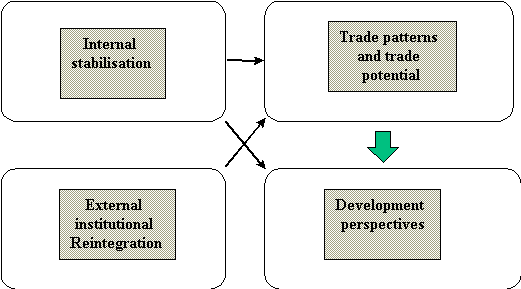 Figure 1: Framework of analysis The Baltic States are in a historic perspective a new phenomena, only independent for approximate 20 years between the two world wars. Nevertheless studies have demonstrated that at least to some extent economic and political traditions differs from other parts of the former Soviet Union (see Laaser & Schrader, 1992). In this perspective the Baltic States has a position somewhere between Poland (and other Central and East European Countries) on the one side and Russia, the potentially largest economy adjacent to the Baltic Rim (Cornett & Iversen 1997, Callsen & Jäger-Roschko 1996). In the long run Russia is probably the most important trade partner in an All European Perspective. In future Russia will undoubtedly be one the most important economies for most countries in the region despite the huge present problems of transition. The purpose of this paper is to provide an assessment of the contemporary
position of the Baltic States in the process of reintegration
of the East and Central European Nation in general and of their
involvement in the regional system of the Baltic Rim in particular.
The framework of analysis is sketched in Figure 1 on the previous
page. The decisive or independent variables in our framework are
the issues of internal stabilisation (economical as well as political,
see section 2) and the participation in international institutional
settings (external institutional reintegration) in section 3.
The right- hand -side in the figure covers the indicators used
in our analysis (mainly trade and to some extent indicators of
other economic links, section 4) and the final evaluation of the
results in a development perspective (section 5).
From the very beginning of the transition process in East and Central Europe the Nordic countries focused their attention toward the Southern Rim of the Baltic Sea, and in particular toward the three Baltic States. The Danish Secretary of State was one of the first official visitors in the newly independent states and a huge share of bilateral economic assistance from the Nordic countries were directed toward these three new nations. Despite of attempts to co-ordinate, in particular in the field of political and institutional advice, elements of competition prevail, of course mainly with regard to economic interests. (Strategisk Forum 1998). In particular Estonia - partly for cultural and geographical reasons - developed strong ties to Finland, itself suffering from the transition process in the early 1990's. 2.1 Economic links Table 1 provides a brief summary of the changes in the trade pattern of the former statetrade countries of the East and the old market-economies of the Western part of the Baltic Rim since 1993. This changes has to be examined on the background of the overall changes in trade patterns taking place in Europe since the early 1990's. From 1988 to 1992 major changes took place in the trade pattern of CMEA (Council of Mutual Economic Assistance) member countries. On average internal CMEA exports were reduced from 36,8 % to 17,6 percent of total trade. At the same time the AEU-12 share on average almost doubled from 28,8 to 46,9. The changes were are even more significant when the 6 Central and East European countries are considered. Here CMEA exports on average decreased from 31,9 % to 12,1 % (Cornett 1994, p.8). Regarding trade in the Baltic Region (see annex Table A6) the
trade shares of Denmark, Finland and Germany in the Baltic Region
has been reduced from 1993 to 1996. Sweden is apparently a special
case in the sense that Swedish share of exports to the Baltic
region has declined whereas Swedish share of imports from to the
Baltic region has increased. All the transition economies in the
region have increased their share of trade in the region, although
this increases has been relatively modest.
Trade is frequently seen to be the first step in the process of developing economic relations between distinct economic areas, usually followed by foreign direct investments (see table 2) and closer economic agreements with regard to trade, investment and co-operation (see table 5 in the next section) In a regional perspective the most interesting feature is the
geographical concentration of FDI from the Nordic Baltic Rim.
Compared to trade figures the absence of German predominance is
notable. In an All-European perspective the share of the Baltic
States is of course small, also when the size of the population
and the economy is taken into account. FDI received from the EU
increased from 38 Mill ECU in 1993 t0 140 Mill ECU in 1995.
Despite the fact that the Baltic States have intensified economic
relations to the western markets, strong dependence to the CIS-area
persists. It is important to stress that this not is a one-way
dependency, but rather a mutual relationship. I.e. Russia still
depends on the Baltic States with regard to transport facilities
for exports and imports. This gives rise to both risks and challenges
for development in the Baltic States, not only on a regional level
but also in an European perspective, in particular with respect
to infrastructure investments, reinforced by the overcrowded road-connection
through Poland and Germany. The process of catching up on the income level in the EU not only requires political and economic reforms (see Cornett & Iversen 1997), but also excess economic growth to reduce the gap. This is a necessary condition to become a full member of the western economic system. As can be seen from Table 3 Poland has been ahead of the 10 CEEC
countries since 1995. With regard to the Baltic States the picture
is mixed, but the most recent numbers (and forecasts) indicate
a relative high growth performance. A comparison with Figure A1
and A2 in the annex makes the saliency of the catch-up problem
evident, since the excess growth compared to the traditional market
economies in the region seems to by rather modest.
* E: estimates, F: forecast
* F: forecast CEC8 excluding Bulgaria & Romania 3. Trade and Transition : The Baltic Rim in a broader context The external context for the transition process in the Baltic
Rim area is determinded by the established western system,
namely the EU, WTO and the UN-system. The single most important
framework with regard to our analysis is international trade regime
defined by the WTO. The trade regime relevant for this analysis mainly consists of
obligations according to international, regional and bilateral
agreements. Most important regulatory framework are the obligations
according to the so-called European Agreements with the EU (see
Table 5 below). With regard to economic agreements the Baltic
States position is one step behind the status of Poland, but ahead
of Russia. The future status will mainly be determined by the
result of the accession negotiations with the EU. For our analysis
the trade-regime as stipulated in table 5 constitutes the institutional
framework for the trade-flow analysis.
* Estonia, Latvia & Lithuania where not members
of WTO when the current source was published
With regard to internal economic stabilisation the Baltic states does not constitute an homogenous group, as well as huge differences between the Baltic group and the rest of Central and Eastern Europe still remain. The first table in the annex (Table A1) gives a tentative classification of the status of economic transition in 25 transition economies in CEEC and FSU. The data are obtained from EBRD's Transition Report 1997 (EBRD 1997). A cluster analysis based on the data from table A1 in the annex suggests, that the 25 transition economies can broadly be divided in three different groups or clusters, see also the note in Figure 2 below. Furthermore the figure seems to suggest that there is a fairly strong empirical relationship between reform progress and economic growth (R2 = 0,4). The three groups are broadly characterised as follows: Group 1 consists of countries that according to EBRD's assessments have moved furthest towards a market economy and the privates sector make up a large share of their economy. Group 2 consists of countries that are lagging behind in the economic transition process. In general the private sector only makes up a fairly small share of the economy in these countries. Group 3 is an intermediary group consisting of countries that have taken steps towards a market economy without having moved as far as the countries in group 1. For our purposes the most interesting feature of this cluster analysis is that all the countries in the eastern part of the Baltic Rim region are included in group 1. This group includes the countries that have moved furthest towards a market economy and institutional reforms. For the greater Baltic Rim region, including Russia the picture is more differentiated, with Russia lacking behind the smaller countries at the southern shores of the Baltic Sea. If political destabilisation increase, and the economic problems persists, the overall stabilisation of the region could be challenged.
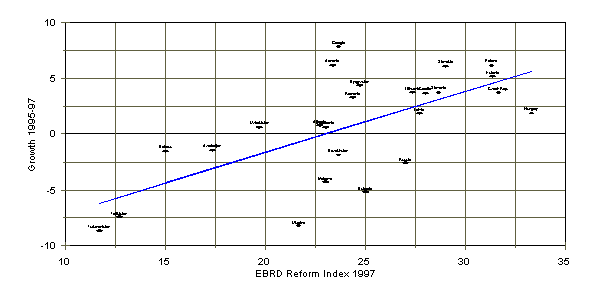 Figure 2: Economic Reform and Growth of The Economies of Transition (Source: EBRD,1997) R2-adj. = 0,40
Note:
Cluster 1: Croatia, Czech Rep., Estonia,, Hungary, Latvia, Lithuania, Poland, Russia, Slovakia, Slovenia Despite of the fact that the cluster-analysis not is able to show significant differences between the Baltic States and Poland, or within the group, the results are valuable at least in two perspectives. Firstly, the results enable us to group the whole range of transition-economies in three groups of which two belongs to over area of analysis. It is worth to have in mind, that a countries not considered homogenous from an genereal perspective, looks much more homogenous from an transitional point of view. Secondly - and for our purpose most important - the analysis shows that the political decision to split the accession-process with regard to EU membership is rather problematic.
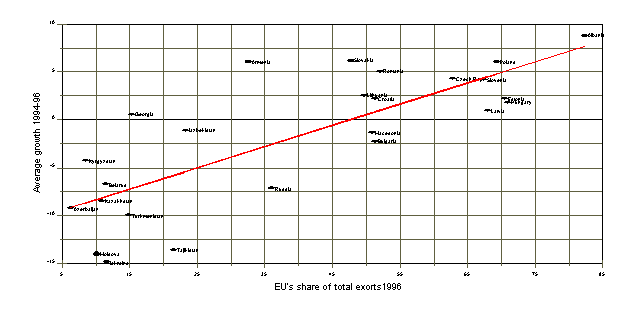 Figure 3: Trade and Growth of The Economies of Transition (Source: IMF, 1997 and EBRD, 1997) Note: R2 = 0,61 From a methodological point of view this cluster analysis illuminates
all the traditional critique of (the lack of analytical power)
of cluster-analysis. Regardless of the fact that this analysis
does not contribute very much to our main focus the Baltic States
in a Baltic Sea and European perspective, the findings are relevant
in an broader transitional or global context. Figure 3 provides
an alternative perspective on the transition economies. Figure
3 suggests that there is a strong degree of co-variation between
share of exports destined to the EU-area and economic growth in
the transition economies (R2 =
0,61). The results are to some extent similar, but at least one
interesting feature is visible with regard to the Baltic Rim,
where Lithuania exempted from the cluster of the countries with
the highest scores on the growth and export-share. In an EU perspective
the most interesting feature is, that the five first-round East
and Central European countries are within this group. For obvious reasons trade in the Baltic Rim region is dominated
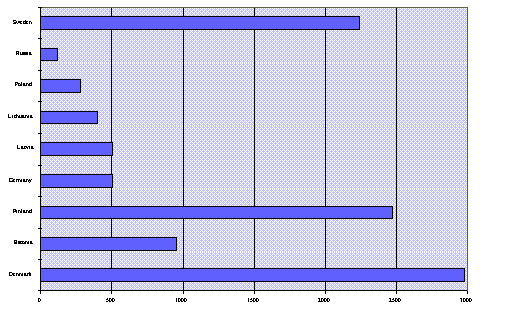
by Germany. But as can bee seen from table 6 and figure 4 the
small open market economies in the Baltic Rim account for the
largest per capita trade in the region. The transition economies
in the Baltic Rim only account for a relatively small share of
trade in the area.
Note: GDP in PPP is calculated as population multiplied by GDP per capita in PPP.
In the following section of the paper we will try to estimate future trade in the Baltic Rim. The basic idea behind the estimates is that the geographical pattern of trade in the Baltic Rim will converge to, or approach, the geographical pattern of trade among the existing members of the EU as the political and economic reforms bear fruit. In the present context the following specification of the gravity
model will be used:
A log transformed version of the model was estimated on trade between the present EU-member countries and the ten CEEC candidates in 1993, 1994, 1995 and 1996. As Luxembourg counts as part of Belgium, we are speaking of 24*23 (= 552) bilateral trade flows. Trade data were obtained from Direction of Trade Statistics Yearbook (IMF 1997). Income data were obtained from World Bank Atlas (World bank 1995 and 1997). These data are presented in table 6. Information about distances in kilometres was obtained from distance tables in a Danish publication, namely Kraks Store Kortbog Europa (1995). These data were confirmed by comparison with distances from Autoroute Express (computer software). Only the first three dummy variables, P1, P2 and P3 were included in the regression as the value of the fourth is predetermined by the value of the other three. In earlier studies (Cornett & Iversen 1995 and 1997) the gravity model was applied in two steps. First the model was estimated on internal EU trade and then the estimated parameters were applied on trade between EU and CEEC and internal CEEC trade. The main advantage of the approach taken here is that it utilises much more data containing much more information. This is obtained at the cost of less stable parameters. The reduction of parameter stability is probably due to the significant changes in GDP in the CEEC's during their transition to a market economy (see for example the discussion between on one hand Gros & Gonciarz (1996) and on the other Baldwin (1997) and Kellman (1997). The results from the regression analysis for 1996 are reported
in table 8. The results show that the models' independent variables
explain almost 90 percent (88,8) of the variation in the dependent
variable. Furthermore, the results in the table show that the
income parameters are positive and that the distance parameter,
as expected, is negative. All parameters are statistically significant
(p<0,0000).
545 cases used 7 cases contain missing values
The gravity model (table 8) reveals the rather interesting result, that b4 > b5 > b6 . This suggests that the relative effect of the dummy variables (P1, P2, P3 relative to P4) is ranked according to the presentation of the variables in table 6. Similar results were obtained from running the regression for data from 1993, 1994, and 1995. The relative effect of EU-EU trade is greater than EU-CEEC trade, which in turn is still greater than CEEC-EU trade. This seems to lend some support to the popular notion, that trade relations between the EU and the CEEC are asymmetrical to the benefit of EU. The existing trade regime in Europe is primarily based on the Internal Market, which encompasses all the present EU member countries and the so-called Europe Agreements, which covers trade between the EU on one hand and the CEEC's on the other (Baldwin 1994 and Iversen 1995). The results from the gravity model seem to support the notion that the existing trade regime is especially favourable for the EU rather than the other way around. Nevertheless, on the basis of the present analysis it is not possible to conclude that the present trade regime in fact causes this pattern. It should be remembered, that some of the more protectionistic features of the Europe Agreements were supposed to be phased out by 1997. The effects of this still remain to be seen. In the following section these empirical results will be used
to shed light on future trade relations in the Baltic Rim. The
discussion will focus on the following questions: Is the trade
potential in the Baltic Rim fully exhausted? Can further redirection
of trade in Baltic Rim be expected? In the following we present two trade scenarios for the Baltic Rim Region: A short term and a long term scenario. Potential trade in the short term scenario is calculated on the basis of the gravity model and the parameter estimates in table 3. The dummy variable P1 is designated the value 1. Consequently all bilateral trade flows are treated as if they were EU-EU trade relations. In the long run scenario the same procedure is followed, but here it is combined with a long term growth scenario. A series of studies seems to confirm that there is a considerable potential for economic growth in the region (Good 1996, Drud Hansen & Skak 1997, Barbone & Zalduendo 1997, Fischer, Sahay & Végh 1997, Denizer (1997), EBRD 1997 and Fischer, Sahay & Végh 1998). According to the EBRD (1997, p. 98) especially two factors seem to account for the favourable growth prospects in the CEEC's: The first is the high level of skills acquired through the previous regimes' high priority to education. The second is the existence of a technology or productivity gap between the CEECs and more advanced economies The combination of these two factors indicates fertile ground for transfer of technology from the OECD countries for instance through direct foreign investments in Central and Eastern Europe (see also Estrin, Hughes & Todd 1997, p. 27ff.). According to the EBRD these two factors together could contribute to an annual growth rate between 4 and 7 percent. Unfortunately EBRD also points out that the quality of institutions supporting investment in resources and technological innovation is low in the majority of the transition economies. EBRD concludes that the lack of proper institutional frameworks might pull in the opposite direction and reduce annual growth rates by up to 1,5 percentage points. Together these factors should make it possible for the transition economies in CEE and FSU, depending on future reform policies, to obtain annual growth rates between 2,5 and 5,5 percent. Denizer (1997) and Fischer, Sahay & Végh (1998) use
a more formal and integrated approach in that they apply the growth
equations of and Levine and Renelt on the economies of transition.
These growth equations are described in Table 9.
Various long term growth prospects for the countries of Eastern
Baltic Rim are presented in table 11. Not surprisingly, as can
be seen from Denizers results, future growth in the region is
highly dependent on future investments.
For our purposes present incomes in the countries of the Baltic
Rim were extrapolated for fifteen years using fixed annual growth
rates. Incomes in Germany, Denmark, Sweden and Finland were extrapolated
with a 2,5 percent annual growth rate. Incomes in Estonia, Latvia,
Lithuania, Poland and Russia were extrapolated with a 5,0 percent
annual growth rate.
Table 11. Gravity Model Trade Scenario.
Table 12. Distribution of Trade In The Baltic Rim. Actual and Potential. Percentages.
We present the results from this exercise in table 11 and 12 above.
As can be seen from the tables our estimates suggest that there
still is a rather considerable unutilised trade potential in the
Baltic Rim. Regardless of future growth in the region we expect
that some reorientation of trade will take place in the region.
These tendencies will probably be reinforced in the longer run
as the countries of Eastern Baltic Rim continues to grow. The title of this paper, 'The Baltic States in an European and Baltic Perspective: Trade and Transition in the Baltic Rim' is too ambitious to provide a appropriate coverage of all relevant aspects of the topic within the space available in one paper. Nevertheless some tentative conclusions are possible. First of all, it is impossible to divide the European and Baltic perspective. The later is a part of the former, but characterised by special features, like spatial proximity, historical links and a common cultural heritage. The second more general conclusion is that the political and economic process of transition and transformation are not dividable in practice, and are strongly dependent on the speed and intensity of reintegration in the institutional framework of the western marked economies. The analysis in the previous sections makes evident, that the transition process walks hand in hand with huge socio-economic changes in the Baltic Rim. Political and structural changes will be required in the eastern part of the region as well as in the western part or the European Union as a whole, if the ultimate goal of economic equity has to be reached. Market access and non-discrimination in the field of economic transition will still be the guideline for policy, not only with respect to the Baltic Rim but also to the less favoured countries outside the EU-neighbourhood (see cluster 2 and 3 in figure 1). A successful reintegration has to be based on the principle of
reciprocity, and has to be seen in an All-European perspective.
The process of transformation is an All-European process, and
not only a question of unilateral adaptation in the applicant
countries. Economic integration has to go beyond the removal of
barriers (negative integration), and include a participation on
equal terms for East and Central European countries in the building
of a new economic constitution (positive integration). Transition
periods and economic transfers are two side of the same coin.
The more restricted (limited) the transfer payments, the longer
transition-period or more exemptions from EU-rules are required. Despite of the fact that the Baltic States were a part of the
Soviet Union for almost 50 years the cluster analysis reported
in this paper demonstrated that they at least measured on the
included variables are very similar to the main group of East
and Central European countries.
Note: E: estimates, F: forecast With regard to the economic aspects of transition our analysis has no indications of significant differences within the group of the former state-trade countries of the Baltic Rim area (Russia is exempted) with regard to economic performance and internal stabilisation (growth, inflation or unemployment). With regard to the issue of external equilibrium all countries have still huge problems. From a political point of view the figures in table 13 illuminates the interesting point, that external balance-problems seems to be largest in Estonia, the only Baltic State included in included in the first wave of enlargements. The low debt-export ratio of the country is of cause important to bear in mind. Similarly the very high debt-export ratio of Poland constitutes a heavy burden for future development. In the long run external balance-problems are only a crucial
factor for economic development, but constitutes a challenge
not only for economic but also political stability. A sustainable
solution of this problem requires both economic assistance (see
section 5.3 below) and most important a solving of the balance
of payment problems through a positive trade-balance. Recent trade data suggest that a reorientation of trade in the Baltic Rim is taken place as a result of economic and political transition and liberalisation of trade. Those trade relations that includes at least one eastern trade partner seems to be of increasing importance. In our study we use an updated and reformulated gravity model
to trace these changes into the future. The results of our gravity
model scenarios confirms, that the reorientation of trade in the
Baltic Rim is likely to continue and the present tendencies is
likely to be reinforced by future economic growth in the region.
If this part of the conclusion holds, it lends ample support for
the wider perspectives for the regions development presented below. The process of transition and recovery in East Europe and in the Baltic states has been challenged not only by the regained influence of traditional political groups in East Europe but also through the reluctance of the EU to open their markets in sectors where the former CMEA-countries are competitive. The only feasible road to avoid further drawbacks is to establish a self sustainable economic system able to handle internal problems of transition in the region, and enable the states to accommodate the external challenges (i.e. the process of enlargement). Reforms in the applicant countries are only the first step in this process. Reforms of the economic system in Western Europe (the EU) are necessary as well. Most urgent are probably the reform of the Structural Funds (see European Commission 1997c, Cornett 1998). Furthermore it is important to adapt EU-assistance policy not only to the internal EU modes of operation but also to take the needs and organisational setting of the receiving countries into consideration. In a transitional perspective the European Union is the cornerstone of the rearrangement of the economic landscape not only in Europe but also in an Baltic Rim. It is still too early to take this process for granted, despite of the fact that the IGC of Amsterdam at least on the surface paved the road for the first round of eastward enlargement. The pivotal position of the EU does not mean that the EU is the only important factor in this process. With regard to the future economic system a satisfactory accessesion to the EU-system will almost automatically provide a link to the global economic system of WTO arrangements. A solution of the internal EU problems with regard to institutional reforms and the transfer-payments through the budget seems to be a precondition for a successful fullfillment of this pivotal role. In the field of politics the picture will remain complicated. Individual countries, ethnic groups and especially also the revival of traditional goals in Russian foreign policy and the derived perception of threats in East and Central Europe as well as in parts of the former Soviet Union, constitute decisive features of the regional system. Both in an economic and social perspective the German reunification has proved the saliency of the tremendous challenges facing the Eastern part of the in their attempt to recover after 40 years of command economy. Compared to the of huge transfer payments from West to East the assistance made available by international organisations (EBRD, World Bank and IMF) the EU individual countries are rather limited. Privat investment - as mentioned in section 2 - will become still
more important with respect the economic relationship between
the East and Central European Countries and the EU, despite of
the fact that the EU-transfers mainly within the framework of
PHARE, TACIS and the 'Pre-Accession Strategy' within the framework
of the 'Agenda 2000' are of considerable size. Annex :
Table A1: Progress in Transition in Eastern Europe, The Baltic's
and the CIS.
Source: EBRD(1997), Transition Report, London Table A2: Trade in the Baltic Rim Region 1993. Mill. USD.
Source: IMF (1997): Direction of Trade Statistics Yearbook, Washington. Table A3: Trade in the Baltic Rim Region 1993. Percentage Distribution.
Source: IMF (1997): Direction of Trade Statistics Yearbook, Washington. Table A4: Trade in the Baltic Rim Region 1996. Mill. USD.
Source: IMF (1997): Direction of Trade Statistics Yearbook, Washington. Table A5: Trade in the Baltic Rim Region 1996. Percentage Distribution.
Source: IMF (1997): Direction of Trade Statistics Yearbook, Washington. Table A6: Annual Growth of Trade in the Baltic Rim Region 1993-96. Percentage.
Source: IMF (1997): Direction of Trade Statistics Yearbook, Washington. Table A7: Change in Percentage Distribution of Trade in the Baltic Rim Region 1993-96. Percentage Points.
Source: IMF (1997): Direction of Trade Statistics Yearbook, Washington. Table A8: Short Term Gravity Model Scenario. Mill. USD.
Source: IMF (1997): Direction of Trade Statistics Yearbook, Washington. Table A9: Actual Trade as Percentage of Short Term Potential.
Source: IMF (1997): Direction of Trade Statistics Yearbook, Washington. Table A10: Long Term Gravity Model Scenario. Mill. USD.
Source: IMF (1997): Direction of Trade Statistics Yearbook, Washington. Table A11: Projected Annual Growth In Long Term Gravity Model Scenario.
Source: IMF (1997): Direction of Trade Statistics Yearbook, Washington. 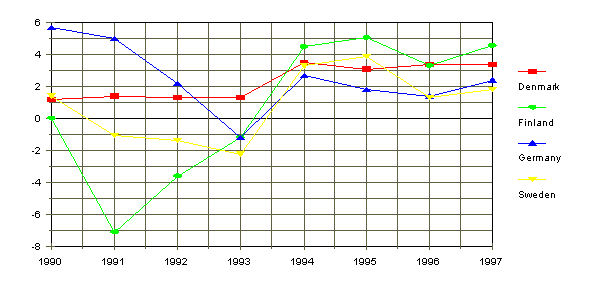 Figure A1: Economic Growth in The Market Economies in The Baltic Rim (Source: OECD 1997) 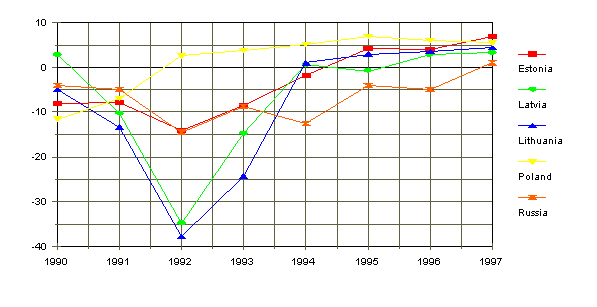 Figure A2: Economic Growth in The Transition Economies in The Baltic Rim (Source: EBRD 1997) | |||||||||||||||||||||||||||||||||||||||||||||||||||||||||||||||||||||||||||||||||||||||||||||||||||||||||||||||||||||||||||||||||||||||||||||||||||||||||||||||||||||||||||||||||||||||||||||||||||||||||||||||||||||||||||||||||||||||||||||||||||||||||||||||||||||||||||||||||||||||||||||||||||||||||||||||||||||||||||||||||||||||||||||||||||||||||||||||||||||||||||||||||||||||||||||||||||||||||||||||||||||||||||||||||||||||||||||||||||||||||||||||||||||||||||||||||||||||||||||||||||||||||||||||||||||||||||||||||||||||||||||||||||||||||||||||||||||||||||||||||||||||||||||||||||||||||||||||||||||||||||||||||||||||||||||||||||||||||||||||||||||||||||||||||||||||||||||||||||||||||||||||||||||||||||||||||||||||||||||||||||||||||||||||||||||||||||||||||||||||||||||||||||||||||||||||||||||||||||||||||||||||||||||||||||||||||||||||||||||||||||||||||||||||||||||||||||||||||||||||||||||||||||||||||||||||||||||||||||||||||||||||||||||||||||||||||||||||||||||||||||||||||||||||||||||||||||||||||||||||