|
Andris Bauls Beginning from 1991 the demographic situation in Latvia has been changed substantially. Latvia's population has ceased to increase numerically. Instead, it has begun decreasing by an annual average of 35000 (1.3% of the population total). The decrease results not only from mechanical movement, but also due to natural movements. The internal migration of the population has also decreased substantially. Within the period 1951-1990 2172 thousand people arrived in Latvia or 54 300 people per annum, but the number of people leaving Latvia during that time was 1802 thousand or 45 000 per annum. The net migration from 1951 through 1990 constituted 370 thousand people or 9300 per annum. The dominant direction of the international migration was as follows: to Riga and to cities of republican significance,to regional centres, where new industrial enterprises were built and to rural areas belonging to the Riga agglomeration.
From 1991 to 1997 36510 people from other countries arrived in
Latvia or 5216 people per annum,but the number of people leaving
Latvia during that time was 165480 or 23640 per annum. In the
period referred to the net migration was already negative and
constituted 128970 people or 18420 annum.
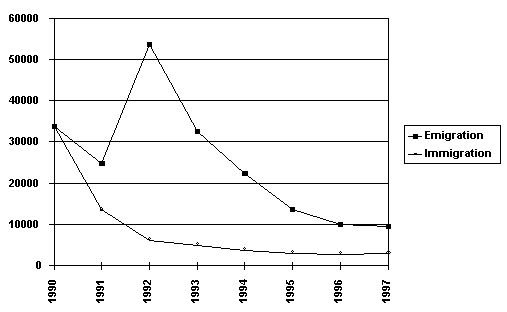 Fig.1. International migration over 1990-1997. In the period under consideration Latvia's population decreased by 7.0%, but 3/4ths of this decrease is accounted for by international migration. The role of international migration in population decease lessens with each year because the net international migration decreases. If in 1990 98% of the total population decrease were accounted for by international migration, in 1994 this percentage was 52%, in 1995 it was only 38%. The highest negative balance of international migration was in 1992, when the number of those emigrating exceeded the number of new arrivals by 47 200 people. The major migration flows are connected with Russia. Not Russians do immigrate into Latvia, but Latvians residing in Russia. Emigrating from Latvia to Russia are not only the Russian population but also non-Russians (their numbers being slightly in excess). Not all the residents of other nationalities leaving Latvia return to their ethnic homeland. Thus, in 1994-1995 a mere 47% of the Ukrainians emigrating from Latvia returned to the Ukraine. Compared to the number of Russians leaving Latvia, the number of Russians leaving Latvia for Russia is by 20% higher. The mechanical decrease in the population of Latvia occurs in actual fact at the expense of the non-latvian population (Table 1).
Table 1. Migration balance for different nationalities
Further of some of the peculiarities of the internal migration of Latvia's population are characterized. Up to the 1990s dominant was movement of people from rural areas to towns and cities, from the regions remote from Riga to the central part of Latvia, from the outskirts of the collective and the state farms to the so-called perspective centres. Particularly substantial the population decrease due to internal migration was in the eastern part of Latvia (Latgale). In the early 1990s, marked by changes in the processes of internal and international migration, registered in Latvia was a high degree of population concentration in towns (71%) and the flows due to international migration were the reversal to the flows of migrants prior to 1990 - more people started flocking to rural areas then were leaving them. Returning to rural areas mainly people of the retirement age who had earlier left the countryside for town. This section of the migrants can in no way contribute and be much support for development of the rural areas. Another group of migrants returning to rural areas are young people who have received good education. It is this part of migrants that may in the future turn out support and sustenance for the countryside, provided they manage to take advantage of the opportunities offering themselves. The protracted economical crisis does not favour adaptation of the migrants and lowers the intensity of internal migration. The highest extent in the internal migration was reached in 1990, the subsequent years witness a decrease, but in 1995 the numbers settle down to a stable 39 000 people per annum. The dynamic of internal migration can be seen in Table 2.
Table 2. Dynamics of the internal population migration
The following new trends in the internal migration :
3.The decrease in the city of Riga keeps stable all the time (Fig.2). A special mention must be made of the fact that internal migration must be encouraged in Latvia to promote the decentralization of Riga and the Riga agglomeration.
Table 3. Migration balance per a 1000 people
Let us analyse the changes occurring in the extent of the internal migration in terms of the population localities of varied hierarchical rank: the capital, regional centres, provincial towns, the other towns and rural settlements (Table 4.).
Table 4. Extent of migration flows
While in 1993 the population numbers decreased due to internal migration in towns of all description, in 1995 the population in the regional centres already increases due to internal migration. Let us utilize the following indicators in order to be able to characterize the migration intensity: Ka = I/L % (coefficient of arrival) Kd = E/L % (coefficient of departure) Kb = (I-E)/L % (coefficient of the migration balance)
Ko = (I+E)/L % (coefficient of the migration extent,
where I is the number of arrivals, E is the number of departures,
L is the number of the population (Table 5.).
Table 5. Indicators of migration intensity
The highest population mobility is observed in towns, - the others, showing the tendency to increase, are, as to intensity, followed by rural localities. The population in regional centres show the tendency to decrease. The population migration between urban and rural areas is analysed in Table 6. 63% of the rural residents who leave the rural locality arrive in Riga or some regional centre.
Table 6. Migration between urban and rural areas
The migration intensity in different parts of Latvia varies over a comprehensive range. For characterizing the migration intensity Latvia is divided into 8 regions. Table 7 shows all the data for 1993-1996 expressed as the arithmetic means.
Table 7. Inter-regional migration
57% of all migrations occur within the borders of each region, but 50% of all the within-regions migrations occur within the Riga region. At the beginning of the 1990s a trend was discernible for people to move from the central to the eastern part of the country, but the extent of today's migrations cannot in any way compensate the displacements, which occurred prior to 1990. The migration balance is positive for the regions of the eastern of the country, notably the Rezekne, the Daugavpils and the Gulbene regions. As a result of the migrations, the greatest population losses are sustained by the City of Riga (Table 8.)
Table 8. Population migration of Riga
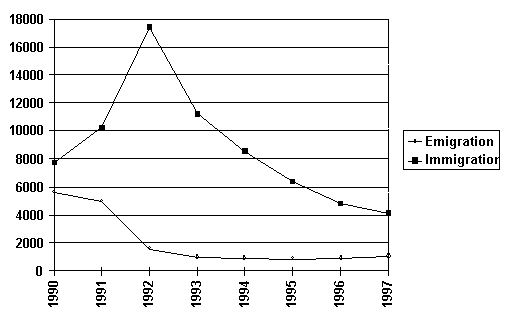 Fig.2. International migration in Riga. As a result of the internal migration Riga loses annually more than a thousand people, 80% of this loss falling to the Riga region. Only 8% of all migrations are accounted for by reasons connected with denationalization of the land and the returning of people's private property. Around 300 people arrives in Latvia from foreign countries every year by this reason. References
Demographic yearbook of Latvia 1991-1997. Riga.CSB. | ||||||||||||||||||||||||||||||||||||||||||||||||||||||||||||||||||||||||||||||||||||||||||||||||||||||||||||||||||||||||||||||||||||||||||||||||||||||||||||||||||||||||||||||||||||||||||||||||||||||||||||||||||||||||||||||||||||||||||||||||||||||||||||||||||||||||||||||||||||||||||||||||||||||||||||||||||||||||||||||||||||||||||||||||||||||||||||||||||||||||||||||||||||||||||||||||||||||||||||||||||||||||||||||||||||||||||||||||||||||||||||||||||||||||||||||||||||||||||||||||||||||||||||||||||||||||||||||||||||||||||||||||||||||||||||||||||||||